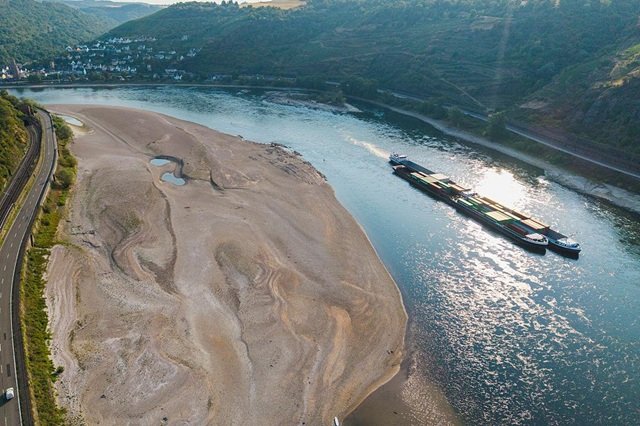
At Europe’s biggest and busiest port, the consequences of a rapidly deepening drought are already being measured in extra barges, reduced cargoes and rising costs. With water levels on the Rhine at a historic low during a sweltering summer, cargo vessels carrying chemicals, oil and other goods to and from Rotterdam are being loaded to only about 30 per cent capacity to prevent them from grounding.
The adjustment has forced operators to pay for about 100 additional barges a week, while still leaving them unable to transport everything they previously carried. For Lex Bezemer at the Port of Rotterdam Authority, the disruption is “one of the most significant episodes we have experienced in recent decades”.
Yet Rotterdam’s expensive workaround is only a small part of a much larger economic bill. Across Europe, unusually low rainfall and persistent heat are disrupting agriculture, industrial production, energy generation and transport, while raising questions about whether businesses and infrastructure designed for a different climate can continue to operate reliably.
Massimo Tavoni, director of the Venice-based European Institute on Economics and the Environment, describes Europe as a particular climate vulnerability. “Droughts are dangerous. They are extreme events, but they are long lasting,” he says. “Europe is extremely exposed. It really is a hotspot for climate change.”
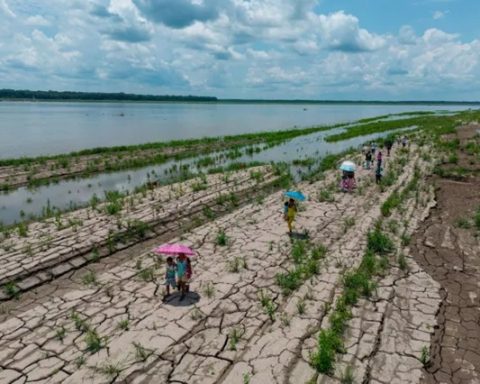
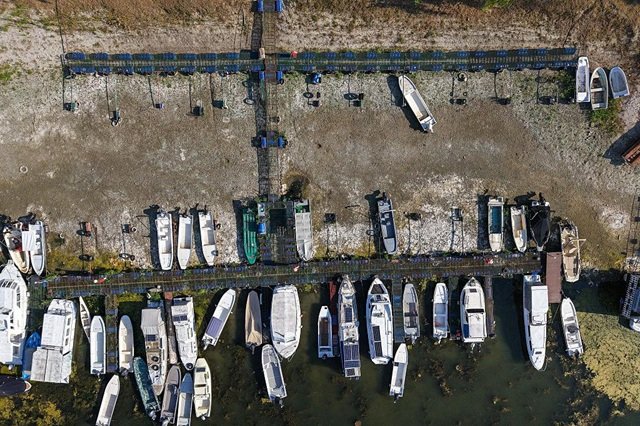
June and July ranked as the hottest on record in western Europe, according to Copernicus Climate Change, the EU’s earth observation agency. With little meaningful rainfall forecast in the coming weeks, a large part of Europe is experiencing critical soil moisture deficits and falling river levels. At Kaub in Germany, the shallowest point on the Rhine, levels fell on Friday to the lowest point since records began, reaching a “single-digit” level below which shipping may become unfeasible and the river could split into two.
The economic implications are substantial. Experts at institutions including Zurich Insurance estimate that this year’s flash drought could cause a short-term economic loss to Europe of at least €50bn, with the figure potentially rising significantly if water shortages persist. The wider economic toll of this summer’s heat could be considerably higher, reaching €180bn according to one estimate.
Oliver Rakau, chief Germany economist at Oxford Economics, warns that the consequences accumulate with time. “The longer the drought lasts, the more the adverse impact builds,” he says.
The European Drought Observatory estimates that around half of the EU and UK are now experiencing some level of drought. In France, environment minister Monique Barbut said this summer’s extreme conditions could cost the country €10bn-€15bn. A drought in 2022 caused €5.6bn in direct and indirect losses, she said, adding that this year’s bill “will undoubtedly be much higher”.
The effects extend well beyond farms and waterways. Europe’s growing dependence on data centres has created another point of vulnerability because many facilities require water for cooling. More than a third of the continent’s 3,000 data centres are located in areas facing high or extremely high water stress, according to analysis by the World Resources Institute.
“There is already intense competition for water resources in a normal year,” says Liz Saccoccia, WRI water security lead. During a drought, she says, that competition becomes more severe, increasing the risk of industrial disruptions, energy outages and agricultural losses.
The speed of the deterioration has been particularly striking. Western Europe experienced heavy rainfall at the beginning of the year, making the transition to severe drought within months unexpected. Balakrishnan Solaraju-Murali, a climate data specialist at Zurich Insurance, says the speed of the transition is “most alarming”.
The previous assumption that full reservoirs and saturated soils by April would protect Europe against summer water shortages is becoming less reliable. A wet winter, he argues, is no longer enough to guarantee protection from a summer disaster because climate change has altered the conditions on which that expectation was based.
For Europe’s €18.8tn economy, the implications are increasingly visible. Peter Bakker, president of the World Business Council for Sustainable Development, describes drought as a “balance-sheet issue”, affecting agriculture, energy generation, industrial production and vital transport routes.
Energy systems are already under pressure. Nuclear power plants from France to Hungary have had to reduce operations because of insufficient water for cooling, while hydropower has also suffered. In Romania, the military carried out controlled underwater explosions on the Danube riverbed in an ultimately unsuccessful attempt to redirect cooling water towards the drought-threatened Cernavodă nuclear power plant. After those efforts failed, the plant began shutting down last week.
French energy provider EDF warned in July that it expected a 10 per cent fall in earnings this year, citing lower river levels and heatwaves affecting power generation as well as reduced market prices. German chemical company Covestro declared force majeure for certain PET products and warned that low Rhine water levels could prevent its Dormagen plant from meeting delivery commitments. In the Netherlands, parts of some waterways have been closed to shipping.
The Danube is presenting another economic bottleneck. Low water levels have increased the cost of transporting grain from central and eastern Europe towards the Black Sea, where renewed escalation in the war between Russia and Ukraine has already disrupted grain shipments and increased pressure on alternative export routes.
Cezar Gheorghe, founder of Romanian grain consultancy AgriColumn, says the cost of moving grain by barge along Romania’s section of the Danube to Constanța has increased from about €11 a tonne before the harvest to €18-€20.
Agriculture faces an even more direct threat. Around Vercelli in northern Italy, one of Europe’s most important rice-growing areas, some paddies have been left “completely dead, burnt, with the rice dried out” after irrigation water failed to reach them, according to Roberto Guerrini, a rice farmer and president of the Vercelli-Biella branch of Coldiretti, Italy’s biggest farmers’ association.
“I don’t remember an Italian summer with so little rain and such constant heat for two and a half months,” he says.
Some farms across the broader Po Valley are losing half or more of their production, Guerrini says, leaving many at risk of going out of business. Repeated shortages are forcing farmers to consider changing crops or leaving land unplanted rather than risking another failed harvest. If recent patterns continue, Italy’s rice-growing area could shrink substantially. “We really risk losing the identity of a territory,” he says.
The consequences for economic growth are equally serious. A European Central Bank working paper estimated that, in an extreme scenario, heat- and drought-related losses could reduce annual real per capita value-added growth in agriculture by 4.5 percentage points, with eastern Europe facing the largest impact.
The Rhine is particularly important because it is a central artery for German industry. Research by the Kiel Institute for the World Economy found that low water levels during the 2018 drought contributed to a 0.4 per cent decline in German GDP, equivalent to about €18bn today. A month with 30 days of low water reduces inland water transportation by about a quarter and German industrial production by about 1 per cent, according to the institute.
Water levels are already lower this year than in 2018. Marion Amiot, head of climate economics at S&P Global Ratings, says the effects on trade could therefore be similar or worse as supply shortages emerge.
Neil Shearing, chief economist at Capital Economics, estimates that the Rhine disruption alone could temporarily reduce Eurozone GDP by between 0.1 and 0.2 per cent. Some lost activity could be recovered later in the year or early 2027 if river conditions improve, meaning he has not yet reduced full-year forecasts for the Eurozone.
But the wider cost of drought extends beyond lost production. Ernst Hobma, an economic researcher at the Netherlands’ Triodos Bank, estimates that water shortages could cause a 0.35 or 0.4 percentage point GDP loss for 2026 across the EU’s agriculture, transport and energy sectors, equivalent to about €75bn. His broader estimate puts the cost of this summer’s extreme heat at 1 per cent of EU GDP, or €180bn, including wildfires, infrastructure disruption and deaths caused by extreme heat.
Lower agricultural production may have a relatively limited effect on headline GDP, but reduced harvests can raise food prices. David Rees, head of global economics at asset manager Schroders, warns that drought could contribute to another wave of food price inflation next year, alongside fertiliser shortages stemming from the Iran war and the El Niño weather phenomenon. Higher food prices could in turn influence interest-rate decisions by the European Central Bank.
The financial consequences may also persist long after the immediate drought has ended. Research by FAIRR, an investor network focused on food-sector risks, estimates that chronic water stress is already imposing $6.4bn in hidden annual costs on 18 of the world’s largest listed livestock companies through higher feed prices and alternative water supplies. That figure could reach $7.1bn by 2050.
“Water is very expensive,” says Henry Throp, research manager for climate at FAIRR. “You just don’t see it on the balance sheet in the way you’re expecting.”
Europe is consequently beginning to treat drought less as an exceptional interruption and more as an operational risk. Only about 15 per cent of EU businesses have completed formal adaptation plans, even though 42 per cent reported increased climate-related costs over the past year, according to WBCSD research.
The shift is already visible in corporate decisions. After the Rhine receded in 2018, BASF doubled its number of “low-water-capable vessels” and introduced an early-warning system capable of providing up to six weeks’ notice. EDF is pursuing greater water efficiency, including a new turbine at its Lacourt hydroelectric plant capable of generating power with river flows of 3.5 cubic metres a second, compared with 6.5 cubic metres for older units.
Farmers are adapting too. Grain and oilseed producers across Europe are harvesting during the small hours, taking advantage of overnight dew to meet minimum moisture thresholds and reduce the danger of machinery igniting parched fields.
The data-centre industry is also adjusting. Around a third of installed European data-centre capacity now uses non-water-based cooling, while closed-loop systems that reuse water are becoming increasingly common in southern Europe.
“I don’t believe water scarcity will put the brakes on data centres,” says Michael Winterson, secretary-general of the European Data Centre Association. Instead, he argues, it will force companies, regulators and society to reconsider how data centres are designed and operated. “This summer is a clarion call.”
At Rotterdam, meanwhile, the immediate priority remains keeping Europe’s supply chains moving. The port authority is monitoring weather conditions and developing stronger connections between inland shipping, rail and road transport.
But the wider challenge is greater than finding temporary alternatives to a shallow river. Europe must determine whether investment in resilience can keep pace with increasingly rapid and persistent water shortages.
In Vercelli, where rice growers are calling for state support to build reservoirs capable of capturing autumn and spring rainfall, Guerrini sees the current crisis as evidence of a failure to prepare.
“But this should have been done 30 years ago,” he says. “This work wasn’t done, and now we are paying the consequences.”