



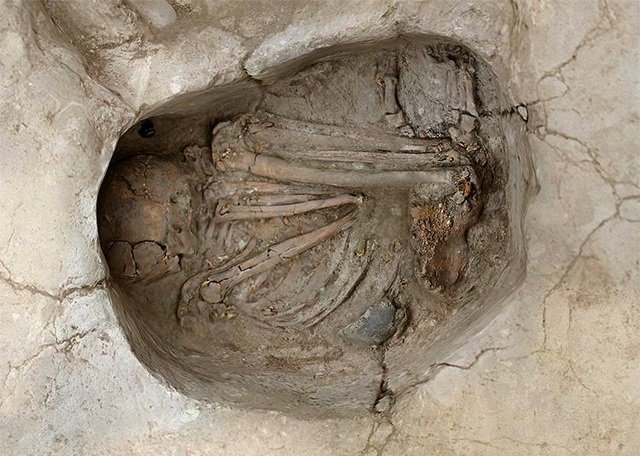
Through burial practice, it is believed that the living create, affirm, and transform social relationships with those who have passed. Interring the dead in settlements, sometimes even below house floors, makes ancestors enduring participants in daily life. Residential burial practices establish continuity between generations, anchor memory in place, and inscribe kinship, power, inheritance, and ritual within spaces where the living are situated. Residential burials do not mark biological death as an end to social bonds but indicate their reconfiguration, tying households and communities to both histories and futures in the making. Why, then, do some people bury their dead in or near residences and others do not? How can ethnography guide or obscure our interpretation of these intimate contexts in the archaeological record? These questions formed the starting point for our inquiry into residential burial on a global scale, in the ethnographic and archaeological records.
To address these questions, we used information from 60 ethnographically documented cultures in the Probability Sample Files in the electronic Human Relations Area Files (eHRAF) World Cultures database. The aim was to examine residential burial practices across these cases. However, given the limited occurrence of residential burial in the 60 case studies, we soon realized that the ethnographic record did not mirror patterns familiar to archaeologists. Ethnographic descriptions tend to highlight changes in burial practice, often linked with the spread of monotheistic religions. As a result, our questions and interests shifted to how a systematic cross-cultural study of residential burial based on the ethnographic record compared to the archaeological record.
We then asked whether an archaeological sample would differ significantly from the ethnographic sample. The coding of residential burial in 49 cultures formed part of a simple random sample from eHRAF Archaeology. A comparison of these two datasets revealed that residential burials were more prevalent in archaeological than in ethnographic contexts. These findings have important implications for using ethnographic analogy when the aim is to understand mortuary (or other related) practices in the archaeological record.
While ethnographic descriptions can help us understand reasons for change in mortuary placement, the ethnographic record does not fully capture the more frequent occurrence of residential burial, which is apparent in the archaeological record. Therefore, instead of the more conventional use of ethnographic analogy for archaeological interpretation (i.e., formulating hypotheses), our study illustrates how archaeological insights can be used in conjunction with ethnography to develop and test sociocultural theories of permanent residence, kinship, and social structure. The ethnographic studies in our dataset, which derive mainly from the 20th century, have only a small percentage of cases with residential burials. The more frequent occurrence of this practice in archaeological samples indicates that the archaeological record represents a broader array of different burial behavior than those represented in the ethnographic record. While contemporary people rarely bury ancestors at home, in the past, houses, huts, and settlements were much more often spaces where both the living and the dead coexisted—and felt at home.
As we reported in American Antiquity, from which this article is excerpted, we first discuss how traditions of funerary placement can be used to model social organization and reflect diachronic changes. Then, we discuss the role of ethnographic analogy in archaeological explanation and present results from the two datasets on residential burial, based on 60 ethnographic and 49 archaeological cases. These cases suggest a decline in residential burial at different points in the past while also highlighting a more recent global shift away from this practice. These findings underscore the value of archaeological evidence, which can illuminate a diversity of burial practices that have decreased significantly in the ethnographic present but not fully disappeared. Our results have implications not only for our understanding of cross-cultural burial patterns and how they changed in response to other societal changes but also (more generally) for how archaeologists employ ethnographic data and analogy when interpreting the archaeological record.
Why Are Burials So Important?
Funerary practice is ideal for cross-cultural, anthropological studies that combine ethnographic and archaeological data. It is visible and broadly recorded in both research databases. These ritual practices document how social organizations are created and materialized. Burial is a socially and emotionally dramatic moment in individual life cycles—a moment of making, showing, and reaffirming relationships. Arguably, funerary rituals establish kinship between the living and the dead and the memory of the event, while the spatial placement of the dead and the physical markers (memorials) help those kinship relationships to endure. A combination of emotion, social ceremony, and reaffirmation, funerary practices are critical to institutional formation.
Moreover, the relationship between settlement continuity and intramural interments aligns with the view of other scholars who suggest that residential burial does not merely tie the living to their ancestors but also links them to a dwelling and the land it sits on. In many contexts, connections were affirmed and reaffirmed through the sequential reuse of mortuary contexts and ritual activities conducted adjacent to them.
Necrogeography
The use of the dead to structure, mark, and reinforce the taskscapes of the living has been an integral aspect of both prehuman and human practices for thousands of years. The spatial relationship between the living and the dead can, however, also become a matter of political intervention. In the late 19th-century Ghanaian Gold Coast, colonial British law was revised six times to mandate and enforce the transition from residential interments to community cemeteries. Moving the resting place for ancestors to locations outside the house has implications beyond the spiritual: “the colonial state enforced cemetery burial because they realized Gold Coast people would never sell their land if it contained the remains of their elders; cemeteries were therefore a crucial tool in the transformation of land into private property for state dispossession,” stated a 2022 article published in the Journal of Social History. Consequentially, the movement of the deceased to community cemeteries led to changes in interpersonal networks and community relationships with the supernatural, their ancestors, and property. Even after some converted to Christianity, colonial-era Ghanaians initially resisted moving burial locations. Funerary customs can be a core extension of personal identity and connection to places, so they are not easy to change. Although the factors and circumstances that prompted householders to shift their funerary practices and reposition their ancestors outside their houses varied from one historical case to another, the behavioral ramifications in most contexts likely extended well beyond the spiritual to social networks and material possessions.
This connection between burial location and broader social organization has long been explored in anthropological and archaeological studies of kinship and descent groups. In particular, cross-cultural research suggests that formal cemeteries frequently emerge where corporate groups use burial places to legitimize claims to land and resources. However, kinship studies have a long history in anthropology with particular salience for British social anthropologists who examined variability in structural forms governing broader social practices. Implicit in understanding kinship is that the organization it implies is essential to group and individual operations and survival. The British social anthropology approach was fundamentally that of social science, looking for systematic patterning affecting group reproduction. Although criticized for the functionalist logic of the social body, the approach can and should be reconceptualized as social networks in which active participants form kinship through blood or other means as well as break kinship ties for historical and strategic goals. This is captured by the concept of kinship-making that recognizes dynamic ways in which different individuals, households, and larger social networks can coexist and evolve.
Using the HRAF Collection of Ethnography, substantial comparative studies seek to understand variation in kinship patterns, and we hope that by looking at funerary practice, we can document dynamic moments when kinship is formed, given degrees of permanence, or reconstituted through memories and material marking. This is the basis of our comparative study, where we look for regular patterns with implied causal relationships between burial practice and the degree of permanent residence. While cross-cultural comparison in this article focuses exclusively on the link between residence permanence and residential burial, a follow-up study could explore the link between kinship and residential burial practices.
Caring for the Dead
Why do the living care deeply about the dead and choose to place the dead systematically according to specific cultural practices? In some cases, they appear not to; in others, it is highly variable, and often follows specific cultural rules. Humans deal with the dead in ways that vary across time and space, and reasonably, this important moment in the life cycle engages both continuity and change in social relations, especially manifest in kinship reflected in the funerary placement of the dead. Thinking materially (which is so basic to social science reasoning), people care about the dead, especially because of inheritance—the social roles that the living take from the dead and the access it gives them to particular resources, including land and its productive potential.
Credit Line: Excerpted from “Funerary Placement in the Past and Present: Uses of Ethnographic Analogy for Archaeological Interpretation” by Sabina Cveček, Timothy Earle, Carol R. Ember, Gary M. Feinman, and William A. Parkinson. Copyright © The Authors 2026. Published by Cambridge University Press on behalf of Society for American Archaeology. This is an Open Access article, distributed under the terms of the Creative Commons Attribution license (http://creativecommons.org/licenses/by/4.0). This article was distributed by Human Bridges, a project of the Independent Media Institute.