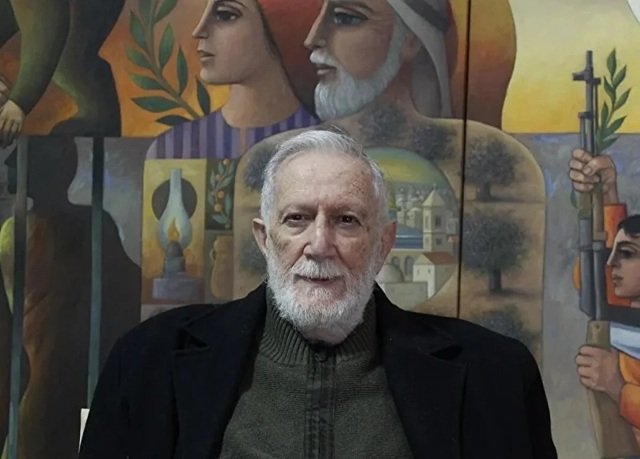
For Sliman Mansour (1947-2026), a gentle and generous painter of Palestinian emancipation.
In January 1968, 470 delegates from seventy countries gathered in Cuba for the Cultural Congress of Havana. They arrived from nations at war, socialist societies under construction, national liberation movements struggling against colonialism, and imperial centres where intellectuals had begun to rebel against power. Vietnam was resisting the most powerful military on Earth. The murder of Che Guevara three months earlier had not extinguished the conviction that imperialism could be defeated; it had only intensified it.
Imperialism, the delegates understood, does not survive by the gun and the bank alone. It also occupies the school, the radio station, the publishing house, the laboratory, the museum, and the imagination. It teaches the colonised to see their own histories as backward, their languages as provincial, and their popular arts as raw material awaiting refinement by the metropolis. Against this machinery, the congress called for what Fidel Castro described as ‘a Vietnam in the field of culture’: an organised struggle over the means by which human beings understand themselves and their power. Our latest dossier, A Vietnam in the Field of Culture: The Cultural Congress of Havana, 1968 (August 2026), takes its title from Castro’s phrase and returns to the congress in the year of his 100th birth anniversary.
The Cultural Congress of Havana gives us the ground on which to encounter this newsletter’s theme: radical traditions. A radical tradition is not an altar to the past. The word radical comes from the Latin radix, or root. To go to the root is to discover the struggles that produced a people’s thought and beauty and to carry their unfinished possibilities into the present. Tradition is not what remains unchanged. It is what the people continually remake as they struggle to realise their humanity and to flourish within nature rather than through its destruction.
One of the clearest examples of this radical tradition in this period emerged through the anti-colonial reworking of Caliban, the enslaved figure in William Shakespeare’s The Tempest (1610–1611). Across the Caribbean and Latin America, Caliban became a way to think not about returning to an untouched past, but about transforming what colonialism had imposed – language, literature, and knowledge – into weapons against colonial rule. Two works sharpened this anti-colonial reading: Aimé Césaire’s play A Tempest (1969) and Roberto Fernández Retamar’s essay Caliban (1971). In Shakespeare’s play, Prospero (European civilisation) seizes an island, enslaves Caliban (the colonised), and teaches him language so that he can be commanded. Césaire dramatises Caliban’s refusal of that colonial command. His Caliban demands to be called X, suggesting both the violence that erases his name and the freedom that he wants to enjoy. Césaire leaves Prospero and Caliban locked in a deteriorating colonial world: Prospero cannot imagine himself without the subject he dominates, while Caliban’s refusal to be colonised fractures his world. Caliban does not ask for better representation within Prospero’s order. He contests the order itself. For Retamar, Caliban is not an embarrassing shadow at the edge of Latin American civilisation. He is its colonised people. Prospero invaded his land, killed his ancestors, enslaved him, and imposed a language upon him. What can Caliban do, Retamar asks, but use that language to curse Prospero?
The curse is only the beginning. Caliban does not merely reject the coloniser’s language; he seizes it. The science, technology, literature, and political concepts accumulated in imperialist centres were made possible by wealth and labour extracted from the colonised world. Retamar refuses the idea that they belong naturally to the West. Their reclamation is not imitation but restitution. To reclaim them is to dig up the roots of a world that colonialism tried to monopolise and to turn its instruments towards liberation. Caliban turns the language of command into a language of revolt – into the radical tradition that we cherish. I spent an hour with the people at Tank Magazine talking about Retamar’s essay and its context.
Who is permitted to stand for reason, and who is confined to emotion? At Havana, this was not an abstract question. Debates over négritude confronted this problem directly. René Depestre pointed to Léopold Senghor’s formulation that ‘emotion is Black, as reason is white’ as an example of the danger facing an anti-colonial cultural revolt. Depestre honoured négritude’s original affirmation of Black-African cultures against racial dehumanisation but warned that, when separated from class struggle, it could harden into racial essentialism and be captured by reactionary elites. In Haiti, François Duvalier’s noirisme had turned the defence of Black culture into a state ideology that terrorised the people and the left in the name of Black authenticity. The congress therefore rejected both liberal assimilation and racial essentialism. Racism could not be defeated by admitting a few of the colonised into the master’s house, nor by turning colonial categories into permanent truths. It required a transformation of the material relations that continually reproduce race as hierarchy.
The radical tradition also appears, however, in works whose politics remain limited or unresolved. Octavio Paz’s The Labyrinth of Solitude (1950), written far from the revolutionary politics of Havana, approaches Mexico’s colonial wound through masks, silences, festivals, and solitude: the habits of concealment and distance formed in a society marked by conquest. Paz understood that conquest survives inside forms of subjectivity. The colonised and postcolonial subject may wear a mask not because there is nothing beneath it, but because history has made exposure dangerous. Solitude becomes both wound and defence. Yet the labyrinth is never merely psychological because its walls were built through conquest, racial hierarchy, class power, and Mexico’s unresolved relation to modernity. The radical tradition begins where Paz’s account reaches its limit: solitude is broken by collective struggle. The peasant assembly, the strike committee, the literacy brigade, the theatre workshop, and the community radio station do more than express an existing people: they help bring a new one into being. Even Paz’s account points beyond itself towards this fact.
A related question emerged in Iran through the work of Jalal Al-e Ahmad (1923–1969): how can a people take hold of modern knowledge without submitting to the categories and dependencies of imperial power? Al-e Ahmad, who moved from the communist milieu of the Tudeh Party towards a religiously inflected anti-imperialism, published his landmark polemic Gharbzadegi in 1962, a title often rendered in English as Westoxication, Occidentosis, or Weststruckness. Read widely in Iran, including among sections of the ulema (clerics), the book described a society stricken by the West, not simply because it imported foreign commodities, but because it had begun to inhale the West’s categories as if they were oxygen. The result was a kind of civilisational bad breath: the stale exhalation of imitation, dependency, and self-estrangement. Technology arrives without the social capacity to direct it, the local elite becomes a broker for imported goods and imported desires, and a people are taught to experience their own world as an inadequacy.
Al-e Ahmad’s polemic could have been read as a romantic retreat into an uncontaminated past, but its strongest insight points elsewhere. He wanted both an acknowledgement of our own traditions and a radicalisation of them for the modern world. This is where Al-e Ahmad’s question meets the concerns of Havana. The congress did not reject science or technology as Western but asked who owns them, towards what ends they are organised, and whose labour makes them possible. Delegates described doctors trained at public expense in the Third World and extracted by the imperial centre, as well as local knowledge gathered as ‘scientific raw material’ and returned in the finished form of policy, surveillance, and military intervention. The answer to Occidentosis is therefore not purity but sovereignty: the collective capacity to take hold of modern knowledge, redirect it towards social need, and transform society in the process.
The liberation movements represented in Havana were already putting this sovereignty into practice. They showed that culture was not something to be preserved in isolation or postponed until after victory, but a means through which liberation itself was built. In Vietnam, the National Liberation Front’s monthly reports counted people freed from illiteracy alongside military victories, while cinema teams worked from cellars under bombardment. In the liberated zones of Guinea-Bissau, Angola, and Mozambique, schools, printing presses, artists’ workshops, and revolutionary songs formed the foundations of a new society before formal independence arrived. Liberation itself was an act of culture.
The same understanding animated Lotus. First published in March 1968 as Afro-Asian Writings, the journal helped build the cultural infrastructure that Havana had called for: a multilingual home for writers from Africa and Asia, and later Latin America. Its pages refused the colonial arrangement in which Southern writers awaited recognition in London, Paris, or New York. Lotus made another literary geography visible: Palestinian resistance could speak with Vietnamese liberation, South African struggle with Egyptian poetry, and newly decolonised nations with those still fighting for freedom. A single example captures what this infrastructure made possible. In 1972, Lotus published a play, Ughniyyat al-Mawt (Death Song), by the Egyptian playwright Tawfiq al-Hakim. Through the journal’s networks, the play was translated into Hindi and performed that year in New Delhi; it was also translated into Amharic, and a performance was broadcast on Ethiopian state television. A story about a rural Egyptian family whose blood feud was disrupted by the education of a son in Cairo could therefore travel beyond Egypt and speak to audiences confronting their own dilemmas of tradition, modernity, and social transformation.
We need the urgency of Lotus today. The media apparatus that Havana confronted has become a dense system of platforms, algorithms, data extraction, and concentrated ownership. It does not merely censor; it floods the world with images, breaks common experience into personalised streams, turns attention into property, and makes solidarity appear distant even as war arrives instantly on our screens. Racism and colonialism are renewed through old hierarchies wearing digital clothes. The peoples of the world are invited to consume one another’s images while being prevented from building durable relationships with one another’s struggles.
A new cultural vision of the world cannot be assembled from diversity slogans supplied by the same institutions that finance war and plunder. It must arise from struggles against racism, colonialism, patriarchy, and capitalist exploitation. It must recover the total meaning of culture affirmed at Havana: culture as art and education, but also as health, science, labour, sport, media, technology, and the organisation of everyday life. The intellectual worker at the centre of this project is not a solitary genius standing above the people but one whose knowledge is placed inside a collective process. The horizon of this project is not the replacement of one elite by another but the broadening of intellectual life until the division between thinkers and doers begins to disappear. Radical traditions give us neither a completed map nor a refuge from the present. They give us methods: Paz’s journey through the masks left by conquest; Césaire’s refusal of the colonial script; Retamar’s seizure of the master’s language; Al-e Ahmad’s alarm at dependent imitation; the internationalist literary commons built by Lotus; and Havana’s insistence that revolution must transform the totality of life.
We have inherited the storm. Our task is to emancipate ourselves from it.