Giorgia Meloni is preparing to send more military assistance to Ukraine, but this time Italy’s prime minister is seeking to do so with as little political noise as possible. Publicly, Rome has placed the emphasis on humanitarian assistance and the delivery of electricity generators to help Ukrainians through the coming winter. Behind the scenes, however, the government is finalising a substantial military package for Kyiv, including advanced air-defence systems, interceptor missiles and radars.
The timing is politically sensitive. This is the final year of the Italian legislature, and the approaching elections are already beginning to shape political calculations. The new package would be Italy’s thirteenth military aid package since the beginning of Russia’s invasion. According to La Repubblica, the plan has been settled for weeks and is expected to become operational before October.
The government insists that the systems are exclusively defensive, intended to strengthen Ukraine’s shield against Russian attacks. Following the latest meeting of the Coalition of the Willing, Meloni publicly highlighted Italy’s humanitarian commitment, particularly the shipment of generators for hospitals, schools and Ukraine’s electricity network. Rome’s statement made no reference to the military component of the new assistance package, which includes defence systems developed jointly with France.
The distinction is revealing of the political balancing act confronting Meloni. Like the previous 12 packages, the new one will be approved through an interministerial decree whose contents are classified. La Repubblica has nevertheless reconstructed part of its contents and confirmed its substantial military component. For Meloni, the challenge is no longer simply how to support Kyiv, but how to sustain that support without aggravating divisions within her governing coalition or alienating voters further to the right.
Since entering government in 2022, months after Russia’s invasion of Ukraine began, Meloni has maintained a clearly Atlanticist position and consistently supported Ukraine. That stance, however, has never been shared with equal enthusiasm by all her coalition partners. The result has been a gradual lowering of the government’s political tone on the issue.
The most persistent resistance has come from the League and its leader, Matteo Salvini. Salvini, who for years demonstrated close political ties with Vladimir Putin, has repeatedly questioned the continuation of arms deliveries to Ukraine and continues to argue that diplomatic and commercial relations with Russia should eventually be rebuilt once the war ends. Only days ago, he again criticised what he called European “russofobia” and warned against permanently isolating Moscow.
But Meloni’s problem is becoming larger than the tensions within her governing coalition. The emergence of retired general Roberto Vannacci and his new party, Futuro Nazionale, is threatening to reshape competition on the Italian right. Vannacci is seeking to occupy the political space further to the right of the governing coalition, and recent voting-intention surveys give him a slight advantage over the League, the party from which he came.
Ukraine has become one of his principal political causes. Just weeks ago, Vannacci accused the government of having delivered 13.000 million euros to Ukraine “without obtaining any result” and rejected the description of himself as pro-Russian, instead defining himself as “filoitaliano”. His rise creates an additional problem for Meloni because it forces Salvini to harden his own position in an effort to prevent the League from losing voters to its former political ally.
Giovanni Diamanti, president of YouTrend, has argued that the government’s foreign policy is already “indirectly influenced by Vannacci”. In comments to HuffPost Italia, he described Ukraine as one of the “symbolic battles” in the competition taking place on the Italian right.
The political sensitivity of the issue is rooted in a longer history. Sympathy towards Russia has for years had considerable weight among sections of Italy’s right and far right. The League maintained close political links with Moscow before the invasion, while Silvio Berlusconi cultivated a well-known personal relationship with Putin for decades. Meloni herself, during her lengthy period in opposition before the invasion of Ukraine, had advocated closer relations with Russia and criticised sanctions against the Kremlin.
Once in government, she broke substantially with that tradition by aligning herself clearly with Kyiv. Yet the normalisation of relations with Putin remains attractive to part of her electorate, making every new military commitment politically more consequential.
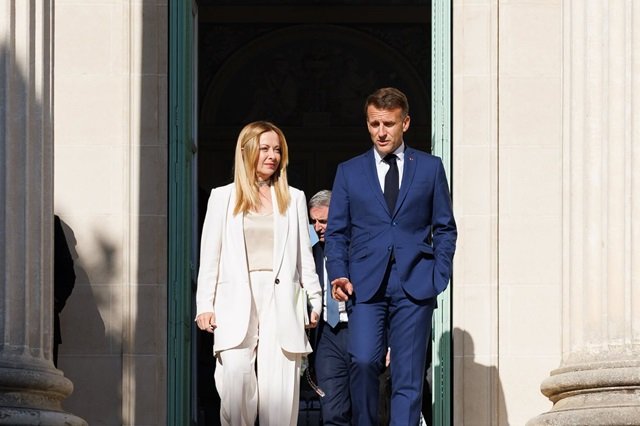
The latest package carries another sensitive dimension: it stems from an agreement between Meloni and French President Emmanuel Macron. Italy and France jointly produce air-defence systems at a time when Kyiv is seeking alternatives because of shortages of Patriot, the advanced American anti-missile systems.
Here again, Meloni must carefully manage political distance. Rome cooperates closely with Paris on defence, but the Italian prime minister has also sought to preserve an independent profile from Macron and has distanced herself from some of the more interventionist initiatives supported by France and the United Kingdom. Italian authorities have, among other things, rejected the deployment of Italian soldiers on Ukrainian territory.
An excessively close association with Macron could also create difficulties at home. Salvini and, above all, Vannacci could use it to challenge the sovereignist political message with which Meloni reached power.
The result is an increasingly difficult political equation. Meloni must demonstrate to Kyiv and Italy’s European partners that Rome remains a reliable ally. She must cooperate with Macron without appearing subordinate to him. At the same time, she must prevent military assistance to Ukraine from becoming fresh political ammunition for forces further to the right seeking to capture the most radical part of her electorate.
Italy’s Ukraine policy is therefore becoming inseparable from the country’s domestic political competition. The government’s next military package may be defensive in its stated purpose, but its political consequences are considerably harder to contain. For Meloni, supporting Kyiv now requires not only a calculation about Italy’s foreign-policy commitments, but also a calculation about who benefits from them at home.