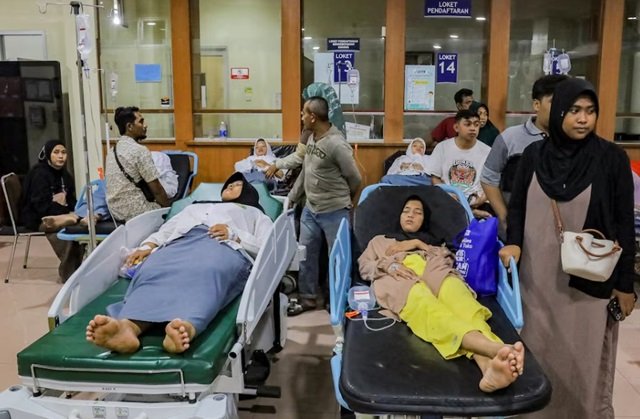
Nearly 800 Indonesians have fallen ill in a series of separate food-poisoning incidents linked to President Prabowo Subianto’s flagship free meals programme, raising fresh questions over the safety and management of a scheme designed to provide food to tens of millions of children.
The latest outbreaks include more than 500 students in East Java province who fell ill this week. The incidents come as the multibillion-dollar programme faces growing criticism over repeated cases of mass food poisoning, allegations of corruption, changes in leadership and the enormous cost of delivering meals on such a vast scale.
Charles Honoris, a member of the parliamentary commission overseeing health and a lawmaker from the only political party outside the governing coalition, said on Wednesday that 512 students in Sidoarjo, East Java, had suffered food poisoning. He cited local health department data.
A further 49 people were affected in the East Java city of Nganjuk, while 237 cases were reported in the West Sumatra region of Agam, according to Honoris. Taken together, the three incidents account for 798 reported cases.
Honoris said the outbreaks could not be treated as isolated events.
“This is a failure of the system,” he said in a post on Instagram.
The National Nutrition Agency, which oversees the programme and has an annual budget of $12.94 billion, did not immediately respond to a request for comment on the lawmaker’s claims. The agency suspended the kitchen connected to the Sidoarjo outbreak on Wednesday.
The latest incidents add to a much larger record of food-safety problems surrounding the free meals initiative. Network for Education Watch, a non-governmental watchdog, reported that 37,600 individuals had been affected by mass food-poisoning outbreaks linked to the scheme as of August 8.
Authorities have previously identified improper food storage and delays in delivering cooked meals as frequent causes of food poisoning.
The scale of the programme makes food safety a particularly significant challenge. Launched by Prabowo last year, the initiative was intended to tackle under-nutrition by providing free meals to tens of millions of children. Its ambitions, however, have been accompanied by persistent operational problems and public controversy.
The repeated poisoning incidents have also begun to affect public support. A survey conducted in July by pollster Saiful Mujani Research and Consulting found that only one-third of respondents were satisfied with the programme. Reported cases of food poisoning were cited as one of the major reasons for dissatisfaction.
For the government, the controversy presents a difficult balance between the programme’s central objective and the risks exposed by its implementation. Providing free meals on such a large scale requires not only sufficient funding, but reliable food storage, timely delivery and effective oversight.
The latest outbreaks have therefore turned what was conceived as a major social programme into an increasingly visible test of administrative capacity. As hundreds more people fall ill in separate locations, the question is no longer simply whether the government can provide free meals, but whether it can do so safely and consistently enough to maintain public confidence in one of President Prabowo’s most important policies.