A Chinese-German research team has developed an ultra-sensitive magnetic sensor capable of detecting signals a billion times fainter than Earth’s magnetic field, creating a potential new tool for the search for elusive dark matter particles and for measuring extremely weak magnetic activity in the human brain.
The table-top device, known as the Levitated Magnet Magnetometer (LeMaMa), operates at room temperature and can measure magnetic fields down to the femtotesla level. A femtotesla is a quadrillionth of a tesla, making such measurements among the most technically demanding in magnetism.
Researchers from Peking University and Johannes Gutenberg University Mainz in Germany built what they describe as the world’s first room-temperature ultraprecise magnetometer based on a levitated magnet. Their findings were published in the journal Science on August 6.
“The combination of room-temperature operation, tiny components and high sensitivity makes LeMaMa promising for fundamental physics experiments,” Ji Wei, assistant professor at Peking University’s school of physics and corresponding author of the study, told Guangming Daily on August 17.
Magnetic fields exist across an enormous range of strengths, from about 1.5 tesla in a hospital magnetic resonance imaging machine to the femtotesla-level fields generated by human brain activity. Detecting such weak signals has traditionally required highly specialised equipment and demanding operating conditions.
Until now, femtotesla-level measurements have mainly depended on two approaches. Superconducting quantum interference device (Squid) magnetometers provide excellent sensitivity but must operate at cryogenic temperatures near absolute zero, requiring bulky and expensive liquid-helium cooling.
Spin-exchange relaxation free (Serf) atomic magnetometers can also reach femtotesla sensitivity, but require heated atomic vapour and operation in a near-zero magnetic field inside heavy shielding. This means samples generally have to be brought into a shielded room, restricting close-range and high-resolution detection.
LeMaMa takes a different approach. It operates at room temperature, requires no magnetic shielding and has been miniaturised so that the entire device fits inside a vacuum chamber about the size of a lunchbox. It requires neither liquid helium nor heating, potentially allowing ultra-sensitive magnetic detection to move beyond conventional laboratory environments.
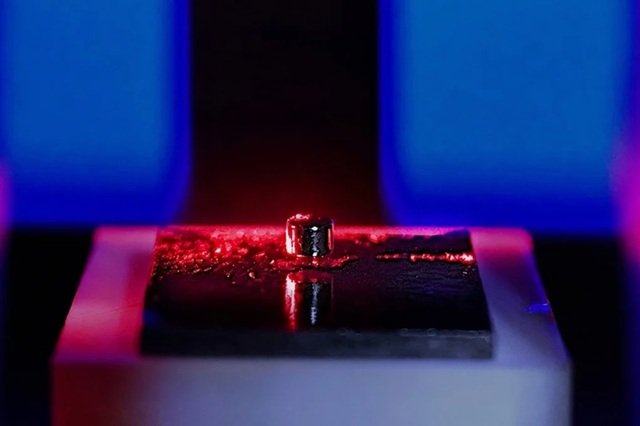
At its centre is a sensing magnet just 0.4 mm thick. The researchers suspend another magnet above it to provide an upward force that counteracts gravity. Specially designed diamagnetic materials beneath the sensing magnet provide an opposing force, allowing it to remain stably suspended in mid-air.
“It’s like balancing an egg on a smooth table – it might stay for an instant, but the slightest disturbance knocks it over,” Guangming Daily quoted Ji as saying. “To solve that, we place specially designed diamagnetic materials underneath, which push against the magnet instead of attracting it – like an invisible hand supporting it from below.”
The resulting system functions like a compass without a pivot or suspension thread. When an external magnetic field is applied, the floating magnet moves slightly, and those minute deflections can be measured to determine changes in the surrounding magnetic field.
The researchers also had to minimise environmental interference. The sensing magnet is enclosed in a vacuum chamber, while the complete apparatus is placed on a vibration-isolation stage. Laboratory tests showed that LeMaMa could detect ultra-weak magnetic fluctuations at the femtotesla level even in the presence of Earth’s much stronger background magnetic field.
The technology could have particular significance for fundamental physics. The team has already used LeMaMa to search for axion dark matter, with Guangming Daily quoting Ji as saying that the work improved sensitivity over previous best results by multiple orders of magnitude within a specific mass range.
The sensor’s small size could also extend its applications beyond particle physics. According to the Peking University website, its core sensor is only a few hundred micrometres wide, making it suitable for high-resolution magnetic imaging and close-range magnetic-field detection.
Potential applications include measuring neural magnetic signals for brain research and neurological diagnostics, as well as high-precision magnetic mapping and mineral resource surveying in geophysical exploration. What began as a floating magnetic ‘needle’ could therefore become a compact instrument for probing some of the faintest signals produced by nature.