A striking contradiction is emerging in East Asia. As Japan expands its defence partnerships, strengthens its military capabilities and deepens cooperation with countries across the Indo-Pacific and beyond, China is increasingly portraying Tokyo’s transformation as a strategic threat. At the same time, a new study by a People’s Liberation Army medical team has warned Chinese cities to prepare for the possibility of a nuclear attack, specifically identifying Japan as a “major danger signal” to the international community.
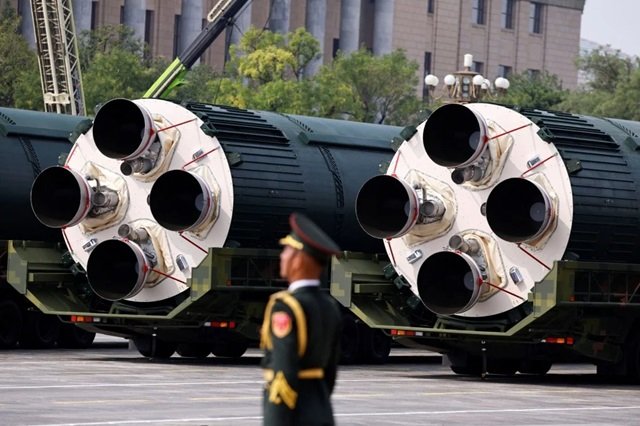
The study, published last Friday in the peer-reviewed Chinese Journal of Radiological Health by researchers at the PLA Rocket Force Characteristic Medical Centre, assessed the likelihood of a large-scale global nuclear war as relatively low. But it warned that a smaller-scale nuclear attack could not be ruled out.
“However, the possibility cannot be ruled out that small or medium-sized nuclear-armed or potentially nuclear-armed states, driven by geopolitical or religious conflicts, could carry out a single nuclear-weapon terrorist attack on neighbouring countries or on key cities of major powers,” the researchers wrote.
The report singled out Japan because Tokyo has not acceded to the Treaty on the Prohibition of Nuclear Weapons, the first legally binding international agreement to ban nuclear arms, signed in 2017. It also pointed to debate in Japan over its long-standing “three non-nuclear principles” of not possessing, not producing and not permitting the introduction of nuclear weapons.
“Japan has still not acceded to the Treaty on the Prohibition of Nuclear Weapons, and the current Japanese government is even openly considering revising the principle of ‘non-introduction of nuclear weapons’ within its ‘three non-nuclear principles’, sending a major danger signal to the international community,” the report said.
The PLA study nevertheless placed its assessment within a broader warning about nuclear terrorism. While the prospect of a major global nuclear war was considered relatively unlikely, the researchers said Chinese cities could not be assumed to be immune from a single low-yield nuclear terrorist attack.
Their modelling examined the consequences of such an attack on a major Chinese city, drawing on historical data from the 1945 Hiroshima bombing and simulations conducted around the world. The researchers described the medical consequences as potentially involving hazardous conditions, widespread social disorder and complex patterns of injury.
China has already established an emergency rescue network comprising more than 30 bases for treating casualties from a nuclear attack. The researchers called for greater treatment capacity, additional resources and specialised training, alongside stockpiles of emergency supplies such as antibiotics and radiation-protection equipment. Such supplies, they said, should remain in a state of “combat readiness”.
They also called for broader public education on nuclear and radiation safety, rescue procedures and protective measures, arguing that preparedness could help minimise irrational behaviour and panic during an emergency.
The report reflects a wider deterioration in the strategic environment surrounding China and Japan.
Beijing has repeatedly accused Tokyo of pursuing “remilitarisation” and has long expressed suspicions about Japan’s nuclear ambitions. An official Chinese report released in January alleged that Japan “may already have produced weapons-grade plutonium in secret” and possessed “the technological and economic capabilities to achieve nuclear armament in a short period of time”.
The report also said Japan had established a comprehensive nuclear fuel cycle system and possessed robust nuclear industrial capabilities.
Those concerns come amid wider fears of a renewed global nuclear arms race. The end of the New Strategic Arms Reduction Treaty, described as the last remaining cap on US and Russian nuclear arms, has intensified those concerns. In April, UN Secretary General Antonio Guterres warned that momentum behind nuclear proliferation was building.
“For too long, the treaty has been eroding. Commitments remain unfulfilled. Trust and credibility are wearing thin. The drivers of proliferation are accelerating,” Guterres said during a gathering to review the Treaty on the Non-Proliferation of Nuclear Weapons.
But Japan’s changing strategic position is not confined to nuclear questions. Tokyo is rapidly constructing a network of defence relationships that could affect the balance of power in any prolonged conflict over Taiwan.
The shift was particularly visible in Australia last month, where Japan and Canberra deepened cooperation in defence planning, advanced weapons development, and the construction and sustainment of Japanese-designed warships.
Australia is only one element of a much broader strategy. Japan is connecting military relationships across the Indo-Pacific with defence-industrial and technological partnerships involving North America and Europe.
The United States remains Japan’s only treaty ally and its security cornerstone. But Tokyo is increasingly looking to other countries to complement that relationship, through operational and logistical cooperation with Australia and the Philippines, weapons production, intelligence sharing and more secure supply chains.
The objective, analysts say, is not to create a Nato-style coalition committed to fighting alongside Japan. Instead, the expanding network could give Tokyo greater capacity to sustain a prolonged crisis.
That possibility has direct implications for Beijing’s calculations over Taiwan.
Beijing regards Taiwan as part of China and has said it will reunify with the island by force if necessary. Most countries, including the United States and Japan, do not recognise Taiwan as an independent state, while Washington opposes any attempt to seize the self-ruled island by force and is committed to supplying it with weapons.
Japan’s own role became more prominent after Prime Minister Sanae Takaichi said last November that an attack by Beijing on Taiwan involving military force could constitute a “survival-threatening situation”. Such a designation could allow Tokyo to exercise collective self-defence under certain circumstances.
Beijing interpreted the remarks as implying possible “armed intervention in the Taiwan Strait” and demanded that they be retracted. The dispute contributed to a sharp deterioration in Sino-Japanese relations and renewed attention to Japan’s potential role in a Taiwan conflict.
Tokyo’s response has been to strengthen its own capabilities while simultaneously widening its external relationships.
Christopher Hughes, a professor of international politics and Japanese studies at Warwick University, described the approach as three-layered: strengthening Japan’s capabilities, integrating more deeply with the United States, and building complementary ties with American allies and partners.
Celine Pajon, head of Japan research at the French Institute of International Relations, similarly argued that Japan was not seeking to replace its alliance with Washington but to become less dependent on any single partner.
The change represents a departure from the traditional “hub-and-spokes” model of US-led security in the region, in which Washington sat at the centre of separate alliances with Japan, Australia and the Philippines.
Tokyo is now connecting those spokes through bilateral and minilateral arrangements.
Japanese Defence Minister Shinjiro Koizumi described the ambition at the Shangri-La Dialogue in May as turning individual security relationships from “points into lines, and from lines into planes”.
The purpose extends beyond military exercises. Japan is increasingly concerned with what happens if a conflict disrupts supplies, logistics and access to essential equipment.
That thinking is visible in the deepening relationship with Australia. Under a defence coordination framework established in December, the two countries have expanded cooperation in operations, intelligence, technology and industry. On August 18, they agreed to allow Japan to use Australian ranges to test next-generation long-range precision-strike and autonomous systems, including those linked to its hypersonic missile programme.
Australia is also acquiring Japan’s upgraded Mogami-class frigate, creating plans for the warships to be built and sustained locally.
The network extends further. Japan, Australia and New Zealand launched trilateral defence-ministerial talks in May, while Japan, Australia and Indonesia held their first trilateral defence ministers’ meeting on August 26. Japan is also expanding operational and defence-industrial ties with India.
The Philippines is particularly significant because of its geography, its alliance with the United States and its proximity to Taiwan. Japan, the Philippines and the United States have been deploying missile systems close to Taiwan along the first island chain, creating what some analysts describe as a tacit “division of labour”.
Japan is strengthening its Type 12 missile capabilities across its southwestern islands, while the Philippines has deployed BrahMos anti-ship missiles and US forces have fielded systems including NMESIS and Typhon.
The military arrangements are accompanied by agreements designed to improve logistics and access. A Japan-Philippines Acquisition and Cross-Servicing Agreement that entered into force in August enables reciprocal logistical support during joint operations and exercises. A reciprocal access agreement also facilitates Japanese military training and rotational deployments in the Philippines.
For Beijing, such arrangements represent more than additional Japanese military activity abroad. Access, logistics and complementary capabilities could allow dispersed forces to operate across the first island chain, forcing China to account for threats from several directions during a Taiwan contingency.
Chinese defence ministry spokesman Senior Colonel Jiang Bin accused “certain politicians in Japan and the Philippines” of increasing “military collusion” and criticised Tokyo for “instigating bloc confrontation and building ‘small circles’”.
Japan is simultaneously seeking greater industrial and technological depth through Europe, Canada and other partners. Tokyo has strengthened cooperation with Nato on cyber defence, hybrid threats, technology and defence industry, while Japan, Britain and Italy are developing a next-generation fighter through the Global Combat Air Programme.
Canada joined that programme as an observer in July.
The objective extends beyond advanced weapons. European partners could contribute technologies, drones and other systems while helping Japan reduce its dependence on any single source of supply.
Japan’s liberalisation of defence exports has reinforced this process. Equipment transfers, joint development and industrial cooperation are increasingly being used as instruments of security policy, particularly in Southeast Asia, creating long-term relationships involving training, maintenance, parts and upgrades.
Economic security forms another layer. Tokyo is seeking to reduce vulnerabilities in foreign weapons supplies and dependence on China for critical materials and components. Supply-chain resilience, trade and investment are increasingly being treated as part of Japan’s strategic competition with China.
The result is a network designed not simply to increase Japan’s military strength, but to improve its ability to endure a prolonged crisis.
That does not mean every partner would fight the PLA. European countries, in particular, are unlikely to provide large-scale military support in a Taiwan conflict. Their potential contributions could instead involve diplomacy, sanctions, cyber and information operations, intelligence, capacity-building and selected military deployments.
The strategic value may therefore lie less in the promise of direct military intervention than in making Japan harder to isolate or exhaust.
For Beijing, however, the distinction may matter less than the cumulative effect.
Japan’s expanding network could make China’s strategic environment “more complex and less predictable”, while giving Tokyo greater access to technology, production, intelligence, economic support and political backing during a prolonged confrontation.
But the same network that strengthens Japan’s ability to deter or withstand pressure could also deepen the regional security dilemma.
From Tokyo’s perspective, the measures are largely defensive and intended to strengthen deterrence. From Beijing’s perspective, they can appear to be the construction of a wider military coalition.
That perception gap now intersects with China’s renewed nuclear warnings.
The PLA medical study does not claim that Japan is preparing to launch a nuclear attack. Its warning concerns the possibility of nuclear terrorism and the potential consequences for Chinese cities. Yet its explicit reference to Japan shows how deeply Tokyo’s changing defence posture has entered Chinese strategic thinking.
The central question is therefore becoming increasingly difficult to separate from Taiwan: whether Japan’s growing military capabilities and expanding network of partners will prevent a conflict by strengthening deterrence, or whether the same developments will intensify the strategic competition surrounding the island.
For now, Tokyo is building what analysts describe as “strategic endurance”. Beijing is watching — and increasingly warning that the consequences of Japan’s military transformation could extend far beyond conventional warfare.