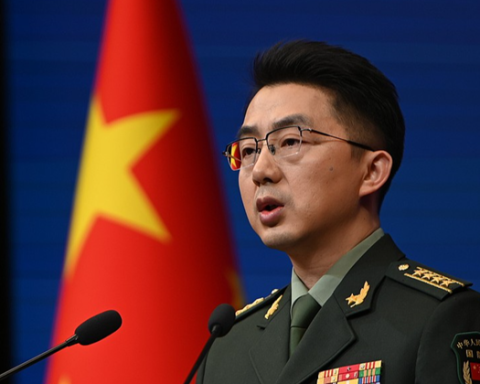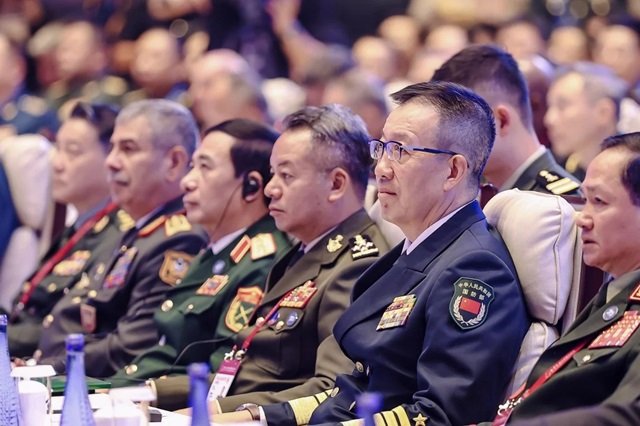
Chinese Defence Minister Dong Jun used his keynote address at Beijing’s Xiangshan Forum to deliver a message that was notable as much for what it omitted as for what it said. Speaking just over a week before Chinese President Xi Jinping’s planned summit with US President Donald Trump, Dong adopted what retired People’s Liberation Army senior colonel Zhou Bo described as a “relatively mild” tone towards Washington, while continuing to articulate Beijing’s long-standing objections to military alliances and bloc politics.
The timing gave the speech particular significance. US officials have recently highlighted improved military-to-military communication between the two powers, following a period in which such contacts had been strained. Against that backdrop, Dong’s emphasis on dialogue rather than confrontation, partnership rather than alliance, and cooperation rather than zero-sum competition presented a less directly confrontational formulation of China’s security position.
Dong warned that international security remained “fragile” and argued that a “zero-sum mindset” could not resolve the problems facing the world. He called for a new security approach based on dialogue, partnership and mutually beneficial outcomes, while urging major powers to shoulder their responsibilities and countries to reject exclusive blocs. The language nevertheless retained familiar elements of Beijing’s criticism of Washington’s alliance system, particularly its opposition to arrangements that China regards as efforts to contain or target it and its partners.
The Chinese defence chief also referred indirectly to the conflict involving Iran. As Washington presses ahead with strikes against Tehran and seeks to pressure Iran towards ending a conflict now in its seventh month, Dong said that “the causes of disputes cannot be resolved by force”. He further urged countries to learn from history, remain vigilant against “hegemonism and militarism”, and prevent minor disagreements from escalating into major frictions.
Taiwan, however, was absent from the address. Dong did not mention the self-governed island, nor did he directly address the South China Sea dispute or Japan. That omission marked a departure from his speech at last year’s forum, when he said that “Taiwan’s return is an integral part of the post-war order”. Zhou cautioned against interpreting the silence as a reduction in Beijing’s concern over Taiwan.
“Not mentioning Taiwan does not mean that China is less concerned with the issue,” Zhou said. “It doesn’t mean that China is not paying attention to it.”
Taiwan remains a core interest to Beijing, and the issue is expected to return to the agenda when Xi meets Trump. Beijing regards Taiwan as part of China and has not ruled out the use of force to achieve reunification. Most countries, including the US, do not recognise Taiwan as an independent state, while Washington opposes any attempt to take the island by force and remains committed to supplying it with weapons.
The contrast with US defence chief Pete Hegseth’s address at the Shangri-La security dialogue in Singapore earlier this year was also noted by Zhou, who pointed out that Hegseth had likewise avoided mentioning Taiwan. The absence of direct references therefore sits alongside, rather than replaces, the continuing importance of the issue in the relationship between Beijing and Washington.
Dong’s speech also placed considerable emphasis on areas where China says international cooperation is necessary. He singled out artificial intelligence, outer space and the deep seas, fields in which China and the US are simultaneously competing and developing increasingly important technological capabilities. He called for cooperation so that emerging technologies could benefit humanity rather than become another source of strategic confrontation.
The speech extended that message into China’s wider military diplomacy. Dong said the Chinese armed forces were prepared to share their experience of military governance and to help, “within our capacity”, countries seeking to develop their armed forces. He outlined plans to expand practical cooperation through joint exercises and training, personnel training, and equipment and technology.
For Zhou, the offer reflected growing confidence in China’s military and Beijing’s efforts to increase its influence in this field. Shi Yinhong, a professor of international affairs at Renmin University of China, similarly said Dong’s address reaffirmed long-held Chinese positions, particularly Beijing’s opposition to closed US-led alliances involving Western countries. Shi also said that China’s offer to assist other militaries demonstrated an ambition to expand its global military influence, although he considered that few countries beyond some developing nations were likely to take up the offer.
Dong linked security to economic and social development, arguing that narrowing development gaps was central to effective security governance. “Development is the greatest guarantee of security,” he said, particularly in relation to countries of the Global South. He also said that China was ready to work with all parties to maintain regional stability and safeguard peaceful development.
The overall message combined familiar strategic positions with a notably restrained presentation. Dong continued to criticise hegemonism, militarism and exclusive alliances, but did so without directly naming the US, Taiwan or the South China Sea. At the same time, he presented China as a country willing to engage in dialogue, cooperate on emerging technologies and assist other nations with military development.
The speech therefore arrives at a sensitive point in the China-US relationship, with military communication improving and Xi’s planned meeting with Trump approaching. Whether the softer language represents a lasting adjustment in tone or simply reflects the immediate diplomatic circumstances remains a question for the coming weeks. For now, Beijing’s defence chief has chosen to emphasise dialogue and cooperation while leaving several of the relationship’s most contentious issues conspicuously unspoken.