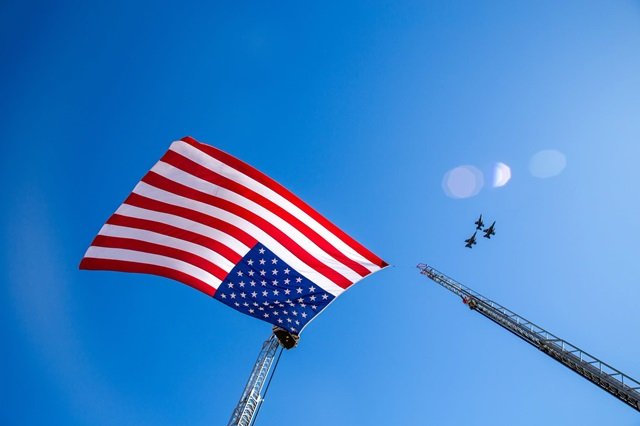
The United States has acknowledged that the Pentagon is operating weapons in Earth’s orbit, marking a significant moment in the accelerating militarisation of space as Washington seeks to deter what its officials describe as increasingly aggressive orbital activities by China and Russia.
Gen. Douglas Schiess, chief of the U.S. Space Force, said on Tuesday that enlisted members of the military branch “operate on-orbit weapons that can defend the Joint Force against space-enabled attacks”. He added that the service would make “disciplined and responsible choices” as it expands its orbital defence arsenal in the coming years.
His comments followed remarks by U.S. Air Force Secretary Troy Meink, who said a day earlier that the United States “has on-orbit space control weapons capable of defending the Joint Force against hostile adversary action”. Together, the statements represented the clearest acknowledgement yet by senior Pentagon officials that the United States possesses weapons in orbit, at a time when strategic tensions over space capabilities are intensifying.
The significance of the statements lies not only in the existence of the capabilities themselves, but in Washington’s increasing willingness to discuss them openly. Victoria Samson, chief director of space security and stability at the nonprofit Secure World Foundation, described the development as part of “the increasing comfort level of the U.S. government to speak about aggressive actions in space” that has emerged in recent years.
“We’ve gone from not talking about counterspace capabilities … to now saying flat-out we have weapons in space,” Samson said. “The pendulum keeps on shifting over that way.”
Neither Schiess nor Meink disclosed what types of weapons they were referring to when speaking to reporters after their remarks. That lack of detail leaves the precise nature and capabilities of the systems unclear, even as the public acknowledgement itself becomes part of the strategic calculations of other space powers.
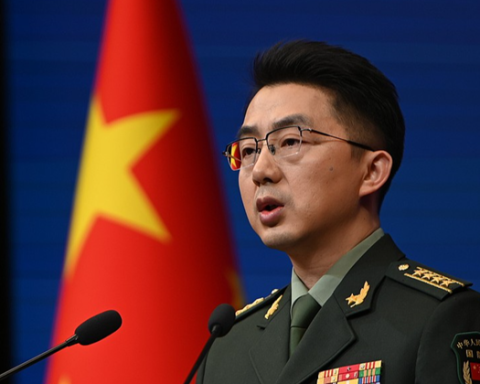
China responded by reiterating its opposition to the militarisation of outer space. Chinese Foreign Ministry spokesperson Guo Jiakun said on X that Beijing “stands for peaceful use of the outer space and keeping it safe, and opposes any arms race in outer space or any attempt to weaponize it and turn it into a war zone.”
Russia’s Foreign Ministry likewise criticised the acknowledgement, saying that Washington’s admission that it had deployed orbital weapons ignored the possible consequences of a conflict and threatened long-term stability in space-based activity.
The United States, China and Russia, the world’s three leading space powers, have spent years developing extensive satellite networks and manoeuvrable spacecraft with capabilities that could potentially be used to attack, disrupt or interfere with other spacecraft. Yet despite the growing sophistication of these systems, no nation is known to have taken the more consequential step of physically attacking another country’s satellite in space.
The distinction is increasingly difficult to separate from the realities of modern warfare. For decades, satellites have supplied armed forces on Earth with communications, navigation and intelligence, generally travelling along fixed orbital paths once deployed. Increasingly, however, military planners view spacecraft as active components of conflict, with technologies capable of disrupting satellite operations through signal jamming, blinding sensors with lasers or manoeuvring close enough to capture or interfere with another spacecraft.
China demonstrated in 2022 that it could command a satellite to grapple with another spacecraft and move it in orbit, highlighting the increasingly active role that manoeuvrable spacecraft can play in military space operations.
The United States has also been demonstrating increasingly dynamic orbital capabilities. Its largest recent orbital exercise, Apollo Maneuvers, was designed to demonstrate dynamic space operations and involved satellites operating in multiple orbits simultaneously, alongside international and commercial partners.
Against that backdrop, U.S. officials argue that acknowledging space-control capabilities is part of maintaining deterrence. Richard Palmer, director of the Capability and Resource Integration Directorate at U.S. Space Command, said on Tuesday that “the acknowledgment of these space-control capabilities is fundamental to ensuring that we prevent deterrence from failing, and that we are postured and ready should deterrence fail to employ them effectively”.
Speaking at a space defence conference hosted by consulting firm Novaspace in Paris, Palmer said there were “some actors across the globe who are very much interested in undermining the collective interests of the countries and allies gathered here in this audience and across Europe and the rest of the world”. He declined to discuss the nature or capability of the weapons.
“The bottom line is that our joint force and our allied forces require space. Our economies require space,” Palmer added. “We are ready in the U.S. to preserve that.”
Yet the same ambiguity intended to preserve operational secrecy may also carry strategic consequences. Craig Albert, graduate director of the Master of Arts in Intelligence and Security Studies at Augusta University, said that the failure to discuss the specific weapons could leave adversaries to make their own assumptions about what the systems are capable of doing.
“In the absence of complete information, competitors may assume the systems threaten their own space assets and invest in counterspace capabilities or comparable weapons,” Albert said.
The concern comes as the head of U.S. Space Command has warned that adversaries are developing capabilities intended to deny the United States access to key systems and reduce military effectiveness, with adversaries likely to seek to target U.S. space assets early in a conflict.
The implications extend beyond Washington, Beijing and Moscow. Other countries are also developing counterspace capabilities, including Germany, which has a €35 billion ($40 billion) military space spending plan aimed at countering growing threats from adversaries.
As military competition increasingly reaches orbit, the strategic environment remains less established than on traditional battlefields. Military norms, strategic precedents and laws of war governing the relatively unfamiliar domain of space remain underdeveloped. At the same time, the wars in Ukraine and the Middle East have demonstrated how indispensable satellites have become to modern warfare on Earth.
The United States’ admission therefore marks more than a disclosure of previously opaque capabilities. It places the reality of orbital weapons more openly at the centre of the strategic competition among the world’s leading space powers, while leaving unanswered questions about what those weapons can do — and how their existence will shape the next stage of the race for control of space.