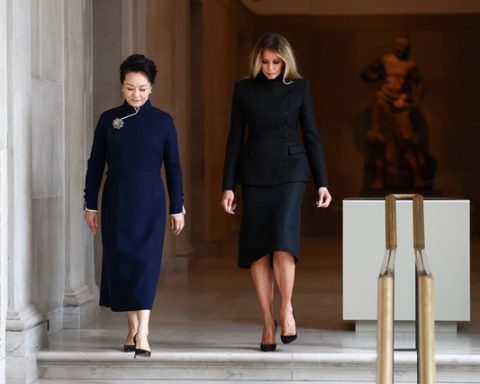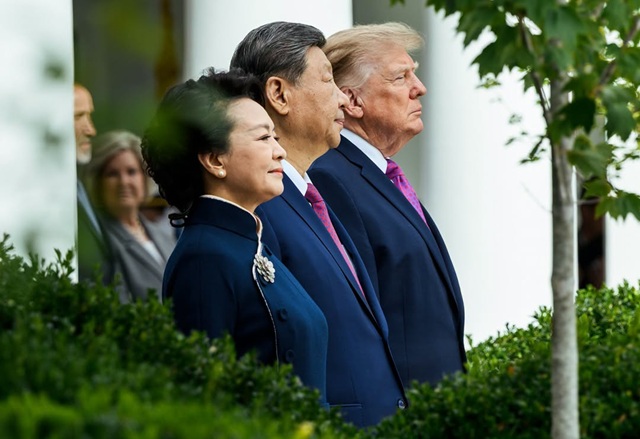
As Chinese President Xi Jinping and US President Donald Trump concluded a three-day state visit on Friday, attention extended beyond bilateral talks, the state dinner and military ceremonies to the highly visible interactions between the two presidential couples. According to the South China Morning Post, the contrasting body language of Xi and his wife, Peng Liyuan, and Trump and first lady Melania Trump offered a glimpse of how the couples interacted in public, particularly during their visit to the National Archives Museum in Washington.
The differences were apparent from the moment the couples approached the museum. Xi and Peng walked up the stairs holding hands and appeared to move closely in step. Patti Wood, an expert in non-verbal communication, described the gesture as natural. She noted that public hand-holding is “not always natural in that culture”. “That speaks well of their relationship and how natural it is,” Wood said. “It’s not always natural in that culture to hold hands, so it’s beautiful, especially beautiful.”
The observation sits within a much older Chinese tradition in which public conduct has often been governed by ideas of ritual, propriety and appropriate relationships. Classical Chinese ritual literature does not establish a simple rule about whether married couples should hold hands, and it would be misleading to use ancient texts as a direct explanation of Xi and Peng’s behaviour. But works such as the Liji, or Book of Rites, place considerable emphasis on regulating conduct, degrees of intimacy, respect and social roles. Public behaviour was traditionally understood not only as individual expression but also as part of a wider system of social etiquette.
Chinese historical narratives likewise contain many accounts of romantic attachment, but their expressions of intimacy frequently appear through culturally prescribed forms. The Han-dynasty historian Sima Qian’s account of Sima Xiangru and Zhuo Wenjun, for example, describes attraction through music, courtship and eventual elopement rather than modern forms of public romantic display. The story became one of the enduring narratives of personal attachment in Chinese literature while also reflecting the importance of family expectations and social propriety.
Wood contrasted Xi and Peng with the American presidential couple. Trump and Melania were physically further apart as they moved towards the building, she said, describing them as “not in sync with each other”. Their postures appeared “stiff instead of fluid”, which Wood interpreted as tension.
Even after Xi and Peng stopped holding hands before entering the museum, Wood observed that their bodies remained “in alignment”. When a couple moves side by side within a close personal space, she said, synchronised walking can indicate a degree of natural connection. “It’s just really interesting because we see that Trump and Melania are far apart in that same instance,” she said.
Inside the museum, Trump showed Xi and Peng historic American documents, including the Declaration of Independence and the US Constitution. The location itself represented a different political tradition from the ritual culture associated with classical China. The Declaration of Independence is closely associated with the American conception of individual liberty and equality, while the Constitution established the institutional framework of the United States.
During the tour, Peng approached Xi from behind while he bent over to examine one of the exhibits and touched him. Wood described the movement as a “bid to play”, arguing that it appeared too spontaneous to have been planned. She interpreted it as a natural expression of wanting to share the moment with her husband: “I want to be in this moment with you, together”. Xi, she said, simply allowed Peng to approach and move close enough for them to look at the material together.
The Trumps displayed a different pattern as they left the museum. Trump reached for Melania’s hand, which Wood called an “abrupt grasp”. She observed that Melania’s body did not initially “naturally relax and move in”. Melania then moved slightly ahead of Trump as they descended the stairs, a movement Wood interpreted as supportive. “He just grabbed onto her, and she took care of it,” Wood said.
After the couples said farewell, Trump and Melania held hands as they walked towards their car. Wood considered this handhold more natural than their arrival, although she continued to detect tension in their movements. “That’s a much more natural handhold,” she said. “But if you look at their body language as they’re holding hands, there’s tension in the handhold.”
The state dinner on Thursday provided another setting in which the two presidents’ interaction was examined. Lillian Glass, a body-language expert who has served as an expert witness in court on behavioural analysis, said Xi and Trump displayed signs of connection. “Xi repeatedly inclined his head towards Trump, and his body oriented in Trump’s direction,” Glass said. “Trump reciprocated by turning directly towards Xi.”
Glass also drew attention to Trump’s head position while greeting Xi and Peng. The US president cocked and tilted his head, which she interpreted as softening his presentation and communicating “warmth, attentiveness and respect”. Melania, she said, smiled towards Xi and remained visibly engaged throughout the encounter.
The South China Morning Post’s account ultimately rests on observations of public gestures rather than evidence about the private relationships of either couple. The three-day visit included bilateral talks, a state dinner, a military review and a rare airport greeting for Xi. Within that highly choreographed diplomatic setting, however, the apparently spontaneous movements — a bow, a handshake, a touch, a step closer or a hand held on a staircase — became part of the visible record of how Chinese and American leaders presented themselves alongside their spouses.