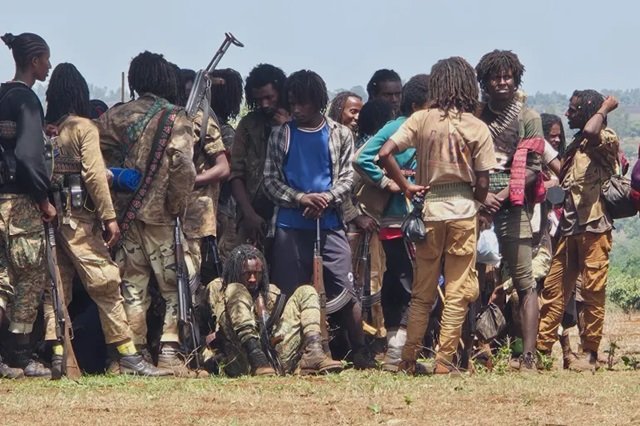
Ethiopia’s renewed civil war is intensifying across its northern regions, with about 150,000 people already forcibly displaced and at least 250 rebel fighters reported killed, according to the Ethiopian government. The fighting remains concentrated in Tigray, Afar and Amhara, but accusations that Eritrea, Sudan and Egypt are supporting the insurgency have increased the risk that the conflict could extend beyond Ethiopia’s borders.
The conflict, which erupted again last week between the Ethiopian army and a coalition of armed groups, has so far remained geographically limited. According to Spanish newspaper El País, the principal clashes have taken place in the north, including around Alamata in southern Tigray, a strategically located town on the road linking the region with Addis Ababa. Government forces say they have taken control of Alamata. Rebel forces, meanwhile, claim to have captured Erebti and Abala in the Afar region, east of the Tigrayan capital Mekele. Various sources cited by El País say the insurgents are seeking to cut Addis Ababa’s communications with Djibouti, through which much of Ethiopia’s supplies enter the country. The army says it has also captured Sekota in Amhara.
The humanitarian situation is already deteriorating in Tigray. “We know that the situation is beginning to become very complicated in Tigray and that hospitals are already receiving many wounded,” said Spanish doctor Iñaki Alegría, who manages a hospital in Oromía and has spent 15 years in Ethiopia. Elsewhere, including the capital, he said, daily life was continuing with relative normality. Alegría estimated that the conflict was currently affecting about 10% of the country, while warning that many people feared it would spread. In his assessment, the outcome remained uncertain, but “without external support, the rebels, by themselves, have little to do”.
The possibility of foreign involvement is central to the emerging crisis. On Sunday, Marshal Birhanu Jula, chief of the Ethiopian armed forces, accused Eritrea of being a close ally of the Tigray People’s Liberation Front, or TPLF, the principal insurgent group. Addis Ababa has for months accused Eritrea of supplying arms to the rebellion. Eritrea has repeatedly denied the allegations, although experts cited in the El País report regard the Ethiopian claims as credible.
The accusation marks a sharp reversal in relations between the two countries. During Ethiopia’s previous war against the TPLF, from 2020 to 2022, Eritrea supported Addis Ababa and played a decisive role in containing the rebels’ advance. Relations have since deteriorated, particularly after Prime Minister Abiy Ahmed repeatedly pressed for access to the sea through Eritrea.
Ethiopia has been without its own coastline since Eritrea became independent in 1993. Ahmed has described the loss of maritime access as “an unjust historical mistake” and has presented the restoration of access through the Eritrean port of Assab as an important national objective. Ethiopia currently depends heavily on Djibouti, through which 95% of its trade passes. The dispute over access to the Red Sea has therefore become closely connected to the deteriorating relationship between Addis Ababa and Asmara.
There have also been specific allegations concerning Eritrean arms deliveries. In January, the Ethiopian government said it had intercepted a major shipment of weapons from Eritrea intended for Fano militias in Amhara, which are participating in the current rebellion against Addis Ababa. Eritrea rejected the accusation. Its information minister, Yemane Gebremeskel, told Reuters that Ahmed was seeking excuses to attack Eritrea. “They wave false flags to justify the war that he has been eager to unleash for at least two years,” he said.
Marshal Jula has also implicated Sudan and Egypt, suggesting that both are supporting the TPLF and its allies. The allegation comes as Sudan itself remains embroiled in a civil war between the Sudanese army and the Rapid Support Forces, or RSF. Sudanese army chief and President Abdel Fattah al-Burhan has accused Addis Ababa of supporting the opposing forces commanded by Mohamed Hamdan Dagalo, known as Hemedti.
A Reuters investigation earlier this year reported the existence of an RSF training camp in Ethiopia’s Benishangul-Gumuz region, alongside military facilities allegedly used to channel supplies and weapons to Sudanese insurgents. Ethiopia’s relationship with the United Arab Emirates further complicates the regional picture: the UAE is an important Ethiopian ally while simultaneously supporting the RSF.
Egypt has its own major dispute with Ethiopia over the Grand Ethiopian Renaissance Dam, or GERD, whose operation affects Nile waters. At the end of 2025, Cairo reached an agreement to strengthen its military presence in Djibouti and Eritrea in exchange for the modernisation of the ports of Dorale and Assab.
The renewed Ethiopian conflict therefore involves overlapping territorial, military and strategic disputes. Weaknesses and divisions within the coalition fighting Addis Ababa could be offset by substantial foreign support, particularly from Eritrea and Sudan. The developments described by El País point to a conflict whose immediate fighting remains concentrated in northern Ethiopia but whose external connections already involve several of the principal states shaping the politics and security of the Horn of Africa.