For almost two decades, Regina Jardim has been recording the lives of Brazilian women killed by men. Her work began after her daughter, Priscila, was shot dead by her ex-partner as she left a nightclub in 2007. Since then, the 66-year-old retired teacher has posted brief profiles of murdered women on her Instagram page, Quem ama liberta, or “Those who love, set free”.
Jardim says she has collected details of more than 30,000 victims, making the page perhaps the closest Brazil has to a database of women killed in femicide. In the early years, she searched local newspapers for reports of deaths. Her task became easier in 2015, when a new femicide law made it compulsory for police and public authorities to investigate and register gender-based violence.
Yet the legislation has not halted the rise in killings. Last year, 1,571 women were killed by men in Brazil, according to the Brazilian Public Security Forum, the highest number recorded since the available records began. Experts believe even that figure does not capture the full scale of the problem.
“I had no idea of the scale of the problem, I had to let others know,” Jardim says. Samantha Carvalho, a lawyer and researcher with the Laboratory for the Study of Femicide at the University of Londrina in southern Brazil, says the violence is becoming not only more frequent but more brutal. In recent years, her organisation has identified evidence of what it calls “femicide by fire”.
The scale of the killings has pushed femicide into the centre of Brazil’s national political debate as the country prepares for presidential elections on 4 October. A July survey conducted for the Ideia Institute found femicide among the three leading concerns of voters. Women account for nearly 53% of the electorate and represent the majority of swing voters, making their support particularly significant in a tightly contested election.
President Lula Inácio da Silva has made violence against women a prominent part of his campaign. “If you beat your wife, don’t vote for me,” he said while launching his campaign earlier this year. “God took six days to make the world and it’s unfinished… It will only be finished when we end violence against women in this country.”
At another rally last month, Lula said 40,000 perpetrators of violence against women had been arrested during the previous three months under a new crackdown. Addressing the United Nations general assembly in New York last month, he pledged to build a “country free of femicide”.
His principal rival, Flávio Bolsonaro of the rightwing Liberal party, has adopted a tougher approach to violent crime. He has appeared on stage holding a knife and promised chemical castration for male perpetrators. His campaign also comes against the record of his father, the jailed former president Jair Bolsonaro, whose presidency was marked by statements widely criticised for their treatment of women. Jair Bolsonaro once said women should “stop whining” about femicide and told fellow lawmaker Maria do Rosário that he would not rape her because she “was not worth it”.
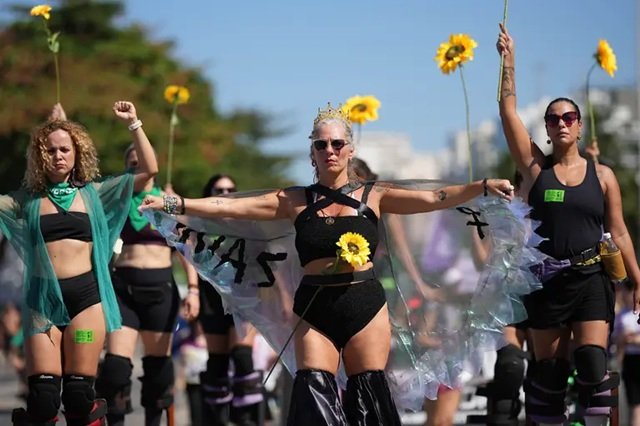
Women were prominent in the #EleNão, or “not him”, movement against Jair Bolsonaro in 2018 and 2022, and female voters were pivotal to Lula’s election victory four years ago. Flávio Bolsonaro’s tough-on-crime proposals, combined with a public reconciliation with his stepmother, Michelle Bolsonaro, a prominent figure among Brazil’s political right, have helped him appeal to conservative and evangelical women.
Other candidates have offered different proposals. Augusto Cury, a psychiatrist and bestselling author running for president for the Avante party, has proposed drones and mobile applications to detect victims of gender violence. The idea has attracted widespread debate and criticism. Carvalho questions its usefulness, pointing out that evidence shows women are often attacked inside their homes. She argues instead for greater resources for monitoring and police training.
“We’re glad to hear all these beautiful speeches but we’re concerned that empty rhetoric is coming from politicians who have never shown concern for women’s rights and from some on the right who want to roll back laws protecting women,” Carvalho says.
Another challenge is the growth of the “manosphere”, or machosfera, a broad online network of forums and influencers promoting misogyny. Brazil is fast-tracking legislation through the Chamber of Deputies that would treat online misogyny in the same legal framework as racism and establish prison sentences of up to five years.
For Jardim, the political attention is welcome, although maintaining her memorial page has become increasingly difficult after nearly 20 years of work. She says the country is only beginning to change its understanding of the problem. “We are at the beginning of a shift in awareness,” she says, “a process that must not be allowed to be broken or allowed to regress.”