A key Sri Lanka-India meeting on illegal bottom trawling has been postponed at India’s request, with Colombo seeking a new date either before or after Sri Lanka’s parliamentary budget period because government officials are barred from overseas travel during that period.
Fisheries Ministry Secretary Dr Kolitha Kamal Jinadasa told a marine and coastal forum on 29 September that the Joint Working Group meeting, originally planned for September, had been moved to October following a request from India. Speaking to The Sunday Morning in Colombo, he said the postponement was caused by a medical emergency and “not for any political reason”. A new date has yet to be fixed.
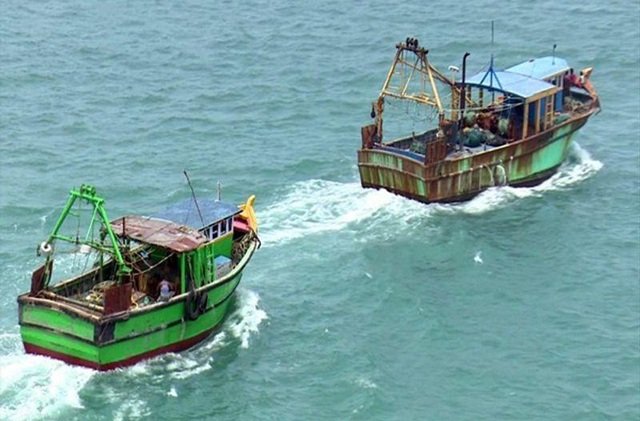
The dispute centres on mechanised trawlers from Tamil Nadu crossing the International Maritime Boundary Line into northern Sri Lankan waters, where Sri Lanka says the practice depletes fish stocks and damages marine ecosystems. Sri Lanka completely banned bottom trawling in 2017 and imposed steep fines the following year, but illegal incursions have continued. India has sought to reduce the practice through subsidised schemes to convert bottom trawlers into deep-sea tuna long-lining vessels and a ban on new bottom-trawler registrations in Tamil Nadu.
The postponed meeting was also expected to involve officials from both countries at the Food and Agriculture Organization Committee on Fisheries conference in Rome. Dr Jinadasa said the Indian secretary was unable to attend that meeting because of the same medical emergency.
Sri Lanka is maintaining what Dr Jinadasa described as a two-track response: maritime enforcement alongside diplomatic engagement with the Indian Government. “Our plan involves action in two ways: one is continuing arrests and another is discussions with the Government,” he said.
Sri Lankan authorities currently apprehend between 50 and 75 illegal trawlers each year. Dr Jinadasa said radar tracking and entrance-monitoring data indicated a “significant reduction” in incursions by Tamil Nadu vessels, although the problem had not ended. He also said India had introduced a low-interest loan scheme to help fishermen convert bottom trawlers to long-line fishing and was deploying a Vessel Monitoring System to allow the Indian Navy and Coast Guard to monitor fleet movements. He described the system as “one of the best in this region”.
The dispute is not confined to foreign vessels. Dr Jinadasa also highlighted domestic bottom trawling in Kalpitiya, Mannar and Jaffna, where official gazette notices prohibit the practice. Enforcement had remained weak in Kalpitiya until a court injunction halted operations involving 28 local fishermen.
The issue is complicated by the commercial value of the shrimp known locally as kurutu issa, which is targeted by the Kalpitiya fleet. Dr Jinadasa described it as “a very good resource” and an important source of foreign income, while acknowledging strong pressure from local communities to find a sustainable way of harvesting it.
The Fisheries Ministry has therefore asked the National Aquatic Resources Research and Development Agency and local universities to develop selective alternatives to bottom trawling. NARA research indicates that completely halting harvesting could allow non-target species such as karalla, or ponyfish, to dominate the ecosystem.
“We do not have any new fishing gear for this fishery other than bottom trawling,” Dr Jinadasa said. “We invite researchers and organisations to introduce new fishing gear that we can use.”
The Government is also preparing a new fisheries act to replace the decades-old legal framework. Cabinet approval has been obtained, stakeholder consultations completed and the draft submitted to the Legal Draftsman. The ministry says all comments raised by the Legal Draftsman have been resolved and expects to table the legislation in Parliament within this year.
The proposed act will include a legal provision allowing newly developed fishing gear to be accommodated once researchers identify selective, non-destructive methods suitable for fisheries such as the kurutu issa shrimp.