The new Netflix series East of Eden gives John Steinbeck’s sprawling American family saga something the celebrated 1955 film largely denied it: room for the characters who were pushed aside in Elia Kazan’s adaptation. Most importantly, the series restores Lee, the Chinese-American servant whose intellectual development and role within the Trask family are central to Steinbeck’s examination of the American dream and who was absent from the James Dean film. Yet the seven-part series also exposes the difficulty of adapting a novel whose complexity depends as much on its ideas and contradictions as on its plot.
A reassessment of the 1955 film reveals how sharply it diverges from Steinbeck’s 1952 novel. James Dean, in his first major leading role, plays Cal Trask, one of the twin brothers whose struggle for their father’s love forms the emotional centre of the story. But the performance has aged badly, according to the review published by Der Spiegel. Dean appears to imitate his great model Marlon Brando, making Cal twitch and jerk with the exaggerated physicality of a child moving between excitement and exhaustion. More consequentially, the screenplay abandoned Lee, one of Steinbeck’s most important characters, apparently at least in part because the filmmakers feared alienating the predominantly white audience of the period.
That omission fundamentally weakened the original film’s treatment of Steinbeck’s central concerns. Lee is not merely a servant in the novel. He pursues knowledge, is fascinated by philosophy and gradually becomes an intellectual force within the Trask family. In the Netflix adaptation, played by Hoon Lee, he initially conceals these qualities, speaking broken Pidgin English in the presence of white people. As the story develops, however, he emerges as the person who helps raise Cal and Aron and quietly directs the fortunes of the entire family.
The expanded role gives the new adaptation a different perspective on the American promise of freedom and self-realisation. Steinbeck’s story presents a society in which that promise was historically restricted by race, while the Netflix version gives Lee’s experience much greater narrative weight. His development is expanded at one point even beyond the treatment he receives in the novel. For Der Spiegel, that alone provides a substantial justification for returning to the material.
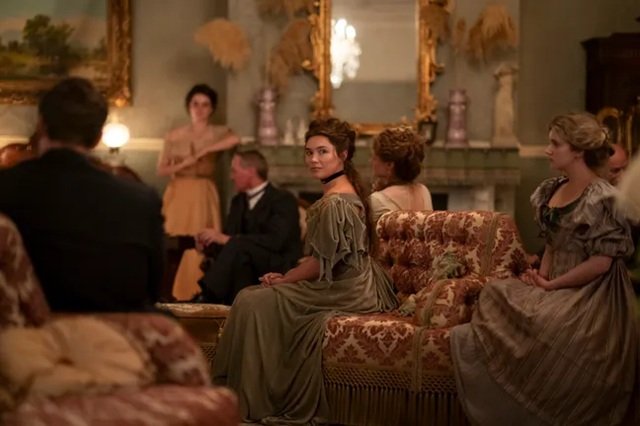
The new adaptation also comes from an unusually direct connection to the earlier film. Zoe Kazan, the granddaughter of Elia Kazan, wrote and produced the series. She makes another major correction by restoring Cathy to her proper place in the story. Florence Pugh plays the character, who later calls herself Kate, as one of the novel’s principal figures rather than the marginalised prostitute of the 1955 film.
Cathy is among Steinbeck’s most difficult creations. He repeatedly calls her a monster and describes her setting fire to the house where her parents are sleeping when she is young. She later marries Adam Trask, gives birth to the twins Cal and Aron, then abandons the family and becomes a prostitute in the nearest town. She is presented as profoundly antisocial, yet she also recognises the hypocrisy of the patriarchal society around her. Her relentless pursuit of freedom leads her beyond conventional moral boundaries.
Pugh brings physical intensity and considerable subtlety to the part, but the series changes Cathy’s character in ways that weaken its force. The screenplay invents a tragic love for Adam’s brother Charles and later has Cathy conduct imagined conversations with him shortly before her death. This version of Cathy becomes dependent on another person’s judgement and appears to regret the choices she made. Steinbeck’s Cathy is different: although her life ends tragically, she does not repent.
That distinction matters because the 1952 novel still reads as a radical work. The series, by contrast, increasingly replaces its intellectual and stylistic daring with melodrama. It tells the story at considerably greater length than the 1955 film, covering the rivalry between Adam and Charles and the corresponding love-hate relationship between their sons. But its seven episodes remain closely tied to the plot, rarely developing an artistic identity of their own. The material is repeatedly forced into familiar conventions of contemporary television drama.
In this respect, the older adaptation was more adventurous than its reputation might suggest. Elia Kazan radically reduced Steinbeck’s 700-page novel, concentrating on roughly its final quarter. At the same time, he exploited CinemaScope and widescreen spectacle, part of Hollywood’s effort to draw audiences into cinemas during television’s first major expansion. The result may now look dated, but its visual ambition was unmistakable.
The Netflix series reverses that strategy. Its images frequently shrink towards the scale of television, even though streaming once promised to bring something resembling cinema into the home. For Der Spiegel, that makes the shortcomings of East of Eden particularly disappointing. The series restores characters and perspectives that the classic film excluded, but the fullest dramatic and intellectual experience of Steinbeck’s story remains in the 1952 novel itself.