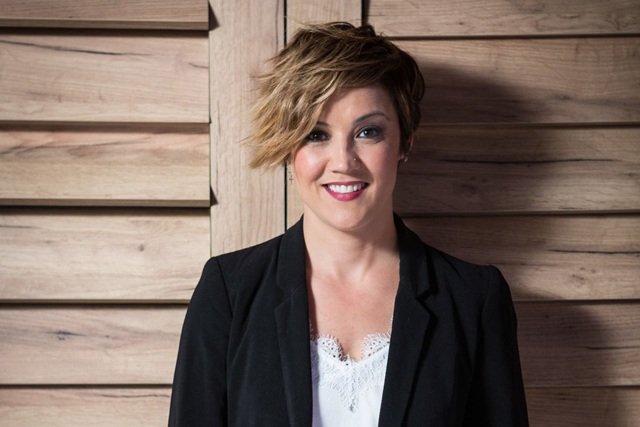
Cristina Pardo, one of Spain’s best-known political journalists, says she has deliberately resisted being placed on either side of the country’s increasingly polarised political divide. After 20 years in television, Pardo, 49, has moved from the relentless pace of La Sexta’s Más vale tarde to La mesa, a Wednesday-night programme on Antena 3. She has also recently received the FesTVal de Vitoria award for her two decades in television. In an interview marking the transition, she describes herself as a veteran rather than a senior journalist and says she still has “a lot of working life ahead”.
Pardo says she regards herself as fortunate after years of working intensely in journalism. She describes her current life as exceptionally calm, saying she can go to the supermarket without worrying about what day of the month it is. Her parents are still alive, she says, and she considers La mesa the best programme she has ever made. The change in professional rhythm has nevertheless required adjustment. After years of delivering breaking news and constantly checking the time on Más vale tarde, she says she has had to learn a slower pace. “I was accelerated,” she said. “I am learning this new rhythm, and I am enjoying it enormously.” She adds that although she remains interested in news, she is no longer “an information junkie”.
The new programme has already produced fluctuating audience figures, opening with a 13.1% share before falling to 8.9% in its most recent edition cited in the interview. Pardo says she takes the figures seriously but does not allow them to determine her view of the programme. “The figure clearly matters, and whoever tells you it doesn’t, is lying, because it is an objective element,” she said. But she also believes it is not the only measure of success. She says Antena 3 has shown patience and committed itself to the format, leaving her focused on doing the programme as well as possible.
Her approach to politics is central to the way she describes her journalism. Pardo has been labelled politically on both sides, particularly after criticising Pedro Sánchez’s government. She rejects those classifications. “I am not a person for labels,” she said, arguing that corruption is wrong regardless of whether it involves the Partido Popular or the PSOE. “I don’t have this idea of thinking that these, or the others, are mine. None of them are.” Her most pointed description of her relationship with politicians is also the title of the interview’s central argument: “Politicians are my employees, everyone’s employees, and I am quite a severe judge of all of them.”
Pardo also accepts that the media may have contributed to Spain’s political polarisation, but she places greater responsibility on politicians themselves. “It is probable that we have contributed a grain of sand,” she said, while arguing that political leaders have chosen to divide society into supporters and opponents. She described the resulting division as “tricky, dangerous and depressing” and said polarisation benefits politicians more than the media.
Her commitment to challenging politicians is rooted in her years as a political reporter. She recalls covering the Partido Popular while working at La Sexta, including the period associated with Mariano Rajoy’s so-called “plasma” appearances, in which he addressed the public without taking questions. Pardo says politicians routinely retreat into statements without questions when confronted by corruption allegations, economic downturns, lies or broken promises. “And they all do it,” she said. She also argues that journalists should sometimes act collectively against such practices, although she notes that the profession is not particularly corporatist and journalists rarely operate as a united group.
Pardo remains proud of having worked as a street reporter, saying journalists are able to tell what they see directly and influence current affairs through their questions. Yet she eventually became tired of the physical demands of political reporting, including competing with other journalists outside the Partido Popular headquarters in Madrid to obtain a response from politicians who might refuse to speak. Her move into studio programmes has therefore represented not only a change in format but also a different stage in her career.
Her interviewing style remains confrontational when she believes it is necessary. She cites her recent interview with Óscar Puente, in which she repeatedly questioned the transport minister about controversial matters, as an example. Pardo says she does not prepare a rigid list of questions. Instead, she writes down subjects she wants to address, listens to the interviewee and responds according to what is said. “Óscar Puente was able to express himself, and I was able to ask follow-up questions, which is what we are there for: to hold the person up to the mirror,” she said. She also expressed gratitude to Puente for appearing on a programme that was unlikely to provide an easy interview.
Away from political confrontation, Pardo says she believes humour can play an important role in public discussion. “Humour is the best weapon of mass destruction,” she said, arguing that jokes, sarcasm and humour can unsettle people and help make difficult events easier to endure. She also defends the inclusion of people from different backgrounds and areas of expertise in political discussions, citing her work alongside Tamara Falcó. Pardo says participants should be allowed to express opinions without being attacked for stepping outside their normal areas of knowledge.
Her career began with radio, influenced by the broadcaster José María García, whom she admired as a child despite having little interest in football. She says his ability to capture an audience persuaded her to study journalism. She later obtained her first job at COPE, an opportunity she attributes to García, and subsequently moved into television, where her work as a political reporter following the Partido Popular established her distinctive public profile. Now presenting La mesa on Antena 3, Pardo says she has no desire to return to the person she was before, describing her career as the result of years of work and the opportunities that followed.