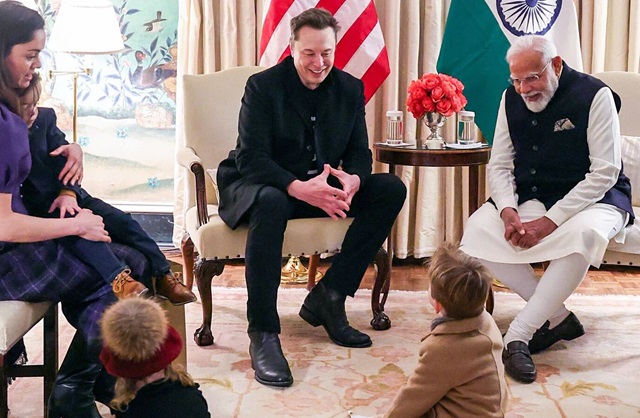
Elon Musk has publicly challenged Indian billionaire Mukesh Ambani over delays in launching SpaceX’s Starlink satellite internet service in India, accusing powerful business interests of obstructing competition in one of the world’s largest telecommunications markets.
“Is Ambani the real boss of India?” Musk asked in a post on social media on Thursday, a day after accusing unnamed “oligarchs” of maintaining a “monopolistic chokehold on the Indian people.”
Musk, the founder of SpaceX, said Starlink had been prevented from launching in India despite spending “five years complying with every single law and requirement” imposed by the government.
The remarks triggered a political response, drawing in Rahul Gandhi, the leader of India’s opposition, who has repeatedly accused the government of being influenced by powerful business figures.
“Wait till you meet the other one,” Gandhi replied, in an apparent reference to Gautam Adani, India’s wealthiest businessman and a frequent target of the opposition politician’s criticism.
“This is indeed troubling,” Musk said in response to Gandhi.
Ambani’s Reliance Industries, the parent company of telecom operator Jio, did not respond to CNBC’s request for comment.
Jio is India’s largest telecommunications and internet service provider. Alongside rival Airtel, the company controls approximately 80% of the country’s telecom market, giving the two operators a dominant position as satellite-based connectivity emerges as an alternative for consumers and businesses.
The public exchange has brought renewed attention to the regulatory obstacles facing Starlink, as well as the competitive landscape confronting foreign technology companies seeking to expand in India.
In March 2025, Starlink signed agreements with Jio Platforms and Airtel to explore arrangements for distributing the American company’s products and services to customers in India. The agreements opened the possibility of cooperation between Starlink and the country’s established telecom operators, rather than an immediate direct contest for subscribers.
Starlink received a licence to launch its satellite internet services in India in July 2025. However, the service had not begun operating in the country by October 2026.
A Bloomberg report in June 2026 said New Delhi had frozen approvals for the launch because of security concerns involving Starlink terminals, which authorities feared could be used even when the service was not licensed. The reported restrictions have complicated the company’s efforts to enter the Indian market, despite its earlier regulatory clearance.
The delay has coincided with plans by Reliance to develop its own satellite communications infrastructure, adding a further dimension to the dispute over market access and competition.
Akash Ambani, Mukesh Ambani’s son and managing director of Jio Platforms, told shareholders in June that the company was planning to introduce low-Earth-orbit satellite communications in India.
According to Indian media reports, Jio is proposing a network of approximately 1,600 low-Earth-orbit satellites and 23 ground stations to expand connectivity across the country. The system would represent a significant investment in satellite infrastructure as Indian telecommunications companies explore ways to extend internet access beyond conventional terrestrial networks.
Starlink, meanwhile, operates a constellation of approximately 11,000 satellites and provides services across more than 170 countries and territories, according to the supplied report. Its existing global network gives it an established presence in the satellite internet sector, although access to the Indian market remains unresolved.
Akash Ambani reiterated the company’s emphasis on domestic technological development on Thursday, telling Moneycontrol, a platform owned by the Reliance Group, that “India needs its own indigenous stack of technologies.” He said Jio would focus on affordable solutions.
The comments underscore the competing approaches to satellite connectivity: Starlink is seeking to extend its international service into India, while Jio is pursuing infrastructure that it presents as part of the country’s own technological capabilities.
The confrontation also comes as Musk’s other major business venture, Tesla, struggles to establish a strong presence in India. The electric vehicle company entered the Indian market in 2025, but its sales have reportedly remained modest, with just over 1,000 vehicles sold since launch.
Starlink’s stalled entry and Tesla’s limited sales illustrate the challenges facing Musk’s businesses in a market with enormous potential but complex regulatory requirements and powerful domestic competitors. The latest dispute has placed those challenges in the public spotlight, with Musk directly questioning Ambani’s influence as the satellite internet launch remains on hold.