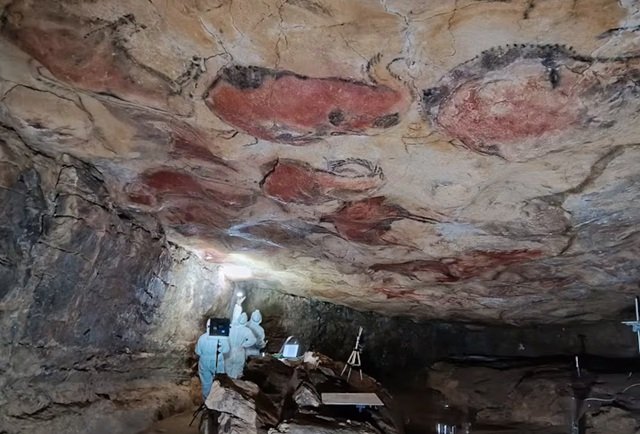
Human DNA can survive for thousands of years on the walls of prehistoric caves, even where no human bones or other biological remains have been found, according to an international research project led by specialists from Spain and Portugal. The discovery, made under the First Art project, establishes cave surfaces as a previously unexplored source of genetic information about the people who visited, occupied or decorated them. It could allow researchers to investigate prehistoric populations in sites where conventional archaeological evidence is absent or excavation is restricted to protect fragile rock art.
The research began with the hypothesis that Palaeolithic artists might have mixed pigments with saliva before blowing them on to cave walls to create paintings. If saliva became trapped on the rock surface, the researchers reasoned, some of the artists’ DNA might have survived. Initial samples collected from Maltravieso cave, in the Spanish city of Cáceres, contained insufficient genetic material to produce conclusive results. The team subsequently expanded its investigation to other caves, eventually finding evidence that supported the hypothesis that human DNA could persist on ancient rock surfaces.
Between 2022 and 2025, the researchers collected samples from 11 caves across Spain and Portugal. Much of their work focused on panels bearing hand representations and figures made with red pigments, among the oldest forms of artistic expression on the Iberian Peninsula. Using advanced genetic extraction and sequencing techniques, they identified human DNA at least 2,000 years old in a pigmented calcite crust at Escoural cave in Portugal.
More unexpectedly, the researchers also detected ancient human DNA on several unpainted sections of cave walls at Escoural and Covarón, in Asturias, northern Spain. The findings suggest that genetic material can remain on rock long after direct human contact, whether through touching the surface, leaning against it or handling pigments during the production of paintings. The presence of DNA on unpainted surfaces indicates that the potential of cave walls as genetic archives extends beyond areas containing visible artistic remains.
The study brought together researchers from the University of Extremadura, the regional government of Extremadura and the Max Planck Institute for Evolutionary Anthropology in Leipzig, Germany, a leading centre for ancient DNA research. The Spanish institutions helped initiate the investigation to learn more about the people responsible for the rock paintings at Maltravieso, a site situated within the urban area of Cáceres. The First Art project was promoted by archaeologists Hipólito Collado and José Julio García Arranz, both members of the Patrimonio&ARTE group, which specialises in the conservation and investigation of artistic heritage.
García Arranz described the findings as a significant advance for archaeology because they introduce a source of genetic evidence that does not depend on recovering human remains. “Until now, genetic information about prehistoric populations came mainly from skeletal remains, archaeological sediments or tools made from organic materials,” he said. “The possibility of recovering DNA directly from walls allows us to incorporate a completely new source of information to reconstruct human presence and behaviour in the past.”
The method could be particularly useful in caves where no human remains have been discovered or where excavation is impossible because of the need to preserve archaeological deposits and rock art. According to García Arranz, the technique offers a way to obtain genetic information without disturbing archaeological layers or putting paintings at risk. Its application could therefore extend investigations into sites that have remained difficult to study through conventional archaeological methods.
Researchers believe the approach could eventually help establish the biological sex of people who frequented particular caves, examine relationships between individuals, trace population movements and investigate genetic ancestry. Such possibilities could provide new evidence for reassessing interpretations of prehistoric societies, although the findings reported so far do not establish who produced particular paintings or how specific caves were used.
The first results from Escoural have nevertheless attracted attention because the sequenced samples contain predominantly female genetic profiles. The researchers suggest that this pattern could support the hypothesis that women played a more active role in creating and using spaces associated with rock art than historical interpretations have traditionally acknowledged. The finding remains an indication rather than a definitive reconstruction of the individuals responsible for the paintings.
Collado, who heads the Archaeology Section of the Directorate-General for Cultural and Documentary Heritage of the Extremadura regional government, said the project was only beginning. He expects the methodology to provide a reference for international research teams seeking to apply the technology to other caves. First Art has already expanded its investigations to sites in Asturias, Cantabria and Andalusia, as well as in the United Kingdom, Croatia, South Africa and Colombia.
Collado said the possibility of finding genetic traces on ancient rock surfaces could transform the study of prehistoric human presence. “If cave walls preserve genetic information from those who occupied them tens of thousands of years ago, each of these caves can become an exceptional biological archive, capable of answering questions that until now seemed beyond reach,” he said. At Maltravieso, whose negative hand paintings are attributed to some of the earliest human groups to inhabit Europe, researchers hope the walls may preserve not only traces of ancient artistic activity but also genetic evidence of the people who created it.