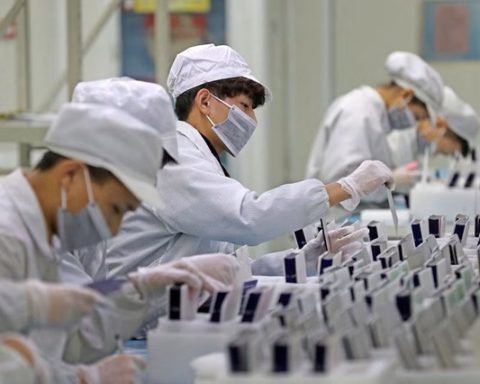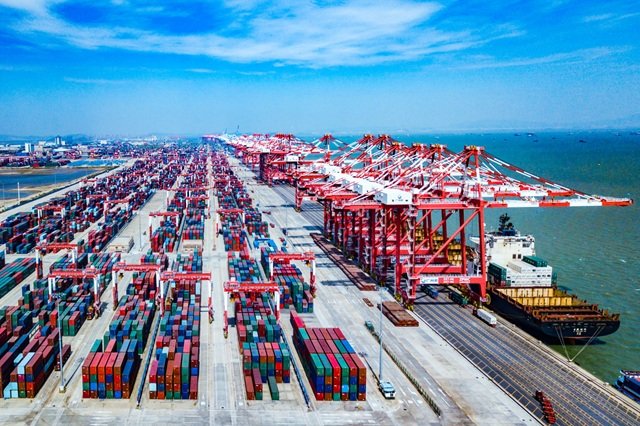
China’s economy grew faster than expected in the third quarter as strong exports of technology and manufactured goods helped offset weak domestic consumption and a deepening property crisis, highlighting the growing imbalance between the country’s industrial strength and household demand.
Gross domestic product expanded by 4.5% in the three months to September compared with a year earlier, according to data released by the National Bureau of Statistics on Monday. The result exceeded the 4.4% growth forecast by economists polled by Reuters and marked an improvement from the three-year low of 4.3% recorded in the second quarter.
Growth averaged 4.6% during the first nine months of the year, keeping China broadly on track to meet its official full-year target of 4.5% to 5%. The stronger quarterly performance came as demand for Chinese technology products benefited from the artificial intelligence boom, while manufacturing and government-backed investment in high-tech industries continued to support economic activity.
However, the latest figures also underscored the limits of that momentum. Household spending remained subdued, property investment contracted further and overall fixed asset investment continued to decline, leaving the economy increasingly reliant on factories and overseas buyers.
Tianchen Xu, senior economist at Economist Intelligence Unit, said a September rebound had offset weaker performances in July and August. He attributed the improvement to stronger government investment, continued resilience in external demand and a weak comparison base, while forecasting full-year growth of 4.7%.
Industrial production increased by 5.5% in September from a year earlier, matching analysts’ expectations and accelerating from 5.2% growth in August. Retail sales rose by 1.1%, exceeding forecasts and improving on August’s 0.4% increase, although the figures continued to indicate limited momentum in consumer spending.
The government’s subsidies for communication appliances, including mobile phones and other devices, contributed to stronger retail sales, according to Lynn Song, chief economist for Greater China at ING.
The urban unemployment rate stood at 5.2% in September.
Investment remained a more pronounced weakness. Fixed asset investment in urban areas fell by 7.2% during the January-to-September period compared with the same period last year. Investment in real estate development contracted by 20.6%, deepening the decline from the first eight months of the year, when it fell by 19.9%.
The property downturn, now in its fifth year, has eroded household confidence and weighed on spending, in part because Chinese families hold substantial wealth in housing. New home prices across 70 cities fell by 0.14% in September from the previous month, excluding state-subsidised housing. The decline was slightly smaller than the 0.17% drop recorded in August, but offered little evidence of a decisive recovery.
Sheana Yue, senior economist at Oxford Economics, said the prolonged housing slump would continue to restrict the benefits of stronger industrial activity from spreading through the wider economy. Weak home sales, construction starts and prices provided little indication that the downturn was approaching its end, she said.
China’s export performance has provided a powerful counterweight to these domestic pressures. Exports rose by 36% in dollar terms in September from a year earlier, while the country’s monthly trade surplus reached a record $133.5 billion. The surplus is on course to exceed last year’s record of $1.2 trillion, intensifying concerns among trading partners about the competitiveness of Chinese manufacturers and the imbalance between domestic supply and demand.
The European Union has been particularly concerned about the impact of low-cost Chinese goods on its industries and employment. Brussels and Beijing agreed this month to establish a quota for Chinese hybrid-car imports, averting a broader trade confrontation, although further European safeguards remain possible.
Economists have warned that persistent domestic weakness could encourage Beijing to rely on exports and industrial expansion rather than undertake more substantial reforms to stimulate household consumption. Eswar Prasad, an economics professor at Cornell University, said imbalances between supply and demand continued to increase, raising the possibility that the government might adopt a more passive approach to stimulus.
Chinese authorities have nevertheless stepped up targeted support, including interest-rate cuts and mortgage subsidies announced in late September. Earlier this month, the government allocated 550 billion yuan in unused debt quota to ease financial pressures on local governments and support infrastructure spending.
National Bureau of Statistics deputy director Mao Shengyong said China had maintained growth despite a complex international environment and insufficient domestic demand, but acknowledged that the foundations for stable and improving economic performance still needed to be strengthened.