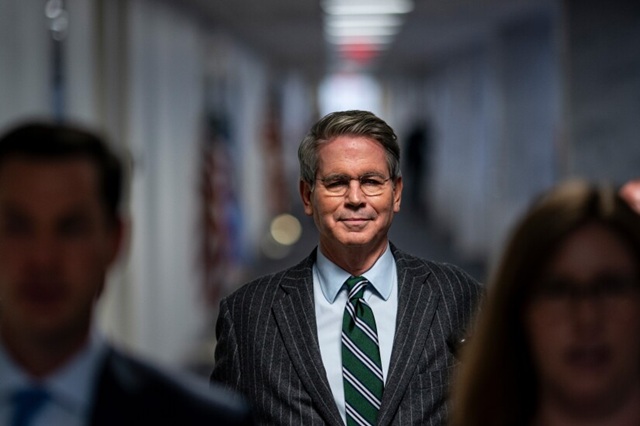
The United States and China have established a new dialogue mechanism to address risks associated with advanced artificial intelligence, even as the two countries continue competing for global technological leadership, US Treasury Secretary Scott Bessent said on Tuesday.
Speaking at an event organised by the National Committee on US-China Relations in New York, Bessent said the two governments should “harbor no illusions” about their differences while working together to prevent risks arising from the development of so-called super intelligence (SI).
The new mechanism is intended to address shared risks and prevent misunderstandings between the two countries. Under the arrangement, Washington and Beijing will exchange best practices for testing advanced AI models before their release, maintain human judgement over the technology and alert each other to serious incidents involving super-intelligence systems.
However, Bessent made no commitment to restricting or slowing the development of the technology, as both countries remain engaged in an intense competition to establish global dominance in artificial intelligence.
The Trump administration has largely resisted broad restrictions on AI development over concerns that regulatory constraints could weaken the United States’ competitive position against China. President Donald Trump indicated some openness to safeguards in a CBS interview released on Sunday, saying: “I don’t mind guardrails.” He nevertheless warned against regulations that could leave the United States in “a deep second position” behind China, which he said had no comparable restrictions.
Beijing has also rejected proposals to slow the development of advanced AI models. China’s Foreign Ministry said in September that fearmongering and confrontation would disrupt efforts to establish global AI governance. Huiyao Wang, founder of the Center for China and Globalization, a think tank closely aligned with Beijing’s thinking, said last month that US-China discussions should “confront AI risks and manage them together”.
The latest dialogue follows an agreement reached during Chinese President Xi Jinping’s September visit to launch an AI communication channel intended to help both governments defuse serious incidents. Trump and Xi are expected to meet for the third time next week on the sidelines of the Asia-Pacific Economic Cooperation Leaders’ Meeting, scheduled for November 18 and 19. Bessent is expected to join the US delegation.
In his speech, Bessent said the two countries would have to reconcile technological competition with their responsibilities in managing the risks associated with increasingly advanced systems. “Our interests will not always coincide, and our approach to every challenge likewise will not always converge,” he said.
The discussions are taking place amid existing tensions over technology exports and access to advanced AI systems. Washington briefly suspended foreign nationals’ access to Anthropic’s Mythos and Fable 5 models in June before restoring it several weeks later. The US government has also restricted exports of its most advanced computer chips to China and accused Chinese developers of copying American AI models through what it describes as industrial-scale distillation.
Chinese Ambassador to the United States Xie Feng, addressing the New York event, said cooperation between the two countries was “indispensable” to addressing international challenges, including global flashpoints and AI governance. “Cooperation may not resolve every challenge,” he said, “but none can be resolved without it.”
The event also took place amid controversy surrounding Nvidia chief executive Jensen Huang, who has admitted to an extramarital relationship with a Chinese businesswoman whom US intelligence officials suspect of espionage. Huang joined Trump’s delegation to Beijing in May and attended a state dinner in Washington in September. His participation in the forthcoming summit has been thrown into doubt, while Tesla and SpaceX chief executive Elon Musk and Mastercard chief executive Michael Miebach have been mentioned as possible members of the US business delegation, according to the South China Morning Post.