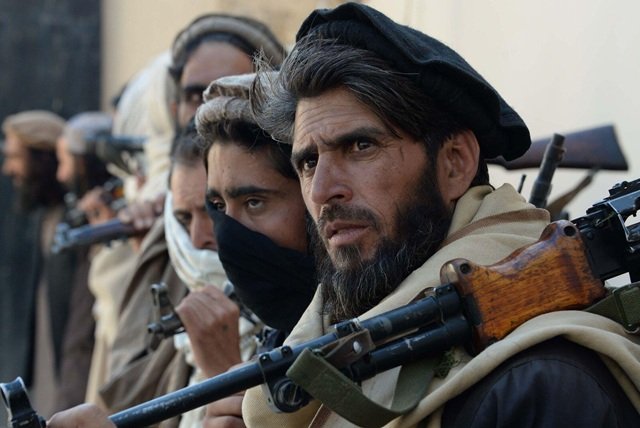
A gathering of Taliban officials and religious scholars in Kabul intended to examine the decrees of Afghanistan’s supreme leader has highlighted a contradiction at the heart of Taliban rule: the concentration of power that once reinforced the movement’s command structure may now be undermining its ability to govern.
On November 16, Interior Minister Sirajuddin Haqqani acknowledged that many Afghans disagreed with Hibatullah Akhundzada’s policies and warned against making the governing system dependent on one individual. A day later, the reclusive supreme leader made a rare appearance in Kabul, emphasizing obedience, unity and the authority of his decrees.
The contrasting messages point to more than another episode of Taliban factionalism. They illuminate a governance dilemma: ministers are responsible for administering a country whose most consequential decisions remain concentrated around a leader operating largely from Kandahar.
Five years after reclaiming power, the Taliban face a challenge that military victory could not resolve. The loyalty sustaining their political order may also be restricting the institutional flexibility needed to govern.
When loyalty becomes a liability
The four-day gathering at Kabul University was organized to examine the political, social and religious significance of Akhundzada’s decrees. More than 1,000 religious scholars, lecturers and officials attended its opening, according to Pajhwok Afghan News.
Yet Haqqani’s intervention complicated the event’s message of unity.
He cautioned against excessive personal glorification and argued that the governing system should matter more than any individual. His acknowledgment of public disagreement challenged the assumption that obedience necessarily reflects popular acceptance.
These remarks carried weight because Haqqani is no outsider. As interior minister and an influential figure within the Taliban’s security establishment, he belongs to the leadership responsible for maintaining the system he was questioning.
The following day, Akhundzada appeared at the gathering, reportedly receiving the title of Sheikh-ul-Islam from participating scholars. He defended his decrees and emphasized obedience as essential to preserving the Islamic system.
Afghanistan International reported, citing Taliban sources, that Akhundzada’s visit was intended partly to contain internal disagreements and narrow differences between the supreme leader and officials opposed to some of his decisions. The report also said he was expected to meet Haqqani and other senior figures. Those accounts have not been independently confirmed, but they add significance to the timing of his appearance.
The contrasting messages suggest different governing priorities. Haqqani emphasized institutional survival and public cooperation, while Akhundzada reinforced religious authority and loyalty.
Neither position necessarily challenges Taliban rule itself. Haqqani did not demand democratic elections or propose replacing the political order. His argument appears directed toward making that order more sustainable.
The disagreement is therefore not necessarily about who should rule Afghanistan, but how much authority one man should exercise over those responsible for governing it.
The Kandahar-Kabul divide
Recent United Nations assessments indicate that this tension extends beyond competing speeches.
A 2025 UN Monitoring Team report identified the most significant public disagreement within the Taliban as involving Akhundzada’s Kandahar base and the Haqqani network. It documented reported tensions over restrictions on female education while concluding that the movement remained largely unified and Akhundzada’s position secure.
A September 2026 UN report went further, describing Taliban governance as highly centralized, with major decisions made by Akhundzada and institutional cohesion maintained through strict loyalty.
The report offered a revealing example. Restrictions on smartphone use by officials were enforced through military courts, while exemptions required the supreme leader’s written approval. Such detailed control illustrates how decisions can remain concentrated at the top, even over matters of administrative implementation.
Kabul-based ministers must nevertheless manage economic difficulties, internal security, public services and foreign relations. Their ability to address these challenges can be constrained when major policies are determined elsewhere.
Restrictions on women’s education and employment illustrate the consequences. These policies have weakened Afghanistan’s social and economic prospects while complicating foreign engagement. Meaningful changes depend on decisions by the leadership responsible for maintaining them, rather than the preferences of individual ministers.
Haqqani’s warning can therefore be interpreted as a concern about governing effectiveness rather than a commitment to political liberalization.
His record as a senior Haqqani network commander offers little basis for portraying him as a democratic reformer. Greater ministerial autonomy would not automatically restore women’s rights, political representation or public accountability.
Nevertheless, his remarks raise an institutional question: can senior Taliban officials challenge governing decisions without being treated as disloyal?
The consequences of failing to accommodate criticism are not merely political. When officials cannot revise ineffective policies, administrative problems can persist even when those responsible for implementation recognize them.
A system that treats criticism as disobedience risks losing the capacity to correct its own failures.
Why Taliban divisions matter beyond Afghanistan
The implications extend beyond Kabul and Kandahar.
China, Russia, Iran and Central Asian governments have pursued different forms of engagement with Afghanistan, while Pakistan remains affected by cross-border militancy, trade disruptions and tensions with the Taliban authorities.
For these governments, the practical question is whether Kabul-based officials possess sufficient authority to implement negotiated commitments.
A minister may support a border-security arrangement, infrastructure project or commercial agreement. But implementation can become more difficult when consequential decisions require approval from a separate, highly centralized leadership.
This is a potential constraint, not evidence that every agreement with the Taliban is obstructed by internal disagreement.
Russia’s economic engagement with the Taliban, for example, illustrates why predictable administration matters. Trade and investment require consistent decisions, regulatory clarity and officials capable of following through on commitments.
The same challenge affects foreign efforts to influence Taliban policies on education, women’s employment and fundamental rights. Governments may develop working relationships with individual ministers without acquiring meaningful influence over decisions controlled by Akhundzada.
Yet Haqqani’s remarks do not establish an imminent leadership collapse. He has not announced an organized challenge to the supreme leader, and Akhundzada’s Kabul appearance does not prove that his authority is weakening.
Nor does acknowledgment of public disagreement demonstrate that most Afghans reject Taliban rule. Reliable nationwide public-opinion measurements remain unavailable.
The more revealing evidence will emerge from the leadership’s response.
Will ministers gain greater discretion over policy implementation? Will Akhundzada tolerate criticism from influential officials? Or will the leadership reinforce the very controls generating disagreement?
These choices will indicate whether the Taliban can accommodate internal differences without treating them as threats to political survival.
Haqqani’s intervention has brought a persistent institutional contradiction into public view. Akhundzada can demand loyalty, but loyalty cannot substitute for effective administration, credible commitments or the capacity to revise unsuccessful policies.
The Taliban’s power trap is therefore one of its own making: the tighter its supreme leader controls the system, the harder it becomes for that system to function without him.