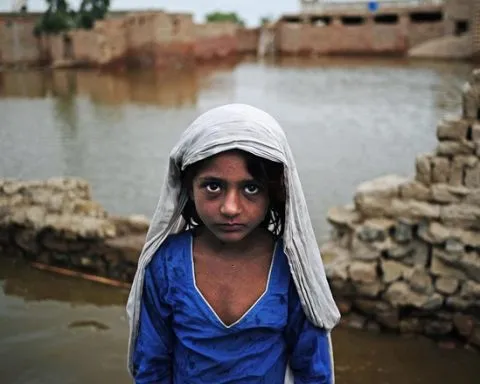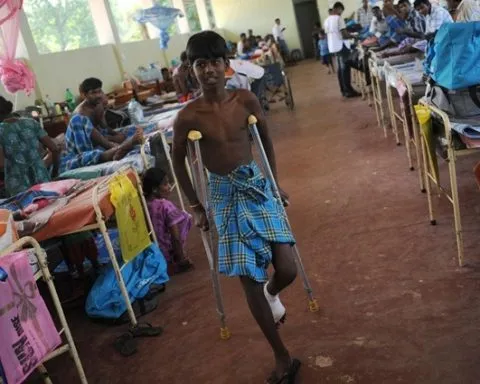
Winter approaches Gaza. For more than two million Palestinians, basic needs will continue to go unmet as rain and cold set in, placing children at particular risk while families continue to fear Israeli bombardment. As the cameras have turned elsewhere, the destruction continues to organise daily life. The United Nations Relief and Works Agency for Palestine Refugees in the Near East (UNRWA) reports that its stocks of lubricant oil for generators have been completely depleted for several weeks, that 84% of the population is experiencing frequent, unpredictable disruptions in access to safe, clean, and reliable water, and that 1.98 million people (94% of the population) require shelter and non-food-item assistance. The US attack on UNRWA, which began in 2018 under US President Donald Trump and continued under President Joe Biden, helped trigger a broader funding crisis: by the end of January 2024, fifteen states had suspended funding to UNRWA, including nine countries that together had provided more than half of the agency’s budget in 2022. Most of them later restored their support, but the United States did not. The timetable of abandonment is less important than the reality that the Palestinians in Gaza now struggle with the bare fact of survival.
The US-created Board of Peace has argued that UNRWA has no place in Gaza and that its functions can be taken up by other partners. Dangerous developments are also underway elsewhere in the UN system. The new executive director of the World Food Programme, Luke J. Lindberg, has publicly supported Israeli Prime Minister Benjamin Netanyahu during Israel’s genocide in Gaza and previously served in the Trump administration. On 20 November 2024, he wrote to Netanyahu on Instagram: ‘May your victory be absolute and unconditional’. The issue is not relief work for Palestinians alone, which is of course vital. It is the politics of UNRWA. Ismail al-Thawabta, a Palestinian official in Gaza, has rightly pointed out that dismantling UNRWA threatens the refugee question itself. UNRWA, he told Al Jazeera, was set up to preserve the international community’s continuing responsibility towards Palestine refugees and cannot simply be treated as a contractor to be replaced whenever the occupying power objects to it. The defence of UNRWA, in other words, is a defence of the legal status of Palestinians as refugees and the rights that remain unresolved, including the right of return affirmed in UN General Assembly Resolution 194 – that is, a defence of Palestinians as political subjects, not merely as recipients of aid and assistance. For those who are able, please consider supporting UNRWA’s work with a donation.
A few weeks ago, as Palestinian families tried to defend their olive groves and homes in the West Bank, I spoke to Palestinian scholars based in Ramallah. We lamented the absolute failure of the world to stop the genocide in Gaza and to pay attention to the ongoing annexation campaign in the West Bank and East Jerusalem. Our conversation also turned to Israel’s recent election, in which Palestinians living within Israel’s 1948 borders exercised the limits of their political rights by voting in historic numbers to protest against the genocide and the occupation: out of 1.159 million eligible Arab voters, almost a million went to the polls, one of the highest levels recorded in three decades. They voted for the Joint List coalition, an electoral alliance comprising Hadash (the Democratic Front for Peace and Equality, led by the Communist Party of Israel), Ta’al (Arab Movement for Renewal), and Balad (National Democratic Alliance), as well as for Ra’am (rooted in Israel’s Islamic Movement), which ran separately. Their vote provided a record 19 seats to the Palestinian-led parties in the 120-member Knesset (four more than the previous high of 15 in 2020) – nearly a sixth of the parliament. Yet despite this unprecedented representation in parliament, the major Israeli parties have refused to include the Palestinian parties in a governing coalition, exposing yet again the apartheid nature of Israel’s political system.
As we talked in Ramallah, we agreed that this historic turnout was nonetheless significant for the movement for Palestinian emancipation. We also discussed the enormous demonstrations in solidarity with Palestinians across the world (organisers estimated more than two million in Jakarta in November 2023, one million in Sana’a in January 2024, and more than one million in Rome in October 2025, for instance) and asked why such extraordinary mobilisation had been unable to stop a live-streamed genocide. Has a sense of demoralisation set in, a fatigue with the ongoing attack on Palestine? Why should those of us around the world continue our struggle for Palestine if it seems futile? Three reasons should guide us: to sustain the morale of the Palestinian people, to compel our governments to uphold the principle of Palestinian self-determination, and to demand that Palestinians have a right to politics.
Palestinian morale. Much is said of Palestinian steadfastness – sumud. Nonetheless, the relentless brutality of the Zionist occupation has taken its toll on Palestinians living under it, from the river to the sea. Colonial violence narrows the horizon of emancipation until survival occupies every waking hour and liberation appears impossible. A march in Nairobi or a refusal by dockworkers in Belgium to load military equipment bound for Israel sends a simple message across the apartheid walls: your struggle belongs to the conscience of humanity, and we will continue to act upon it.
The word ‘morale’ can easily be misunderstood. Palestinians have no obligation to perform courage for the rest of us. Exhaustion, grief, fear, and anger are human responses to unbearable conditions. We cannot admire sumud while turning it into a burden that Palestinians must carry alone; those of us around the world must also take responsibility. This means building contacts with Palestinians across lines of separation, holding institutions in our own countries accountable for complicity in the occupation and genocide, and defending the Palestinian presence in the world. When we read Palestinian literature, display Palestinian art, or teach Palestinian history, we prevent Palestine from being reduced to images of catastrophe and acquaint ourselves with the debates, humour, wisdom, and aspirations of Palestinian society. This is how we strengthen political solidarity.
Self-determination. Two things can be true simultaneously: the two-state solution can serve as a cover for permanent occupation (as I argued in 2017), and the two-state framework can preserve the international commitment to prevent the annexation of the territory envisaged for a future Palestinian state. For the multilateral system to abandon the idea of Palestinian statehood would hand Israel a political victory, removing a major international obstacle to its permanent seizure of East Jerusalem, Gaza, and the West Bank. Of course, Palestinian rights do not depend on diplomatic vocabulary. But the International Court of Justice’s July 2024 advisory opinion, which declared Israel’s continued presence in the Occupied Palestinian Territory unlawful, also explicitly affirmed the Palestinian people’s right to self-determination, including their right to an independent and sovereign state living alongside Israel.
A declaration supporting two states must carry consequences: recognition of Palestine, opposition to annexation, action against trade with Israeli settlements, and an end to military assistance that sustains occupation. Our governments cannot profess their support for Palestinian independence at the United Nations and then help finance the machinery that makes independence impossible. It is within this contradiction that pro-Palestinian politics can intervene.
Palestinian politics. For decades, the Israeli state has tried to suppress the possibility of Palestinian politics by assassinating and imprisoning Palestinian leaders, designating Palestinian political and civil society organisations as ‘terrorist’, and restricting Palestinians’ freedom of association and assembly. The Israeli prison system has long served as an instrument directed against Palestinian political organisation, with senior leaders such as Marwan Barghouti and Ahmad Sa’adat imprisoned by Israel for a quarter of a century.
That is why the Political Rights for Palestinians campaign by the International Peoples’ Assembly is so crucial. I highly recommend reading and circulating the materials from this campaign, but this paragraph is particularly striking:
The occupation seeks to prevent prisons themselves from becoming sites of revolutionary organisation. The use of solitary confinement, constant transfers, bans on communication, and repression of internal prisoner committees reflects a deep fear: that even under conditions of captivity, Palestinians continue to organise. The long intellectual and political legacy of prisoners such as Walid Daqqa, who turned decades of incarceration into a space of radical thought and writing, exposes the failure of the prison to fully extinguish political life.
A people who are denied a political life are then presented to the world as a humanitarian problem that awaits administration. We must reject this framework. Reconstruction requires Palestinian political authority and popular participation. Freedom for political prisoners, protection for organisers, and the ability to build independent institutions belong at the centre of any serious struggle for peace.
We wrap ourselves in keffiyehs and march with flags and signs to demand Palestinian self-determination and to affirm our own humanity. The Palestinian people have the right to remain, to return, to govern themselves, and to imagine a future beyond the ruins. Our solidarity must help keep that future open.
Recently, I was talking to Roger Waters about ‘Comfortably Numb Re-imagined’, his collaboration with Palestinian singer-songwriter Mona Miari. The proceeds from the song go to the Palestine Children’s Relief Fund – another way to turn solidarity into material support. The song includes the line ‘Time to draw a new line in the sand’. So here are the lines I would inscribe in that sand, from me to you:
The nations meet. The broken bread is shared.
No veto stills the hungry in their claim.
The terms of peace are drafted by the scarred.
The dead are called, each by their living name.
And Palestine takes up its rightful seat,
Its children name the trees and fields again.
No charter lives while tanks command the street.
No peace takes root beneath the bomber’s reign.