A recent feature in New Scientist takes readers on an imaginative journey through the most remarkable events in the history—and future—of our solar system. From its violent birth to its distant, star-lit demise, the article highlights six transformative episodes that have shaped the planets, moons, and the Sun itself.
The story begins 4.5 billion years ago in a stellar nursery, where a nearby supernova likely triggered the formation of our Sun and its surrounding protoplanetary disc. This early chaos set the stage for the creation of planets, including the gas giants whose rapid growth has long puzzled scientists. Observing the process from a hypothetical “time machine” would reveal the turbulent clumping of dust and gas into worlds—an epic beginning to our cosmic neighborhood.
About 3.9 billion years ago, the Moon endured a potential bombardment of asteroids during a period known as the Late Heavy Bombardment. While recent research questions the scale of this celestial assault, its effects could explain dramatic planetary shifts, such as Uranus’s extreme axial tilt. This era may also have set the stage for life on Earth, with microbial organisms emerging shortly after the bombardment subsided.
The feature then transports readers to Mars 3.5 billion years ago, when rivers, lakes, and seas may have existed on the Red Planet’s surface. The presence of water raises tantalizing possibilities about early Martian life and hints at how life might arise elsewhere in the galaxy.
Looking forward, the article explores Saturn’s rings 100 million years from now. Due to “ring rain,” the planet’s iconic rings are expected to largely disappear, while Mars may develop a temporary ring system as its moon Phobos breaks apart. Eventually, simulations suggest that Mercury could face catastrophic orbital instability due to a close stellar flyby, a potential prelude to dramatic changes across the inner solar system.
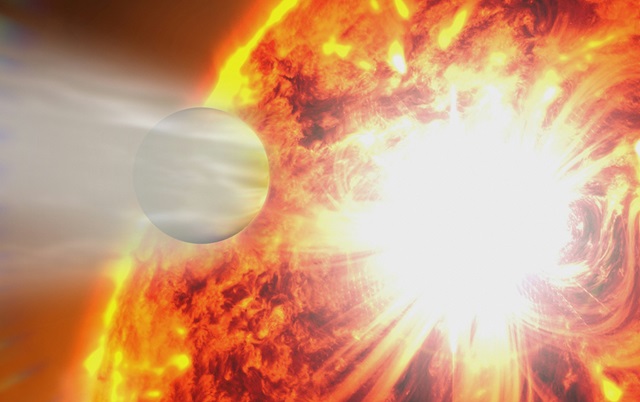
The final chapters of the solar system’s story occur billions of years in the future. In about 5 billion years, the Sun will expand into a red giant, engulfing Mercury and Venus and rendering Earth a scorched, vaporized world. Meanwhile, icy moons such as Europa and Enceladus may become habitable, offering new frontiers for life as the inner planets burn. Eventually, the Sun will shrink into a white dwarf, and the remaining planets will settle into altered orbits, bringing the solar system full circle.
New Scientist’s feature blends current scientific understanding with imaginative time travel, giving readers a vivid perspective on the past, present, and future of our solar system. As the article concludes, while humanity may never witness these distant epochs firsthand, studying them deepens our understanding of planetary evolution, habitability, and the delicate dance of worlds around our Sun.