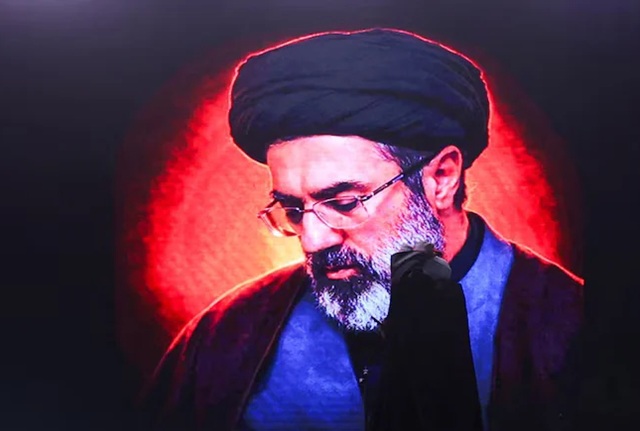
Iran’s leadership has retreated into the shadows, with its newly installed supreme leader, Ayatollah Mojtaba Khamenei, reportedly governing through a clandestine web of couriers while recovering from devastating injuries. As the war drags into its third month, the opaque structure of command in Tehran is raising new questions about who truly holds power, complicating already fragile peace negotiations and fueling speculation abroad about instability at the top.
According to reporting cited by Times UK, Mojtaba Khamenei, 56, has not appeared in public since the airstrike that killed his father, Ayatollah Ali Khamenei, on the opening day of the conflict. The same attack claimed the lives of his wife Zahra and his teenage son Mohammad Bagher, marking a deeply personal and political rupture for Iran’s ruling establishment. Though he survived, Mojtaba Khamenei was left seriously wounded, suffering burns to his face and injuries that reportedly require a prosthetic leg and extensive reconstructive surgery.
These injuries have not only limited his physical mobility but have also constrained his ability to communicate. Reports indicate that speaking is difficult for him, contributing to his absence from public view and necessitating an unusual and highly secretive method of governance. Rather than appearing before officials or addressing the nation, Khamenei is said to issue orders via sealed handwritten messages, transported by a network of trusted couriers using cars and motorbikes. These messages traverse the country in a deliberate effort to evade surveillance by the United States and Israel, both of which Tehran fears could attempt to assassinate its new leader.
Once delivered, the orders are disseminated through the same circuitous channels, creating a slow and fragmented system of communication. The result is a leadership structure that appears increasingly decentralized, with critical decisions often delegated to senior commanders within the Islamic Revolutionary Guard Corps. These generals, hardened by years of conflict and deeply embedded in Iran’s military framework, have reportedly taken on a central role in shaping the country’s strategic direction, particularly regarding negotiations and military operations.
The absence of direct contact between Khamenei and these commanders underscores the extent of the security concerns. Even high-ranking officials are not permitted to meet him in person, out of fear that his location could be compromised. This isolation has fueled speculation within Iran and internationally about the true balance of power within the regime.
In Washington, President Donald Trump has seized on these developments as evidence of disarray. Publicly, he has portrayed Iran’s leadership as fractured and uncertain, suggesting that internal divisions between hardliners and so-called moderates are contributing to the deadlock in peace talks. His statements have emphasized what he describes as confusion over leadership, framing the situation as a regime struggling to define its future direction.
Yet the reality appears more complex. While political rivalries may exist, the growing influence of military commanders suggests a consolidation of authority rather than outright fragmentation. These figures, entrusted by Khamenei himself, are making key decisions, including whether to reopen the strategically vital Strait of Hormuz, a critical artery for global energy supplies.
The ongoing naval tensions in the region highlight the stakes. Iran’s renewed attacks on commercial shipping have escalated fears of broader disruption, even as the United States maintains a tight grip on maritime access. The Strait of Hormuz has effectively become a pressure point in the conflict, with both sides leveraging control as a bargaining chip in stalled negotiations.
Efforts to revive diplomatic talks have so far faltered. In a sign of Washington’s urgency, Vice-President JD Vance’s plane reportedly remained on standby for hours as officials attempted to confirm whether negotiations in Pakistan would proceed. Ultimately, Iran boycotted the talks, insisting on the lifting of a naval blockade before any discussions could resume. The move underscored the challenges of negotiating with a leadership that is both physically hidden and operationally diffuse.
For the Trump administration, the prolonged conflict is becoming a growing political liability. Early predictions that the war would conclude within weeks have given way to a more uncertain reality, with rising fuel prices and declining poll numbers adding pressure ahead of midterm elections. The need for a diplomatic breakthrough is increasingly urgent, yet the path forward remains unclear.
At the center of this uncertainty is Mojtaba Khamenei himself, a leader who is simultaneously present and absent. His authority is undisputed in theory, but in practice, it is filtered through layers of intermediaries and constrained by his physical condition. The image of a supreme leader issuing handwritten orders from an undisclosed location stands in stark contrast to the traditional perception of centralized power in Iran.
This unusual arrangement raises broader questions about the resilience of the country’s political system. Can a state built on tightly controlled hierarchies function effectively when its top leader is unable to engage directly with his government? Or does the rise of military leadership signal a shift that could redefine Iran’s governance in the long term?
For now, the war continues, and so does the uncertainty. Negotiations remain stalled, military tensions persist, and the true extent of Khamenei’s control remains obscured. As Times UK reporting suggests, the challenge for outside observers—and for those within Iran—is not just understanding what decisions are being made, but who is truly making them.