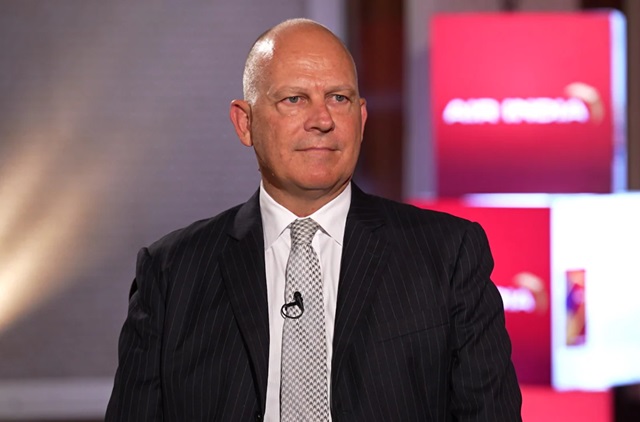
Air India Ltd.’s path to profitability is facing renewed headwinds as Pakistan continues to block Indian airlines from using its airspace, adding significant flight times for long-haul operations. In an interview with Bloomberg TV on Monday, Air India CEO Campbell Wilson confirmed the impact is “significant” and will affect the airline’s bottom line, even as the carrier maintains its non-stop services to key destinations across North America and Europe.
“The impact is significant but we have been able to sustain non-stop operations,” Wilson told Bloomberg, adding, “It’ll certainly hit our bottomline.”
The airspace restrictions have led to increased flight durations—by about an hour on west-bound routes from India—raising operational costs for the Tata Group-owned airline. Wilson declined to elaborate on discussions with stakeholders regarding the ongoing curbs.
The ban follows a dramatic escalation of hostilities between India and Pakistan, sparked by a deadly civilian attack in Indian-controlled Kashmir on April 22. The conflict that erupted on May 7 was the worst between the nuclear neighbors in decades, involving drone and missile strikes, artillery, and small arms fire. Though a ceasefire was reached on May 10, Pakistan has extended the airspace closure for Indian airlines until at least June 24.
Geopolitical tensions such as these have increasingly disrupted global aviation, forcing airlines to reroute flights around conflict zones and reconsider investment strategies. “We want certainty. Uncertainty is difficult when you are making investment decisions,” Wilson said, noting that such concerns were prevalent at an aviation summit underway in New Delhi.
So far, Wilson indicated that international travel demand remains resilient, with no significant drop due to trade tariffs affecting Air India’s core markets. However, he acknowledged emerging complications in global travel, including education-linked mobility. Referring to rising tensions between U.S. President Donald Trump’s administration and American academic institutions like Harvard University, Wilson said that some Indian students are starting to consider alternatives to studying in the U.S.
“You hear people thinking of alternatives,” Wilson said. “It does seem that people are more willing to look at alternative locations than perhaps they were before.”
On the business front, Wilson—who oversaw the high-profile merger of Air India and Vistara in 2024—declined to comment on reports that the airline is in talks to purchase more narrowbody aircraft. However, he confirmed that Air India will begin receiving new planes from its existing order book by the end of this year.
“The deliveries are later than we hoped, slower than we hoped,” Wilson admitted. “It is constraining our ambitions a little bit in the short term but the long term opportunity for this market is massive, so we are very, very confident.”
Air India, which was acquired from the Indian government by the Tata conglomerate in 2021, has been aggressively pursuing modernization and expansion. Yet, with geopolitical uncertainties mounting and operational challenges persisting, its journey toward profitability remains a complex one.