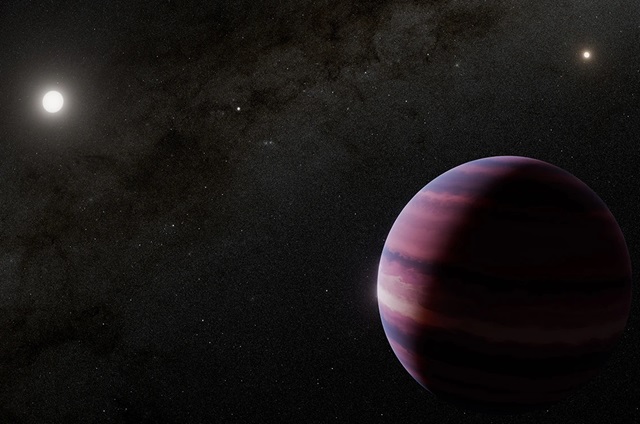
Astronomers have captured a tantalizing glimpse of a planet orbiting within the habitable zone of Alpha Centauri A — the nearest star system to Earth — potentially setting a new record for the closest orbit ever directly imaged. The discovery, reported in recent scientific papers and covered in Nature, is generating excitement about the possibilities for future studies of nearby exoplanets.
The faint, smudgy gas giant was spotted using the James Webb Space Telescope’s (JWST) Mid-Infrared Instrument (MIRI), which employed a coronagraphic mask to block out the overwhelming glare of Alpha Centauri A. This technique enabled researchers, led by Aniket Sanghi of Caltech, to detect the planet despite its close proximity to its bright host star.
Direct imaging of exoplanets is notoriously difficult, especially when a planet lies near the star’s habitable zone—the “just right” range of distances where liquid water might exist on a planet’s surface. Most exoplanets are instead found through indirect methods, such as measuring the wobble of a star caused by orbiting planets. The Alpha Centauri system, only 4 light years from Earth, has been studied extensively with such techniques, but direct visual evidence of planets there has been elusive.
“We couldn’t believe what we saw,” said Sanghi. “I had to take a moment of silence to appreciate what I was seeing.” The team spent about a year carefully reanalyzing the data to ensure the faint light wasn’t an artifact or distorted starlight—and the signal remained consistent.
While the newly spotted gas giant is unlikely to host life itself, the discovery opens exciting new possibilities. “It does open the exciting possibility of evaluating the moons around this planet for habitability,” Sanghi noted.
Experts, including Jason Wang of Northwestern University, caution that more detailed observations are needed to confirm the planet’s existence and better understand its characteristics. The researchers plan to use JWST for follow-up imaging to verify their findings.
If confirmed, this would be the first-ever planet directly imaged within the habitable zone of its star, marking a major milestone in the search for worlds that might support life.
This breakthrough, highlighted in Nature, underscores the unprecedented capabilities of JWST and heralds a new era in exoplanet exploration, bringing us closer to understanding our cosmic neighborhood.