A groundbreaking study by the University of Portsmouth has revealed that great apes can mirror each other’s facial expressions with remarkable precision, offering new insights into the evolutionary roots of human communication. Published in Scientific Reports, the research shows that both orangutans and chimpanzees replicate subtle facial movements in ways previously thought to be uniquely human.
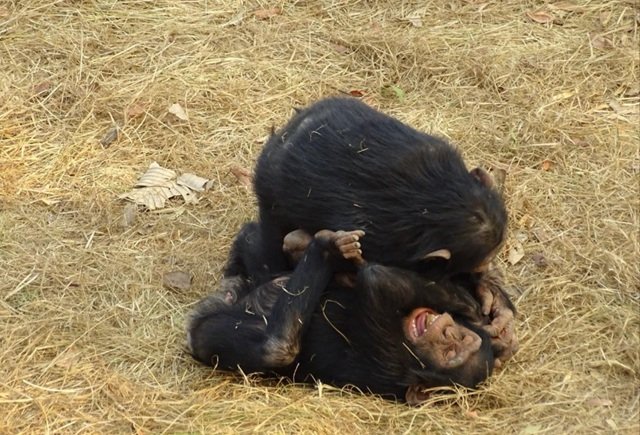
The study examined 96 great apes, including 39 orangutans and 57 chimpanzees, across eight social groups of varying ages and genders. Researchers focused on how these primates mimicked “laugh faces” during social interactions, comparing their behavior to the human Duchenne smile. The findings revealed that apes not only mimic expressions quickly—often within three seconds—but also replicate the exact facial movement patterns used by their social partners.
Scientists observed that apes were more likely to mirror expressions when the upper teeth were not exposed, suggesting a preference for gentler social signals. This precise mimicry plays a role in enhancing social understanding, helping individuals interpret emotions and anticipate behavior. The research also found that orangutans demonstrated greater accuracy in mirroring expressions during longer play sessions, indicating a link between social engagement and communicative precision.
Lead author Diane Austry described the findings as remarkable, noting that apes reproduce exact facial movements rather than general expressions. Co-author Marina Davila Ross emphasized that such explicit replication had not previously been documented across great apes, adding that both chimpanzees and humans use similar facial muscles to produce laugh expressions, highlighting a shared biological foundation.
The study also uncovered behavioral differences between species. Chimpanzees appeared to avoid mimicking exposed teeth in certain contexts, possibly to prevent signaling aggression or risky play, particularly when interacting with dominant individuals. This suggests that facial mimicry in apes is not only precise but also socially strategic.
The orangutans involved in the research were based at the Sepilok Orangutan Rehabilitation Centre, while the chimpanzees were observed at the Chimfunshi Wildlife Orphanage. Researchers say future studies will explore how these expressions function beyond play, pointing to broader implications for understanding emotional communication and its deep evolutionary origins.