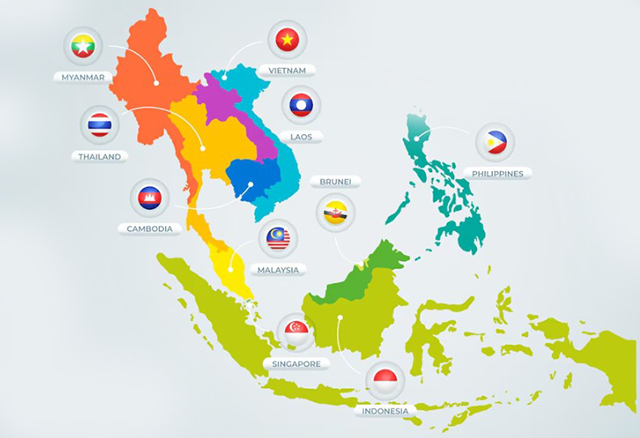
The Association of Southeast Asian Nations (ASEAN) faces renewed scrutiny over its relevance and effectiveness amid escalating tensions between Thailand and Cambodia, as experts warn of a serious blow to the bloc’s already fragile credibility if it fails to de-escalate the situation. Citing a report by the South China Morning Post, analysts say the recent border skirmish and a politically damaging phone call leak could unravel fragile regional cohesion and spark broader instability.
The crisis erupted after a deadly clash on May 28 left one Cambodian soldier dead, marking the first fatal border flare-up between the two countries since 2011. Tensions further intensified when a leaked recording revealed an informal conversation between Thai Prime Minister Paetongtarn Shinawatra and former Cambodian leader Hun Sen. In the call, Paetongtarn referred to Hun Sen as “uncle” and dismissed the authority of a Thai military commander as someone who “just wants to look cool,” insisting that Thailand seeks peace. The leak triggered a political backlash in Bangkok, costing Paetongtarn a key coalition partner and exposing deep concerns over her perceived subservience to Cambodia’s political elite.
Experts quoted by the South China Morning Post warn that if ASEAN fails to respond decisively, it risks further diminishing its stature following already heavy criticism over its handling of the Myanmar crisis. Abdul Rahman Yaacob of the Lowy Institute said a full-blown border war would be disastrous for ASEAN’s image as a conflict-resolution body. “The regional organisation is already under fire for being perceived as not effective in dealing with the Myanmar crisis,” he noted.
Despite ASEAN’s longstanding role in preventing conflict among its members, structural limitations, diverging national interests, and historical animosities have hampered its capacity to mediate. The current rift between Thailand and Cambodia highlights these limitations. While Cambodia has sought resolution through the International Court of Justice (ICJ), Thailand has rejected the court’s jurisdiction, insisting instead on bilateral negotiations.
Kei Koga of Nanyang Technological University warned that the bloc’s internal divisions—spanning issues from Myanmar and the South China Sea to the broader US-China rivalry—are making unity increasingly difficult to maintain. “This situation could create the diplomatic impression that ASEAN is continuing to weaken,” Koga said.
Cambodian analysts argue that their country’s appeal to the ICJ reflects a desire for legal clarity rather than confrontation. “It’s about seeking legal clarity, not confrontation,” said Chhay Lim of the Royal University of Phnom Penh. Cambodia previously secured a ruling in its favour from the ICJ in 1962 over the ownership of the Preah Vihear temple, which remains a sensitive flashpoint along the border.
Thailand’s resistance to international arbitration and insistence on bilateral solutions reflects a broader distrust in ASEAN’s mechanisms, said Purawich Watanasukh of Thammasat University. “ASEAN is not a mechanism that either Thailand or Cambodia fully relies on,” he told This Week in Asia, a publication of the South China Morning Post.
Despite the tensions, some regional leaders are taking steps to prevent escalation. Malaysian Prime Minister Anwar Ibrahim, in his capacity as ASEAN chair, has spoken with the leaders of both countries and urged restraint. While his efforts were described as a “timely and important gesture,” observers like Him Rotha of the Cambodian Centre for Regional Studies stressed that true progress requires moving beyond symbolic actions. “At best, ASEAN could only convene the two parties to have a dialogue and rebuild trust and confidence,” Him said.
The leaked call itself has become a flashpoint of distrust. From Cambodia’s perspective, Paetongtarn’s call may have lacked substance and failed to demonstrate a clear commitment to restraint. As Koga explained, “the issue has become one of trust, with both sides finding it difficult to back down publicly.”
Still, analysts remain hopeful that quiet diplomacy can help ease tensions. Rahman suggested that Malaysia may already be engaging both sides behind the scenes. For ASEAN, the current crisis is not just a test of its conflict-resolution mechanisms but a pivotal moment to prove that smaller states can rely on the bloc for meaningful mediation.
“If ASEAN succeeds here, it can preserve its role as a neutral platform for regional diplomacy,” said Him. “If not, its relevance will continue to erode in the eyes of its own members.”