In a groundbreaking development that could redefine humanity’s understanding of life in the universe, a team of international astronomers has uncovered what they describe as the strongest evidence yet of biological activity beyond Earth. The findings, based on data from NASA’s James Webb Space Telescope, suggest that a distant planet, K2-18b, may be teeming with microbial life beneath its vast ocean.
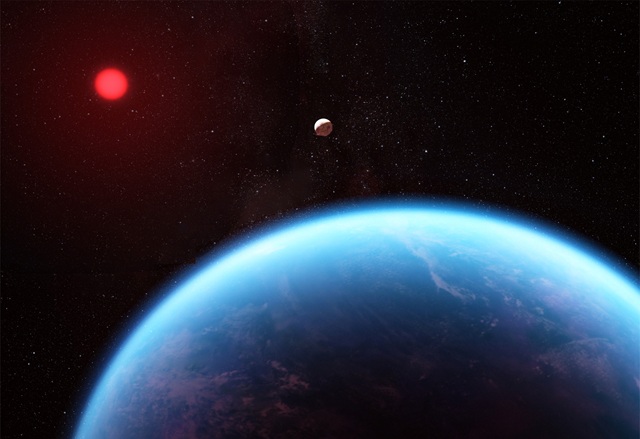
As reported by the Financial Times, the research team, led by Professor Nikku Madhusudhan from the University of Cambridge, identified high concentrations of organic molecules in the atmosphere of K2-18b — a water-covered exoplanet located 124 light years away in the constellation Leo. These molecules, including dimethyl sulphide (DMS) and dimethyl disulphide (DMDS), are produced on Earth exclusively by living organisms, primarily marine phytoplankton.
“Given everything we know about this planet, a world with an ocean that is teeming with life is the scenario that best fits the data,” said Madhusudhan, noting that the chemical signature observed cannot currently be explained by any known non-biological processes.
K2-18b belongs to a rare class of exoplanets known as Hycean worlds — planets that possess both a hydrogen-rich atmosphere and liquid water, existing within a temperature range suitable for life. This makes them prime targets in the ongoing search for habitable environments beyond our solar system.
The new data builds on tantalizing signals first detected in 2023, when the James Webb Space Telescope revealed the presence of methane and carbon dioxide in the planet’s atmosphere. This marked the first time carbon-based molecules had been observed in the atmosphere of a potentially habitable exoplanet. The latest analysis, conducted using two independent instruments aboard the telescope, has now revealed even more complex organic compounds.
While the scientists stopped short of claiming definitive proof of alien life, the implications of the findings are profound. “It’s important that we’re deeply sceptical of our own results,” Madhusudhan said, emphasizing the need for rigorous verification. “Only by testing and testing again will we be able to reach the point where we’re confident in them.”
The discovery has drawn cautious optimism from other experts in the field. “This paper is another step in the right direction on the very long road to an announcement that we have discovered life elsewhere,” said Dr. Dave Clements, astrophysicist at Imperial College London. Robert Massey, deputy director of the Royal Astronomical Society, added, “Even the remote chance that we’ve found evidence for an ocean full of bugs on a planet 124 light years away is an incredible thought.”
The researchers hope further studies will either confirm the biological origin of the molecules or provide alternative explanations. However, direct imaging of K2-18b remains out of reach for current and near-future telescopes, due to its distance and proximity to its host star.
Since the discovery of the first exoplanets three decades ago, astronomers have catalogued more than 5,800 worlds beyond our solar system. While K2-18b now stands out as a compelling candidate for life, other promising prospects remain under investigation — both in distant star systems and closer to home, such as the suspected subsurface oceans of Jupiter’s and Saturn’s moons.
Two upcoming missions, the European Space Agency’s Jupiter Icy Moons Explorer and NASA’s Europa Clipper, are set to further explore these icy worlds in the early 2030s.