by Nil
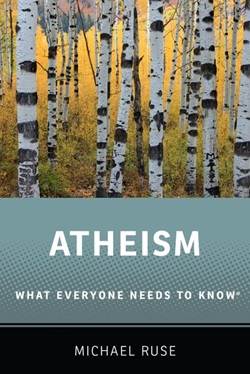
Michael Ruse’s Atheism: What Everyone Needs to Know is not merely a survey of nonbelief—it is a crucial intervention in an era where artificial intelligence, misinformation, and ideological manipulation shape our understanding of truth. Ruse, who passed away last November, meticulously traces atheism’s evolution from the ancient Greeks to the present day, dismantling religious dogmas while exposing the moral and philosophical weight of disbelief. His work is more than an academic exercise; it is a battle cry against complacency. In a world where AI curates religious content, shapes public discourse, and even generates theological arguments, Atheism is vital reading. It forces us to ask: Are we constructing our own gods, or are they being constructed for us?
Ruse’s historical sweep is ambitious. He reminds us that “atheism is not a modern invention; it is as old as belief itself” (p. 9). He resurrects figures like Socrates, who was executed partly for “corrupting the youth” with ideas that questioned the divine order. This is eerily relevant today. AI models, designed to reinforce prevailing ideologies, could soon serve as digital inquisitors, shaping and censoring discussions on religion and belief. If Socrates were alive today, would he be silenced not by hemlock but by an algorithm?
Ruse traces the trajectory from the Greek skeptics to the Enlightenment, where thinkers like Diderot and d’Holbach openly declared their atheism. He notes, “Diderot saw religion as the last refuge of tyranny” (p. 27), a statement that gains terrifying relevance in an age where religious fundamentalism and authoritarianism merge seamlessly with digital surveillance. If governments and corporations use AI to reinforce religious ideologies—whether through selective information dissemination or AI-driven censorship—what does this mean for freethought?
One of Ruse’s most powerful sections deals with science’s role in dismantling religious narratives. He writes, “Darwin did not kill God, but he certainly made belief in Him unnecessary” (p. 53). This argument is more urgent than ever. AI, trained on vast datasets, now crafts theological arguments, generates sermons, and even debates the existence of God. But is this intelligence or mere mimicry? The same AI that defends Christianity today could, with a different dataset, advocate atheism tomorrow. Ruse warns, “Religion adapts to survive, and so must atheism” (p. 83). In a world where AI can generate religious experiences, from virtual reality pilgrimages to AI-generated sacred texts, the challenge is not just to reject theism but to recognise its evolving strategies of persuasion.
Ruse is adamant that atheism is not merely an absence of belief but a moral stance. He echoes William K. Clifford’s argument that “it is immoral to believe something without sufficient evidence” (p. 100). This is a direct challenge to AI-driven misinformation. If belief is now being shaped not by personal reflection but by algorithmic reinforcement, then the ethical imperative of atheism—demanding evidence, resisting dogma—becomes even more pressing.
Yet, Ruse is no naïve cheerleader for atheism. He acknowledges the existential void that disbelief can create: “If God does not exist, does anything matter?” (p. 228). This is not a rhetorical question but a profound challenge. AI cannot answer this. If anything, AI exacerbates the problem, reducing human experience to patterns and probabilities, stripping meaning from existence. If atheism is to offer a compelling alternative to religion, it must grapple with this void, offering not just negation but new ways of finding purpose.
Perhaps the most urgent takeaway from Ruse’s work is that atheism must evolve to counter new threats. Just as religion has adapted to survive in every era, so too must nonbelief. AI, with its capacity to shape ideology, can reinforce dogma as easily as it can dismantle it. Ruse’s book is a reminder that atheism is not just about rejecting God but about defending intellectual autonomy. “To be an atheist is to be permanently in rebellion against imposed meaning” (p. 253). In a world where meaning is increasingly algorithmically determined, this rebellion is more necessary than ever.