
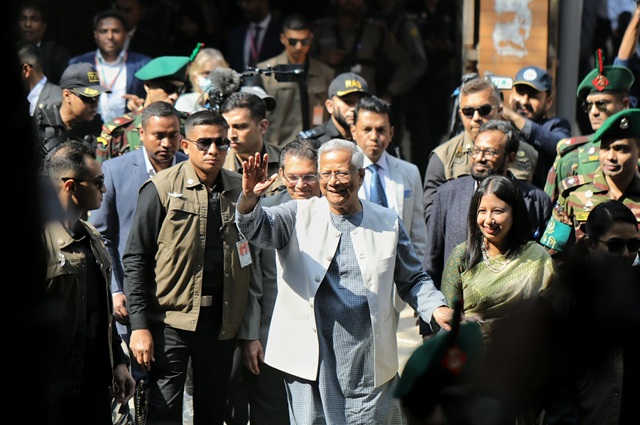
Bangladesh has never been a nation to bow quietly to usurpation. Born in 1971 in a bay of blood, forged through unimaginable sacrifice, it rose as a beacon of resilience, courage, and the unyielding spirit of self-determination. Yet, the recent national polls have cast a long, dark shadow over this hard-won legacy. Conducted under the auspices of an illegitimate marionette government led by Muhammad Yunus—a regime that has been installed and orchestrated by the American deep state and the CIA for their geopolitical and economic advantages—the election, held on 12 February 2026, was a mockery of the democratic process. This is a stark reminder that the sovereignty of Bangladesh is never to be taken for granted.
From the outset, the exercise was steeped in illegitimacy. The country’s largest and most historically consequential political party, Bangladesh’s founding political party, the Awami League, was deliberately excluded, rendering any claim to a broad public mandate patently hollow. From my personal visits to many polling stations, I can testify that voter turnout plummeted to historic lows, a visible testament to public rejection and disenchantment. Where the machinery of the state was meant to facilitate choice, it instead constructed the illusion of consent. The polls, by design or by convenience, served the interests of external actors seeking to mold Bangladesh’s political future into a pliable instrument of foreign policy and economic extraction.
Yet Bangladesh is a nation tempered by struggle and enlightened by history. The blood of 1971 does not permit passive acquiescence to marionette rulers. The people’s memory is long, their courage enduring. This election, far from cementing authority, has illuminated the depth of the betrayal and the urgency of reclaiming the country’s political soul. What was intended as a legitimizing spectacle should instead be cast into the dustbin of history, treated as an aberration, and repudiated with the decisiveness it deserves.
The path forward is clear. Bangladesh must act swiftly to restore its institutions, reassert the supremacy of the Constitution, and ensure that governance emerges organically from the will of its citizens rather than the dictates of foreign power. The puppet government under Dr. Yunus represents not only a threat to democratic norms but also a destabilizing force in the region. Its continuance risks entrenching corruption, enabling unaccountable policies, and undermining the nation’s development trajectory—an intolerable outcome for a country whose independence was bought with unimaginable sacrifice.
Reclaiming Bangladesh’s sovereignty requires more than mere protest; it demands unity, vigilance, and deliberate action. Civil society, political leadership, and the citizenry must coordinate to dismantle the structures of illegitimate authority and restore faith in democratic institutions. International support should be welcomed only insofar as it respects Bangladesh’s autonomy, never as a substitute for it. The nation’s revival must be driven from within, guided by the principles of justice, equality, and national dignity.
This moment, while perilous, also carries the promise of renewal. The people of Bangladesh have always been capable of remarkable resilience. The same courage that fueled the Liberation War in 1971 can now ignite the reclamation of the nation’s destiny. By rejecting the imposed façade of legitimacy and demanding accountable, transparent governance, Bangladesh can reclaim its rightful place as a sovereign, proud, and independent state—a country that honors the blood of its martyrs and the aspirations of its youth.
History will judge this period not by the orchestrated theatrics of an illegitimate administration and unlawful election, but by the courage of a nation that refused to submit to manipulation. Bangladesh, tempered by blood and forged in struggle, will rise again in haste—restoring democracy, dignity, and the sanctity of its sovereignty. What was attempted as subjugation will become the catalyst for renewal, and the marionette government of Dr. Yunus will be remembered only as a brief, ignoble interruption in the march of a proud nation toward its rightful destiny.