There are moments when a nation’s resolve is tested not by what it says, but by what it is willing to endure and still stand firm. The events of the past four days in Balochistan, laid bare in painstaking, somber detail by the DG ISPR Lieutenant General Ahmed Sharif Chaudhry on 08 July 2026, are exactly such a moment and by any honest reading of the facts, Pakistan’s armed forces and its police have responded with a discipline, restraint, and sacrifice that deserves the nation’s full support, not its second-guessing.
A Brutal Few Days, Met with Extraordinary Sacrifice
Consider what actually happened. In Babrai, ordinary villagers, not soldiers, not trained fighters, took up the fight themselves against Fitna-al-Khawarij militants and drove them out of their homes. That is not an accident of circumstance; it is the product of years of the state building trust and resolve among the very communities the terrorists hoped to terrorize into submission. Four civilians paid with their lives. Six more were wounded. And still, the terrorists were routed.
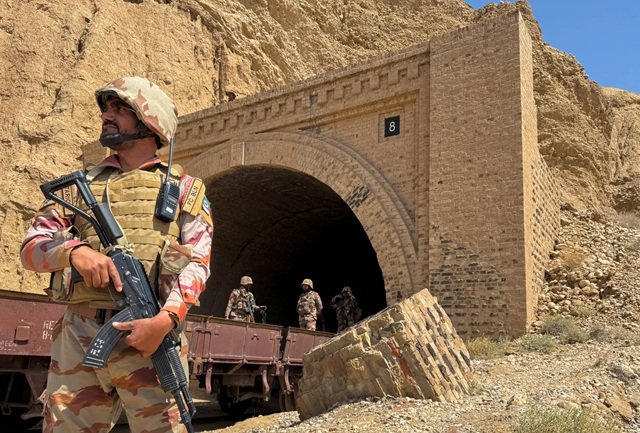
Then came Mangi Dam, arguably the most gut-wrenching episode of the entire ordeal. A police check post, manned by young Baloch men defending nothing more sinister than a water pipeline that keeps Quetta alive, was besieged by a multidirectional terrorist assault. Nine officers died fighting. The survivors were taken hostage. What followed was not a rushed, reckless rescue attempt that might have gotten more of them killed, it was a deliberate, days-long encirclement, conducted with such care that commanders explicitly avoided aerial assets to protect the hostages’ lives. When the terrorists realized the noose had tightened beyond escape, they murdered all eighteen of their captives in cold blood. That single fact should silence any argument that this is a conflict between equals, or a grievance with two legitimate sides. One side lays down its life protecting a water pipeline for its own people. The other executes handcuffed hostages.
Add to this the ambush on an army convoy in Bela, Bandar, where eleven more soldiers, including a JCO, gave their lives, and back-to-back operations in Kharan and Dalbandin that eliminated more militants. By the end of it: 42 Pakistanis martyred, and 54 terrorists killed in return. These are not abstract statistics. They are the price ordinary Pakistani families paid this week for daring to live, work, and drink water in their own province.
The Restraint Deserves Recognition
What is striking, and too often overlooked by critics of the security establishment, is the degree of professionalism on display even in the heat of active hostage crises. The decision to avoid airstrikes near captured policemen, despite the operational advantage air power would have offered, reflects a force that values the lives of its own people over quick, headline-grabbing victories. This is not the behaviour of an institution acting with impunity; it is the behaviour of one bound by rules of engagement that prioritize its citizens even at tactical cost to itself.
The Regional Picture Cannot Be Ignored
The DG ISPR’s briefing also pointed to an uncomfortable but necessary truth: these attacks did not spring from nowhere. The claim that facilitation, manpower, and planning trace back to Afghan Taliban-controlled territory, reinforced by the fact that three of four attackers in a recent Karachi Rangers workshop assault were Afghan nationals, is not a convenient scapegoat. It is a pattern that has repeated itself across multiple incidents, in multiple locations, with a consistency that argues against coincidence. A state has every right, indeed, every obligation, to name the source of a threat when its own citizens are dying because of it, rather than pretend the violence is spontaneous.
Balochistan’s Prosperity Is the Real Target
It is worth sitting with the argument the DG ISPR made about motive: that Balochistan’s development, its water infrastructure, its economic potential, its stability, is precisely what these terrorist networks cannot tolerate. A prosperous, secure Balochistan undermines every narrative these groups depend on to justify their violence and recruit new fighters. That the province’s own Chief Minister traveled by road into the conflict zone to stand beside his police and soldiers is a powerful rebuttal to any suggestion that this is a war being waged against Balochistan, rather than for it.
A Justified Line in the Sand
When the DG ISPR declared that Pakistan would “hunt” and “hurt” those responsible “everywhere,” and that no “rationality or professionality” should be expected in the face of attacks on children, police, and innocent citizens, this was not bluster. It was a plain statement of what any nation owes its people when eighteen hostage policemen are executed in the mountains, when convoys are ambushed, when water infrastructure meant to serve millions is used as a killing ground. A state that did not respond with total resolve in the face of this would be failing its most basic duty to its citizens.
Pakistan’s armed forces, Frontier Corps, and police did not choose this fight. They are, however, choosing to win it, with restraint where restraint is possible, and with overwhelming force where it is necessary. That is exactly what the moment demands, and exactly what the nation should stand behind.