
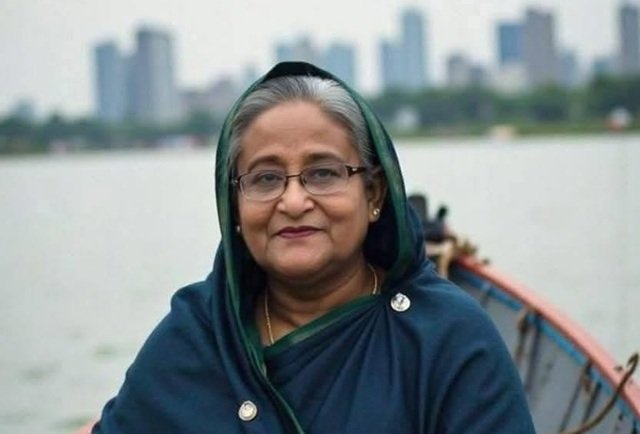
History occasionally produces leaders whose influence transcends the confines of political office and becomes inseparable from the national consciousness itself.
Such figures are remembered not merely for the authority they wielded, but for the ideals they embodied, the resilience they displayed, and the indelible imprint they left upon the destiny of their nations.
For countless Bangladesh’s mass people, Sheikh Hasina represents precisely such a figure—a stateswoman whose political journey has become synonymous with perseverance, patriotism, and an unwavering commitment to Bangladesh.
Leadership is ultimately measured not by the absence of adversity but by the capacity to confront it with courage and conviction. Throughout decades marked by profound political turbulence, violent extremism, constitutional challenges, and global economic uncertainty, Sheikh Hasina projected an image of steadfastness that resonated far beyond the corridors of power.
Whether celebrated or criticised, her political career has consistently reflected an extraordinary willingness to shoulder immense national responsibilities during defining moments of Bangladesh’s history.
Her public life has been shaped by profound personal tragedy. The assassination of her father, Bangabandhu Sheikh Mujibur Rahman, together with most members of her family in 1975, transformed her political mission into one deeply intertwined with the preservation of Bangladesh’s constitutional identity and the ideals associated with its birth.
Rather than retreating from public life, she chose to dedicate herself to rebuilding political institutions and advocating a vision of national development rooted in stability, sovereignty, and social progress.
Observers and supporters frequently argue that under her leadership Bangladesh witnessed remarkable socio-economic transformation.
The country’s sustained economic expansion, significant improvements in infrastructure, notable progress in women’s empowerment, expansion of digital connectivity, and advances in poverty reduction have often been cited as milestones that elevated Bangladesh’s standing in the international community.
These developments contributed to the emergence of Bangladesh as a country increasingly recognised for its economic resilience and developmental ambitions.
Bangladesh is confronting a question far larger than the fate of the prime minister Sheikh Hasina.
The death sentence imposed on Sheikh Hasina and home minister Asaduzzaman Khan Kamal has placed that question at the centre of an increasingly consequential national debate.
The issue has acquired renewed urgency because United Nations human-rights mechanisms continue to oppose capital punishment and have raised concerns about its compatibility with international human-rights standards.
The dilemma becomes sharper still over the reported refusal to disclose the identities of witnesses whose accounts informed the UN human-rights investigation into the violence of July and August 2024.
Prosecutor Gazi Monwar Hussain Tamim reportedly told the tribunal that UN authorities would not provide those names while Bangladesh retains the death penalty as a possible punishment.
The OHCHR investigation was established at the request of Bangladesh’s interim authorities and sought to construct an independent account of the events.
Its published findings documented grave violations, including killings, arbitrary detention and torture, while also recording retaliatory violence against police, Awami League officials and others affiliated with the party.
The investigation involved so-caloled interviews, forensic examinations, medical-record reviews and weapons analysis.
Precisely because the findings are so consequential, they deserve to be tested with exceptional rigour.
A UN report is not, by itself, a substitute for a judicial examination of every allegation against every accused person. Nor should an international investigation become a political instrument whose conclusions are treated as beyond scrutiny.
Evidence must remain evidence: identifiable, challengeable and subject to adversarial examination wherever the rights of an accused are at stake.
This principle becomes especially compelling when the potential punishment is death.
Bangladesh retains capital punishment, but international human-rights institutions have repeatedly urged its abolition.
Amnesty International has specifically criticised Bangladesh’s continued use of the death penalty and raised concerns about trials conducted in absentia and the fairness of proceedings before special tribunals, including the International Crimes Tribunal.
The gravity of the allegations cannot justify lowering the standard of justice. Indeed, the opposite is true.
The more serious the accusation, the more exacting the process must be. Crimes against humanity demand neither impunity nor vengeance. They demand evidence capable of surviving scrutiny.
This is particularly important in a country whose political history has repeatedly been scarred by cycles of retaliation.
Bangladesh emerged from the Liberation War of 1971 through immense sacrifice and rivers of blood.
Its constitutional promise was not merely independence from foreign domination, but the establishment of a republic governed by law, dignity and justice.
The legitimacy of that republic cannot be strengthened by allowing political transitions to become occasions for victor’s justice.
The same standard must apply to everyone.
That principle also matters because Sheikh Hasina is not an ordinary political defendant. She is a prime minister who dominated Bangladesh’s political landscape for years and remains an intensely polarising figure.
Her admirers and observers see her as a stateswoman who devoted herself to national development, secular constitutional values, regional cooperation and Bangladesh’s international standing.
But historical judgment should not be confused with judicial judgment.
A court must determine criminal responsibility through admissible and testable evidence. Historians may later debate political motives, institutional failures, achievements, contradictions and consequences. A tribunal cannot substitute political interpretation for proof.
The victims deserve truth and accountability. Families who lost loved ones deserve answers. Those responsible for unlawful killings or other grave abuses must face justice. Yet justice loses moral authority when its procedures appear designed to predetermine the outcome.
Bangladesh therefore stands at a crossroads.
It can pursue accountability through institutions whose procedures are transparent, impartial and demonstrably independent. Or it can allow criminal justice to become entangled with political retribution, thereby weakening the very legitimacy it claims to defend.
The international community should not demand impunity. It should demand something more fundamental: a process in which guilt is established through evidence that the defence can meaningfully challenge, witnesses can be appropriately scrutinised, and punishment is proportionate, lawful and consistent with international standards.
There is a profound difference between justice and punishment.
Punishment can satisfy anger. Justice must withstand history.
If Bangladesh wishes to close the wounds of 2024 rather than deepen them, it must resist the temptation to convert the courtroom into an extension of the political battlefield.
The country needs truth, accountability and reconciliation—not another chapter in its long history of political retribution.
For those observers who admire Sheikh Hasina, her legacy represents courage under adversity, steadfast patriotism and an enduring devotion to Bangladesh.
Only evidence should.
Justice must be not merely severe, but unimpeachably just. A democratic Bangladesh cannot afford anything less.
In that enduring sense, Sheikh Hasina remains deathless in spirit, unflinching in patriotism, and endlessly devoted to Bangladesh.