
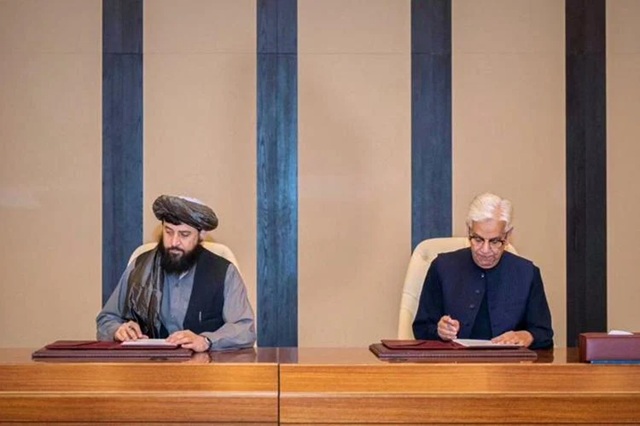
On Wednesday, a high-level delegation of the Islamic Emirate of Afghanistan, led by intelligence chief Abdul Haq Wasiq, arrived in Istanbul for the third round of talks with Pakistan. The discussions, between sides whose conflict has been marked by exchanges of fire along the border and brokered by Türkiye and Qatar, aim to defuse tensions and find a way forward.
However, the realignment behind this diplomatic effort is that Pakistan is not merely seeking temporary pauses in violence, but is also advocating for a durable framework that would ensure its territory is not targeted by cross-border attacks. This is not simply a dispute between two neighbouring countries over the Pak–Afghan border; it forms part of Pakistan’s evolving security doctrine—one that links national survival to enforceable, verifiable regional guarantees rather than rhetorical assurances.
For several years, Pakistan’s western border has represented its most complex security challenge. The 2,600-kilometre boundary between Pakistan and Afghanistan has long remained largely open, dominated by tribal relations, unregulated trade, and shifting terrorist networks. Following the Taliban’s capture of Kabul in 2021, Pakistan’s policy decisions changed substantially. The former insurgent group, once seen as a potential stabilising actor, became a state authority responsible for controlling terrorist movements across the border.
The existence and operational freedom of Tehrik-i-Taliban Pakistan (TTP) along the Pakistani-Afghan frontier remain Pakistan’s chief concern—an issue still unresolved. The outcomes of the first round of talks in Doha and the second in Istanbul were interpreted as moving from temporary ceasefires towards more structured commitments. However, when Taliban representatives stated that they did not have control over all groups within Afghanistan, the talks reached an impasse. The forthcoming Istanbul session will test the political will of both sides to see whether they can move from ceasefire negotiations to a framework based on verification and accountability.
For Pakistan’s military and intelligence establishment, the border issue ranks among its non-negotiable national security priorities. As Major General Ahmed Sharif Chaudhry recently stated, “Our agenda is single-point: the end of terrorism from Afghan territory.” Domestically, Pakistan is under pressure to demonstrate tangible results. Each terrorist attack further erodes public trust in the state’s security apparatus and intensifies criticism of the government’s engagement with Kabul. Ensuring visible outcomes from the Istanbul talks has therefore become both a political and strategic necessity.
Instability along the Afghan border directly affects Pakistan’s western corridor projects, regional trade, and investor confidence. The China–Pakistan Economic Corridor (CPEC) and other infrastructure initiatives rely on safe logistics through Khyber Pakhtunkhwa and Balochistan—areas most affected by cross-border infiltration. The insecure border has already slowed trans-Afghan trade routes, and connectivity projects linking South and Central Asia have been hindered. For Pakistan, counterterror stability is not only a security imperative but also an economic precondition for regional integration.
Communities along the border suffer the most. Displacement, disrupted livelihoods, and exposure to terrorist propaganda have left profound socio-economic scars. Pashtun-majority districts in Khyber Pakhtunkhwa remain vulnerable to radical narratives, particularly in areas with weak governance. While Pakistani counterterror operations have pushed back militant influence, durable peace requires civilian administration, local participation, and socio-economic investment. The struggle for stability cannot be fought with weapons alone.
Although Kabul’s regime has pledged to prevent TTP activity, its capacity and political will remain questionable. The Taliban’s internal cohesion and the autonomy of local commanders complicate enforcement. Pakistan demands concrete, verifiable guarantees, but the cross-border terrain and mobility of TTP militants make effective monitoring difficult. Ceasefires may halt fighting temporarily, but they do not dismantle the networks that exploit border gaps and ideological grievances.
With Türkiye and Qatar acting as mediators, both sides are exploring a joint monitoring and verification mechanism to ensure ceasefire compliance and track terrorist movements. Success, however, will depend on the Taliban’s cooperation and Pakistan’s confidence in external oversight. Beyond military fencing, Pakistan aims to invest in civilian administration, infrastructure, and counter-radicalisation programmes across frontier districts—an approach that is promising in principle but dependent on sustained funding and governance reforms.
A structured intelligence-sharing framework, potentially established through neutral channels, could strengthen early-warning systems and help dismantle cross-border networks. Though challenging, such cooperation is essential and relies on the Taliban’s willingness to engage openly. Pakistan could also collaborate with international partners to link development aid and infrastructure investment in Afghanistan’s border provinces to clear security benchmarks. This approach would take time but offers mutual benefits—stability for Pakistan and reconstruction opportunities for Kabul.
An uncomfortable yet necessary truth underlies these developments: Pakistan’s military and intelligence network is responding defensively while repositioning itself as a regional stabiliser. Critics often portray Pakistan’s demands as coercive, but in reality, the country’s approach reflects a strategic recalibration—transforming its hard-power capacity into a mechanism for regional security management. This transformation demands balance, combining military control with diplomacy and good governance.
Pakistan aims to build regional consensus rather than act unilaterally. Such consensus must recognise terrorism as a shared threat that endangers the security of the entire South and Central Asian region. If Pakistan executes this strategy effectively, it could alter perceptions of its regional role—shifting from a perpetual frontline state to a builder of collective stability through cooperation.
Pakistan’s focus in Istanbul must therefore be twofold: securing verifiable anti-terror guarantees and expanding its frontier strategy beyond purely military measures. A dual-track approach—defence coupled with development—offers the only sustainable path forward. Fragile ceasefires can evolve into enforceable peace through diplomatic engagement, cross-border monitoring, and community resilience programmes. Ignoring the structural roots of cross-border violence would endanger not only Pakistan’s internal stability but also the wider region’s security, from the Hindu Kush to the Central Asian steppes.
The third round of talks in Istanbul must therefore be more than symbolic. It should mark the beginning of a durable architecture for monitoring, verification, and shared investment in regional stability—a framework that secures Pakistan’s borders and redefines its strategic future.