


by Durga
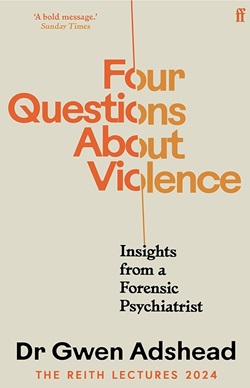
Dr Gwen Adshead’s Four Questions About Violence is one of those deceptively calm titles that conceals a detonator. It’s a book written by a forensic psychiatrist who has spent decades peering into the abyss of human cruelty, and what makes it controversial isn’t its subject matter — murder, trauma, evil — but its demand that we listen to the perpetrators. “I hope it is obvious,” Adshead writes with the clinical cool of a surgeon, “that attempting to understand violence in this way is not the same as excusing violence.” Yet, in an era where every public debate seeks villains and victims in neat binary boxes, her insistence on psychological nuance feels subversive, almost seditious.
The book expands her 2024 BBC Reith Lectures — a formidable intellectual stage — into four broad inquiries: Is violence normal? Aren’t they all evil? Does trauma cause violence? Can we change violent minds? Her method is forensic in both senses: evidence-driven and meticulous in moral dissection. But what makes it powerful is not its data — though she cites studies from the UN’s Global Study on Homicide to the CDC — it’s her willingness to enter the conversational hellscape of the human psyche. As she recalls, “I found myself reminded of a therapy session with a patient in Broadmoor, who was recounting his difficulties in disposing of what he thought was a dead body.” She listened, she writes, “nodding away as he detailed the struggle of trying to roll it up in a carpet,” realising later that this grotesque exchange mirrored her own challenge: to make the inexpressible manageable.
In a world where the media normalises atrocity through repetition — “The BBC… reports repeatedly on violence, which risks making it seem normal” — Adshead dares to ask whether violence might be “unusual but not alien.” The phrasing is chilling. She refuses to call killers monsters. “There is no such thing as a ‘typical killer,’” she insists. The phrase, nestled amid clinical observation, lands like a moral thunderclap. “He’s not an ordinary killer,” pleaded one bereaved wife; Adshead’s rejoinder — that there is no ordinary killing — is both compassionate and devastating. In refusing to ‘other’ murderers, she destabilises society’s favourite psychological defence: the belief that cruelty lives elsewhere.
That refusal to simplify violence turns the book into an argument against political convenience. We live in geopolitical systems that thrive on defining violence as external — terrorism, invasion, barbarism — and yet Adshead’s point is inward: “I wonder if we tend to normalise violence because we know somewhere, deep down, that we all have a capacity for cruelty.” The line could double as a manifesto against moral exceptionalism. When she describes how “men’s violence to their wives and partners went up by 38 per cent if their team lost,” she exposes how the domestic is geopolitical in miniature — a war of power, humiliation, and frustrated identity, fought over beer and football.
Her metaphor of the “numeric-combination bicycle lock” is the most haunting intellectual image in the book. Violence, she writes, is locked inside all of us, and “it is only when enough risk factors are present that the last ‘number’ can click into place to complete the combination and unleash the violence.” This model undermines the simplistic criminological obsession with pathology. Violence, she insists, is relational, contingent, cumulative. “Many of those factors are going to be social ones: lack of job opportunity, rigid beliefs about gender roles, and family conflict.” In that list we glimpse a quietly radical politics: that austerity, misogyny, and inequality are not moral failings but environmental risk factors for homicide.
Adshead’s tone oscillates between scientist and philosopher. “Even the apparently ‘rational’ motives only make sense at the most superficial level,” she notes, challenging the economic metaphors of crime. Her invocation of the Talmud — “Whoever takes one life takes the world entire” — positions murder not as an act but as an existential vacuum. Yet she also humanises those who commit it. One of her Broadmoor patients, Jack, who strangled his mother while psychotic, tells the therapy group: “I wish I could say sorry to my mum… I hope she understands how much I regret it.” The power of that confession isn’t sentimental; it’s destabilising. It forces the reader to see remorse and madness as parallel, not oppositional, states.
Adshead aligns herself with the humane tradition of thinkers like Hannah Arendt and Primo Levi: evil, she suggests, is not a metaphysical property but a failure of imagination. “Violence,” she writes, “is a dreadful and distorted communication from one human to another.” The key word is communication. For her, violence is language — a grotesque, wordless utterance that demands decoding. The implication is political: if violence communicates, then governments, institutions, and media must decide whether to respond with understanding or punishment. Her admiration for Norway’s penal philosophy — where “the primary task of the prison system is not to humiliate or belittle prisoners” — reads like a rebuke to Britain’s populist obsession with retribution.
And yet Adshead never becomes utopian. Her insistence that “violence is not normal for humans” sits beside the grim observation that “we all think we’re good people.” She knows this moral self-deception is what makes cruelty sustainable. Her reference to a Pop Art image — a tearful eye captioned We all think we’re good people — is more than aesthetic; it’s diagnostic. In every atrocity, from domestic assault to genocide, perpetrators build “neutralisation discourses”: “He started it,” “I was drunk,” “You don’t know what I’ve been through.” Her exposure of these linguistic self-absolutions dismantles the myth of madness as exoneration. “This claim to have had no choice,” she writes, “is rarely true.”
That sentence alone could be weaponised against entire state systems. Think of political leaders invoking inevitability — “we had no choice but to strike,” “it was self-defence.” Adshead’s forensic empathy becomes a form of political resistance, questioning not only individual accountability but collective moral denial. Her critique reaches beyond prisons into foreign policy, where the same psychological patterns justify violence at scale.
The book’s geopolitical resonance lies in its quiet insistence on shared humanity. “We are social animals,” she reminds us, and even chimpanzees “have ‘rules’ about when they use violence.” The comparison between primate aggression and human ethics is both scientific and satirical. When she jokes that “ex-Tory party leaders take note,” she folds British political farce into her primatology, mocking the thin line between tribal dominance and parliamentary behaviour. Adshead’s wit is dangerous precisely because it humanises the monstrous.
Four Questions About Violence reads less like psychiatry than moral anthropology. It asks whether empathy can coexist with justice — whether, as she puts it, “denigrating, othering and calling perpetrators ‘monsters’… may even make the problem worse.” Her answer, implicit and radical, is yes: moral superiority is the enemy of moral improvement. If we refuse to understand violence, we become complicit in its repetition. The book’s afterword — wondering whether “there is any link between being mentally well and acting well towards others” — leaves the reader unsteady, like a mirror cracking under scrutiny.
Adshead does not promise redemption; she offers comprehension, which is rarer. Her work belongs to the uneasy lineage of thinkers who stare into horror and report back without flinching. In doing so, she dismantles the cultural comfort that violence is other people’s disease. “It is because violence can be bloody and dreadful,” she insists, “that we must take it seriously and be willing to go deeper into the darkness of it.” That darkness, she warns, is not outside us — it’s the 2 per cent difference between a grizzly bear and a teddy bear.









