by Our Correspondent in Colombo
Less than 24 hours. Yes, just under a single revolution of this beleaguered planet, and our beloved Minister of Public Security—a paragon of wisdom who, by some cosmic joke, seems to understand everything except the very thing his title implies—graced us with yet another masterstroke of statesmanship. National security, according to his infinite sagacity, remains as impenetrable as ever. This, despite a delightful little incident where an alleged criminal was executed—oh, pardon me, shot dead—inside the sanctified walls of the Hulftsdorp Courts Complex. A minor hiccup. Nothing more.
Imagine, if you will, this spectacle occurring in any other functioning nation on this spinning blue marble. Would there be resignations? Public outrage? An avalanche of accountability? Undoubtedly. But this, dear reader, is Sri Lanka. A land so marinated in absurdity that resignation—especially from those with power—remains as mythical as the unicorn. Here, ministers cling to their seats with the tenacity of a barnacle on a sinking ship.

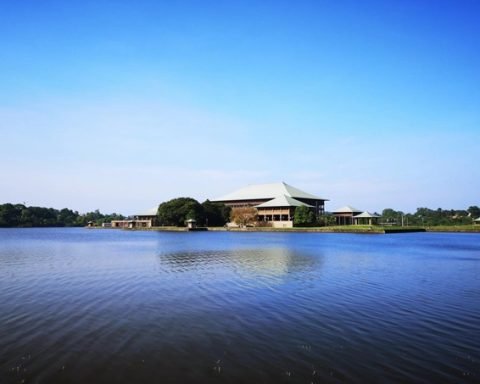
Enter the ever-enlightened Ananda Wijepala, whose nonchalant pronouncement in Parliament was nothing short of poetic nihilism. A man serenely unbothered by the fact that the judiciary—the very spine of any nation’s legal framework—was violently desecrated. His reasoning? This is not a national security issue. No, this is merely another episode in Sri Lanka’s long-running tragicomedy of gang rivalries. As if organised crime has suddenly been rebranded as a harmless family feud over Sunday dinner.
You see, according to our illustrious minister, national security isn’t threatened when bullets fly inside a courthouse. No, no. National security would apparently only be compromised if, perhaps, a foreign power staged an invasion—though, given the government’s current standards, even that might be politely dismissed as an unfortunate diplomatic misunderstanding.
But let’s not overlook Wijepala’s magnificent historical perspective: Media houses have been torched under various governments; journalists, those pesky scribblers of inconvenient truths, have been gunned down in broad daylight. A legacy of blood and silence, it seems. And rather than being ashamed of this macabre tradition, Wijepala invokes it as if it were a badge of honour—proof, perhaps, of the government’s consistent failure across generations. Truly, nothing screams ‘competence’ louder than normalising a nation’s descent into anarchy.
The minister’s coup de grâce? The soothing reassurance that, following this brazen courthouse assassination, the government promptly arrested the main suspect. Bravo! Swift action indeed, akin to dousing a roaring inferno with a teaspoon of water—after letting the entire house burn down. But fear not, citizens, for investigations are underway, and arrests have been made. Sleep peacefully, knowing that your safety is guarded by a system so robust that criminals can operate inside the very institutions meant to judge them.
And then comes the pièce de résistance of this Kafkaesque performance: The assertion that security for judges has not been reduced. That’s right. All is well. It wasn’t a security lapse that allowed a gunman to turn a courtroom into a battlefield—it was, instead, those pesky rules forbidding armed police inside court premises. Ah, yes. The letter of the law upheld so rigorously, while the spirit of justice lies bleeding on the cold marble floor.
But let’s pause to admire the true genius of this narrative: These shootings are isolated incidents, mere specks of unfortunate chaos in an otherwise idyllic paradise of law and order. If the minister says national security is intact, who are we—mere mortals—to suggest otherwise? After all, it’s not like living in a nation where gang lords orchestrate murders from prison cells, and assassinations unfold within hallowed judicial chambers could possibly suggest systemic rot.
And what of the broader implications? If a courthouse isn’t sacred, what is? If judges, the very embodiment of law and fairness, aren’t safe within their own courts, what hope remains for the common citizen clutching at the frail remnants of justice? Yet, the minister assures us that this is not a reflection of national security being compromised—just a casual bloodbath in the corridors of justice.
It’s almost comedic how neatly this farce is packaged for public consumption. Like a magician’s sleight of hand, we are expected to focus on the shiny arrests and prompt investigations while conveniently overlooking the festering cancer of impunity that allowed this spectacle in the first place. Ananda Wijepala, in his infinite wisdom, asks us to believe that everything is under control. But if control looks like this—judges unprotected, criminals armed, and ministers serenely detached—perhaps chaos would be a welcome reprieve.
One might even be tempted to admire the audacity of such governance. To stand before Parliament, smugly dismissing the fears of judges, journalists, and citizens alike, takes a particular brand of hubris. But here’s the rub: In any functioning democracy, this would be a career-ending catastrophe. Yet, in Sri Lanka, it’s just another day in the absurd theatre of politics.
Let’s not forget the poetic irony of Wijepala’s statements. The nation’s security, he assures us, remains steadfast, even as the blood of ‘isolated incidents’ stains the marble floors of its highest courts. But perhaps that’s the cruel joke—we’ve redefined security not by the absence of violence but by the routine efficiency with which we clean up after it.
And so, the nation watches, paralysed by the casual indifference of its leaders. The message is clear: If you’re shot in a courtroom, rest assured, national security is still intact. Your death is merely collateral damage in the grand illusion of stability.
Sri Lanka, a land where ministers don’t resign, even when democracy itself seems to be bleeding out in plain view. Where incompetence isn’t punished—it’s re-elected. Where ‘isolated incidents’ are just another stitch in the tapestry of chaos.
So sleep well, dear citizen. Your safety is guaranteed—at least until the next ‘isolated’ bullet pierces the fragile veil of normalcy. And if that happens? Fear not. There will be swift arrests, another hollow speech, and the comforting knowledge that, in the grand theatre of absurdity, the show must go on.