by Our Correspondent in Colombo
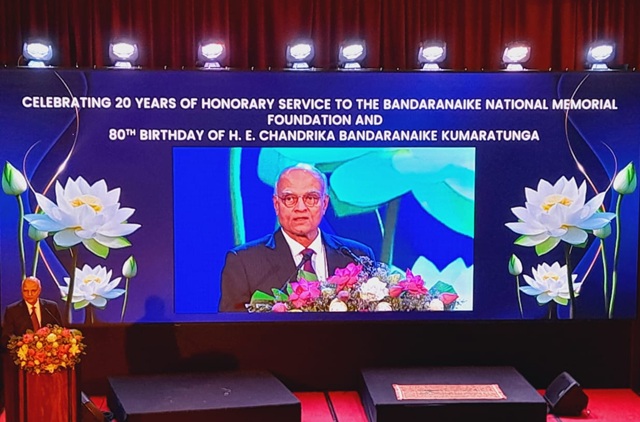
The 80th birthday celebration of former President of Sri Lanka, Chandrika Bandaranaike Kumaratunga at the BMICH in Colombo provided not just a platform for well-wishers to honour a historic figure, but also a rare opportunity for deep reflection on statesmanship, legacy, and the future of South Asia. Among the dignitaries who addressed the gathering was Shivshankar Menon, former Indian National Security Adviser and High Commissioner to Sri Lanka, whose speech stood out as a thoughtful meditation on the life and times of Kumaratunga. Delivered with warmth, intelligence, and unmistakable admiration, Menon’s tribute not only chronicled the former President’s achievements, but also contextualised her work within the wider shifts in regional and global politics. His words were at once a celebration, an appraisal, and a call to action.
Chandrika Kumaratunga, as Menon remarked, should be remembered by history not just as the longest-serving President of Sri Lanka, but as a transformative figure who reshaped the country’s political and social landscape during a period of profound instability. Elected to office in 1994 with a commanding mandate of over 62 percent of the popular vote, Kumaratunga inherited a country mired in civil war, haunted by political assassinations, and suffering from diplomatic isolation. Sri Lanka, at that time, was a nation suspended between despair and fragility. Into this tumultuous void stepped a woman of extraordinary resolve, clarity, and empathy.
Her legacy, according to Menon, cannot be disentangled from the context of her times. The 1980s and early 1990s had been years of bloodshed—insurrections, terrorism, and a relentless civil conflict with the Liberation Tigers of Tamil Eelam (LTTE) that had claimed thousands of lives. But where many leaders would have leaned into further militarisation or authoritarianism, Kumaratunga sought balance and dialogue. She brought to the presidency not merely the ceremonial authority of her office, but a deep-seated belief in inclusive governance, equity, and reconciliation.
Central to Menon’s recollection of her tenure was the notion of courage—not only the physical courage necessary to lead a nation under siege but also the rarer courage of conviction. She famously pursued peace with the LTTE even as they plotted her assassination. In December 1999, during her re-election campaign, she narrowly survived a suicide bombing attempt by the LTTE. Her immediate response was not retaliation but calm leadership. She addressed the nation with a message of restraint and unity, urging Sri Lankans not to target the Tamil community in the wake of the attack. This, as Menon pointed out, revealed her moral compass: a capacity to rise above vengeance, to govern with reason and empathy even in moments of personal peril.
But she was not merely a political survivor. Menon painted a portrait of a multi-dimensional leader—an intellectual, a strategist, and a deeply engaged policymaker. Trained in political science at the prestigious Sciences Po in Paris, Kumaratunga brought a formidable intellect to the office. Menon recalled his first meeting with her in 1997 when he presented his diplomatic credentials. Expecting a routine courtesy call, he instead found himself subjected to a 40-minute inquisition on regional geopolitics, bilateral relations, and Middle Eastern affairs. The exchange, he said, was more rigorous than his entrance interview for the Indian Foreign Service. That she commanded such depth and range of knowledge is telling, particularly in an age where many political leaders prefer optics to substance.
This analytical acumen translated into a forward-thinking economic strategy. Despite the protracted civil war, Kumaratunga managed to maintain economic stability, steering Sri Lanka through treacherous financial waters with minimal negative growth. Her development policies were rooted in social justice. Unlike many of her contemporaries who embraced globalisation uncritically, she approached it with discernment, using the market to advance equity rather than simply accelerate growth. Menon emphasised that few leaders have managed such a balancing act during times of war.
Equally significant was her commitment to regional cooperation, a facet of her presidency that deserves greater recognition. During an era when South Asia was struggling with the aftershocks of globalisation and facing the spectre of growing inequality, Kumaratunga held firm in her belief that the region’s salvation lay in collaboration, not confrontation. She worked actively to revitalise the South Asian Association for Regional Cooperation (SAARC), hosted summits in Colombo, and remained a steadfast supporter of cross-border dialogue. These efforts, though often obstructed by bilateral tensions among member states, were rooted in the conviction that South Asia’s shared histories and cultures offered a foundation for meaningful cooperation.
Menon’s speech took a sobering turn as he reflected on the current state of South Asia. Drawing on the work of economic historian Adam Tooze, he described the region as being in the throes of a “poly-crisis”—an interlocking matrix of debt, political instability, economic downturn, and societal unrest. The COVID-19 pandemic, the Ukraine war, and a global economic slowdown have exposed the structural weaknesses of many South Asian economies. Four of the region’s countries are currently engaged in adjustment programmes with the International Monetary Fund. Political regimes have changed rapidly since 2022—often in unconstitutional or contested ways—and the broader geopolitical environment has become markedly more hostile and fragmented.
This internal crisis, Menon argued, is compounded by an external one. The global order is no longer anchored by a hegemonic power willing or able to enforce norms. The liberal international system constructed after World War II—based on Western leadership, international law, and multilateralism—has effectively disintegrated. In its place is a disorderly, multipolar world where great powers act increasingly on their own terms. Menon cited a litany of conflicts—Ukraine, Syria, Gaza, the South China Sea, Armenia, and beyond—to demonstrate the erosion of global governance. Even multilateral institutions such as the United Nations are now paralysed by divisions among their most powerful member states.
In this context, Menon delivered a clear message: South Asia must look inward for its solutions. The world will not come to the region’s rescue. External powers may have strategic interests in the Indian Ocean or regional trade, but they lack the commitment or capacity to address the developmental and security challenges of South Asia. Instead, the region must harness its own potential.
And that potential is immense. South Asia, as Menon noted, is paradoxically both one of the most culturally unified regions in the world and one of the least economically integrated. Despite commonalities in language, religion, cuisine, and heritage, intra-regional trade constitutes only around 6% of total trade. Infrastructure is patchy, connectivity remains poor, and investment flows are negligible. More often than not, countries in the region act at cross purposes on the international stage, failing to present a united front even on issues where their interests align.
Yet herein lies the opportunity. The very lack of integration, combined with the region’s deep affinities, offers a powerful foundation for a new era of cooperation. Menon called for practical steps: payment agreements to facilitate regional trade, infrastructure projects to improve connectivity, and collaborative approaches to energy, education, and public health. He urged the revival of SAARC—not merely as a ceremonial body, but as an engine of collective action. He emphasised that South Asia’s common security, prosperity, and future depend on institutionalising habits of cooperation.
Moreover, the shifting balance of global power may work to the region’s advantage. The expansion of the BRICS grouping, with over 40 countries expressing interest in joining, signals a hunger for alternative modes of global engagement. The BRICS economies are projected to surpass the G7 in GDP in the coming years. This, Menon argued, reflects a redistribution of global power towards the Global South. But to take advantage of this transition, South Asia needs political leadership of a high order—leaders who, like Kumaratunga, combine vision with pragmatism, empathy with strategic foresight.
Menon’s reflections on leadership were particularly poignant. Drawing on his own experiences, he expressed admiration for political figures such as Dr Manmohan Singh and Atal Bihari Vajpayee—both of whom, like Kumaratunga, demonstrated that it is possible to lead with principle in an age of cynicism. He recounted with humour a story of how Kumaratunga’s legendary unpunctuality nearly caused him to miss his flight—saved only by a last-minute dash to the airport. Yet even this anecdote came with an insight: her political timing, he said, was impeccable. She knew precisely when to act, when to wait, and when to push for reform. This instinct served her well, particularly during the negotiation of the India–Sri Lanka Free Trade Agreement between 1997 and 1999, a period marked by governmental changes in India and intense conflict in Sri Lanka.
Menon offered not only warm wishes to the former President but a profound note of gratitude. He acknowledged her graceful withdrawal from frontline politics—an act that in itself demonstrated maturity and perspective. Rather than clinging to power, she chose to dedicate her energies to civic initiatives through the Bandaranaike Memorial Foundation, continuing to serve the public good. Her post-presidency, he said, exemplified values of service, humility, and integrity—qualities too often absent in today’s political arena.
As Sri Lanka, and indeed South Asia, confronts an increasingly uncertain world, the legacy of Chandrika Kumaratunga serves as both a mirror and a map. It reflects the possibilities of courageous leadership in times of crisis and offers a guide for those seeking a more just, stable, and united region. In celebrating her 80th birthday, Shivshankar Menon reminded us that her story is not merely one of personal achievement but part of a broader regional narrative—a story still being written, whose next chapters depend on whether the lessons of the past are heeded, and the opportunities of the present are seized.