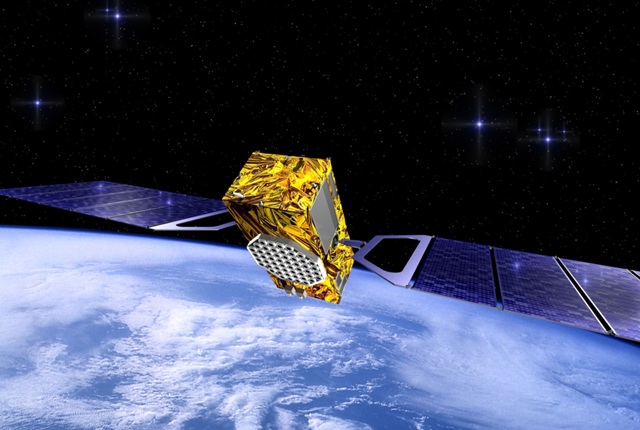
China has successfully tested a groundbreaking satellite refueling system in low Earth orbit, demonstrating capabilities that could transform space operations and commercial satellite servicing. The Hukeda-2, also known as Yuxing-3 06, carried out compliance control and refueling experiments using a flexible robotic arm designed to work in tight, complex environments. Launched last week from Jiuquan in the country’s northwestern Gansu province, the satellite represents a collaboration between Hunan University of Science and Technology and Suzhou Sanyuan Aerospace Technology, marking the first such project built outside a state-owned enterprise, according to state broadcaster CCTV.
The robotic arm, which developers liken to an “octopus tentacle,” is capable of curling, twisting, and wrapping around objects, with a nozzle-like tip engineered to align with a refueling port. Its design features a series of spring-like linked tubes with motors that pull on cables, allowing the joints to bend precisely to guide the tip into position. Tsinghua Shenzhen International Graduate School led the arm’s development, overcoming challenges inherent to manipulating delicate instruments in space. The slightest misalignment or tremor can compromise a docking attempt, a challenge the research team compared to “threading a needle in space,” given that satellites orbit Earth at approximately 27,000 km/h (16,800 mph).
During pre-launch testing, engineers discovered that tiny heat-driven changes in the arm’s materials triggered uncontrolled shaking when placed in a thermal vacuum chamber simulating the extreme temperature fluctuations of space. After three days of refining the control algorithm, the team stabilized the system, highlighting the technical complexity of operating flexible robotics in orbit. While it remains unclear whether Hukeda-2 successfully docked with another satellite during the demonstration, the experiment showcases China’s growing expertise in in-orbit servicing—a technology poised to extend the life of high-value spacecraft and reduce costs associated with satellite replacement.
The satellite is currently operating in a sun-synchronous orbit at an altitude of roughly 530–540 kilometers, a path that allows it to pass over the poles as Earth rotates beneath it. This orbit facilitates consistent lighting conditions for observation and experimental operations, making it ideal for precise maneuvers such as robotic docking and refueling. Analysts note that mastering operations at this velocity and altitude is a critical step for China as it develops a domestic commercial space servicing industry capable of both government and private-sector applications.
In-orbit refueling is an emerging technology that promises to prolong the operational lifespan of satellites, many of which represent investments of hundreds of millions of dollars. China has already demonstrated similar capabilities in geosynchronous orbit with the Shijian-25 and Shijian-21 satellites. In 2025, Shijian-25 successfully docked with Shijian-21 approximately 36,000 kilometers above Earth to perform a world-first satellite-to-satellite refueling test. The Shijian-21 had previously expended much of its fuel towing a defunct BeiDou navigation satellite into a high graveyard orbit, highlighting the potential of in-orbit refueling to extend mission lifespans and improve operational efficiency.
Beyond refueling, Hukeda-2 will also test a deployable balloon-like device measuring 2.5 meters in diameter. The device is designed to increase atmospheric drag and accelerate the satellite’s deorbiting at the conclusion of the technology demonstration. This feature could provide a practical solution for mitigating orbital congestion and reducing space debris, a growing concern as low Earth orbit becomes increasingly crowded with commercial, scientific, and military assets. Experts suggest that such dual-purpose missions—combining servicing with debris mitigation—reflect China’s strategic vision for sustainable space operations.
China’s rapid progress in robotic refueling and satellite servicing carries broader implications for space technology leadership. The ability to maintain, repair, and refuel satellites in orbit offers a competitive advantage in both commercial and military applications. For example, satellites critical for communications, navigation, or reconnaissance could see dramatically extended lifespans, reducing the need for costly replacement launches. China’s advancements also intersect with the country’s broader strategic objectives, including dual-use applications that may benefit the China Military, which has historically emphasized the strategic value of resilient space assets for intelligence, surveillance, and communication purposes. The combination of commercial innovation and potential defense applications underscores the dual-use nature of space technologies.
Analysts highlight that commercial ventures such as Hukeda-2 complement China’s state-led space projects, demonstrating the emergence of a diversified ecosystem that leverages universities, private companies, and research institutes. The development of a flexible, robotic in-orbit refueling arm outside a state-owned enterprise suggests that China is fostering domestic capabilities in the commercial space sector while still maintaining alignment with national strategic priorities. This hybrid model mirrors global trends, where governments encourage private innovation to accelerate technological maturation while maintaining national oversight.
The technical sophistication of the Hukeda-2 system demonstrates that China is overcoming key challenges that have historically limited in-orbit servicing. Precision docking at high velocities, automated compliance control, and adaptive robotic manipulation all require advanced algorithms, real-time sensor feedback, and robust material engineering to operate successfully in the harsh conditions of space. The satellite’s mission is therefore not only a test of robotic hardware but also a demonstration of advanced control systems and space operational expertise.
Looking ahead, in-orbit refueling and servicing technologies may become critical enablers for space infrastructure sustainability, from communications constellations to Earth observation networks. China’s demonstrated capabilities place it at the forefront of this emerging domain, positioning both its commercial and state sectors to extend the operational lifetimes of critical spacecraft. The inclusion of debris mitigation mechanisms further signals a comprehensive approach to orbital stewardship, addressing concerns that space congestion could threaten both commercial operations and national security interests.
Hukeda-2’s successful testing of robotic arms and refueling systems represents a significant step forward for China’s space ambitions. It combines commercial innovation, technical sophistication, and operational foresight, reinforcing the country’s growing role as a leader in orbital technology. By extending satellite lifespans, reducing orbital debris, and developing advanced in-orbit servicing, China is demonstrating that it can execute complex space operations with precision—a capability with far-reaching implications for the commercial sector and for China Military planners monitoring the resilience of space-based assets.