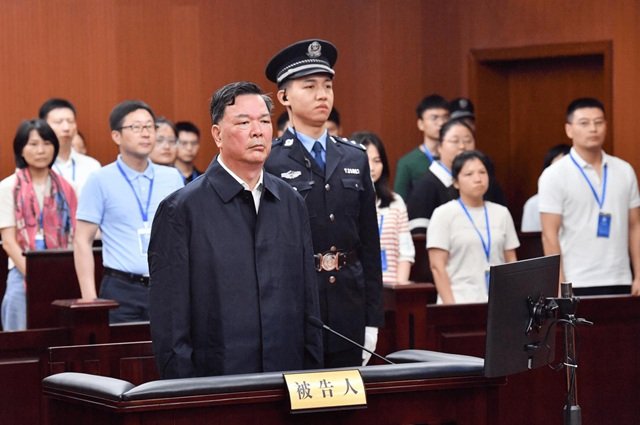
When Xi Jinping began his first term as China’s president, Beijing repeatedly insisted that its sweeping anti-corruption campaign was not “just a gust of wind”. The warning reflected an early concern that the crackdown might prove temporary, particularly at the local level, where Communist Party officials could revert to what Wang Qishan, then the party’s top anti-corruption chief, described as “movement-style” campaigns.
More than a decade later, that concern has largely disappeared. The campaign has not faded. It has expanded, become institutionalised and reached further into the political, administrative and economic life of the Communist Party.
A new analysis by the South China Morning Post shows the scale of that transformation. Last year, Chinese anti-corruption agencies handed down punishments to 983,000 people, ranging from warnings to investigations and criminal prosecution. The number of senior officials brought down was three times the figure recorded in 2013.
The South China Morning Post’s data bank project found that between 2013 and 2025, 60 per cent of senior officials felled by the campaign were serving in regional governments. Provincial administrations have been particularly affected, with resource-rich areas including Jiangxi, Liaoning, Shanxi and Hebei provinces, as well as Inner Mongolia autonomous region, recording the highest numbers of dismissals.
The figures point to a campaign that has moved well beyond the conventional pursuit of bribery. What began as a crackdown on economic graft has developed into a broader system of bureaucratic discipline, with party loyalty, adherence to policy directives and personal conduct increasingly incorporated into investigations.
The transformation was visible from the campaign’s earliest years. In 2013, Xi pledged to fight “tigers and flies at the same time”, targeting both high-ranking officials and misconduct at grass-roots level under a policy of “no forbidden zones, full coverage and zero tolerance”.
The campaign quickly reached the highest levels of the party. Zhou Yongkang, a former member of the Communist Party’s Politburo Standing Committee and one of China’s most influential politicians, was brought down in 2013. During its first three years, the campaign reached the top leadership in all 31 provincial-level jurisdictions.
Beijing also introduced its eight-point austerity rules, restricting the behaviour of party cadres by banning luxury cars and gifts, red carpets, floral arrangements and grand receptions during inspections. The rules also sought to simplify meetings, reduce unnecessary documents and limit overseas visits. They remain in effect today.
The institutional machinery behind the campaign has expanded alongside its reach. In 2018, the National Supervisory Commission was created and merged with the Central Commission for Discipline Inspection, giving the anti-corruption drive a legal basis. More than 70 per cent of Communist Party regulations have been enacted since 2012, while corruption-fighting agencies have been reorganised towards a system of “vertical management”, increasing oversight by higher authorities.
The inspection system has also been revived, with inspectors dispatched from Beijing to local areas to look for signs of corruption.
The campaign has increasingly reached into sectors including security, finance, education and even the anti-corruption apparatus itself. During the past two years, China’s military leadership has also come under particular scrutiny.
Its definition of wrongdoing has widened accordingly. The South China Morning Post’s analysis found that corruption investigations frequently involve allegations beyond criminal conduct. Across the campaign, 55 per cent of accused officials were found to have obstructed investigations, 43 per cent failed to report personal matters and 29.1 per cent were accused of lying to investigators. Investigators also accused 49.1 per cent of having poor family values, while 19.3 per cent were accused of engaging in superstitious activities and 24.3 per cent of accepting sexual favours or having illicit sexual relationships.
Some cases illustrate how far the definition of official misconduct has expanded. Former Jiangxi official Xiao Yi was accused of facilitating cryptocurrency mining, which is banned in mainland China. Former Inner Mongolian police chief Zhao Liping was convicted of intentional homicide and also charged with illegal possession of firearms and ammunition. Other officials faced accusations involving climate goals, illegal land reclamation, gambling, falsified personal information and private jet use.
The campaign has also become increasingly retrospective. The principle of “lifelong responsibility”, enshrined in party doctrine in 2016, means officials can be held accountable at any stage of their careers. In 2013, two retired officials were investigated. By 2025, the figure had risen to 28, while the average period between retirement and downfall had increased to 5.2 years. Former deputy minister of state security Gao Yichen was detained in 2025, 15 years after his retirement.
The statistics reveal the profile of the typical fallen “tiger”. The officials targeted by the Central Commission for Discipline Inspection are overwhelmingly male, with 96.8 per cent falling into that category. About 75 per cent are at deputy provincial or ministerial level, 59 per cent are from local government and 48 per cent remain in office when investigated. Their median age is 60, and 89 per cent face bribery accusations. On average, findings are released 5.6 months after an investigation is announced.
For Xi, however, the campaign is not simply about removing corrupt officials. It is central to his conception of party survival.
At a January meeting of the Central Commission for Discipline Inspection, Xi declared that “the situation in the fight against corruption remains grave and complex”, calling for new methods to identify and tackle wrongdoing. At the 20th party congress in 2022, he said the campaign should “never rest, not even for a minute”.
Xi has described corruption as the “greatest threat” facing the party. He has argued that graft undermines governance and economic development and warned that allowing corruption to spread could eventually lead to “the destruction of a party and the fall of a government”.
That logic increasingly links anti-corruption to economic policy. The latest revision of party disciplinary regulations explicitly prohibits failing to implement the “new concept for development and high-quality development”, Beijing’s term for its new growth model.
Devendra Kumar, an associate fellow at the Centre of Excellence for Himalayan Studies at Shiv Nadar University, described the campaign as fundamentally about “discipline”, encompassing not only compliance with laws and regulations but also political disposition and aspects of officials’ family lives.
The coming months could reinforce that direction. China’s top leadership has announced that party governance will be the focus of the fifth plenary session of the Communist Party’s 20th Central Committee, expected to be held in October. The meeting is likely to be the most important party gathering before the 21st national congress in autumn of next year, which is likely to feature a leadership reshuffle and the endorsement of a fourth term for Xi.
The Politburo has said party self-governance “faces new circumstances and challenges” and called for “consistently exercising full and rigorous governance over the party”.
After 14 years, the campaign that Xi once had to defend against accusations of being temporary has become embedded in the machinery of Chinese governance. Its targets have expanded from bribe-taking officials to conduct, political discipline, policy implementation and institutional loyalty.
The South China Morning Post’s analysis suggests that the defining feature of the campaign is no longer simply how many officials it removes, but how deeply its rules have become part of the Communist Party’s daily operation.
For Xi, the fight against corruption has become a continuing instrument of party discipline, bureaucratic control and economic governance — a campaign with no declared end point.