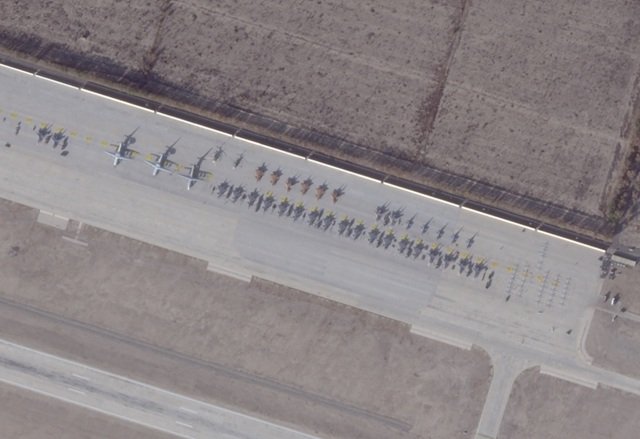
New satellite imagery has brought into focus a significant development in China’s military aviation program, showing two enormous stealth flying-wing drones positioned together at a remote and highly restricted test base near Malan. The images, captured on March 26, 2026, indicate a notable increase in testing activity involving some of the most advanced unmanned aircraft designs currently under development by the People’s Liberation Army.
The base, long associated with experimental aerospace projects, has been under observation for years, but this is the first time both of these large aircraft have been seen outside their hangars at the same time. Their simultaneous presence on the main apron suggests that testing has moved into a more active phase, possibly involving coordinated operations or comparative trials. Analysts have noted that this level of exposure typically signals growing confidence in the maturity of the designs.
The larger of the two aircraft, informally referred to by observers as “WZ-X,” stands out due to its immense wingspan of approximately 173 feet, placing it in the same size category as the B-2 Spirit. Its smooth, tailless flying-wing shape is optimized for stealth, reducing radar visibility while allowing for long endurance missions at high altitude. Although official details remain undisclosed, the aircraft is widely believed to be intended for strategic reconnaissance or long-range strike roles, potentially operating deep within contested airspace.
Nearby, a second flying-wing drone with a slightly smaller wingspan of around 137 feet displays a distinct “cranked kite” design. While narrower, this aircraft appears heavier and is thought to prioritize payload capacity over altitude. Analysts suggest it may serve intelligence, surveillance, and reconnaissance missions, while also retaining the ability to carry out long-distance strike operations. Its configuration reflects a balance between endurance and firepower, pointing to a flexible role within China’s evolving unmanned combat strategy.
The imagery also captured another aircraft on the apron resembling a stealth fighter drone, alongside a Xi’an Y-20 military transport plane. This fighter-like drone appears to be part of a broader effort to develop unmanned systems capable of operating alongside or in place of traditional manned fighters. Its tailless structure and compact size suggest an emphasis on agility and survivability, characteristics that align with emerging concepts in aerial warfare.
China has publicly showcased similar drone concepts in recent years, including during a major military parade in 2025, where several advanced unmanned designs were displayed. These systems are often compared to the United States’ Collaborative Combat Aircraft program, which seeks to integrate drones into frontline combat operations. The presence of such aircraft at the Malan base indicates that China is moving beyond concept demonstrations and into sustained testing and refinement.
Archived satellite data from recent months shows repeated activity involving these aircraft, particularly the fighter-like drone configuration, which appears frequently on runways and taxiways. This pattern suggests ongoing flight testing and iterative development, rather than isolated demonstrations. The base itself is equipped to support multiple concurrent programs, with extensive infrastructure designed to maintain secrecy while enabling rapid experimentation.
China’s focus on flying-wing drones is part of a broader shift toward unmanned systems capable of performing a wide range of missions, from surveillance to electronic warfare and precision strikes. The flying-wing design offers key advantages in stealth and fuel efficiency, making it especially suitable for long-endurance operations. The scale of the aircraft observed at Malan indicates that China is investing heavily in platforms that can rival or exceed existing capabilities in this category.
The emergence of these aircraft comes at a time when global competition in advanced air combat systems is intensifying. The United States, for example, has been operating its own high-altitude stealth drone, the RQ-180, for several years, though details about its capabilities remain limited. The appearance of comparable Chinese systems suggests that the technological gap in this domain may be narrowing.
Despite their impressive size and design, questions remain about how these drones would perform in real-world combat scenarios. Factors such as integration with other military assets, resistance to electronic interference, and survivability against advanced air defenses will ultimately determine their effectiveness. Still, the visible progress at the Malan base points to a sustained and well-resourced effort to develop a new generation of unmanned combat aircraft.
The latest images offer a rare glimpse into a program that is typically shielded from public view. They highlight not only the scale of China’s ambitions in military aviation but also the pace at which those ambitions are being pursued. As testing continues and new designs emerge, the role of large stealth drones in future conflicts is likely to become increasingly significant, reshaping the balance of airpower in ways that are only beginning to take shape.