New findings from China’s Zhurong rover suggest that Mars may have once been home to sunlit beaches with lapping waves and a warmer climate. Ground-penetrating radar aboard the rover uncovered layers of rock beneath the surface of the Red Planet, revealing evidence of an ancient ocean once lined by sandy shorelines.
The rover, which landed on Mars in 2021 and operated for a year, traveled to the Utopia Planitia region, where it detected sloping rock layers that point towards a shoreline estimated to have existed 4 billion years ago. The formations bear a striking resemblance to beach deposits found on Earth.
Scientists believe that rivers once carried sediment to a vast, ice-free ocean, where waves redistributed the sand along the shorelines over millions of years. Professor Michael Manga of the University of California, Berkeley, co-author of the study, said, “These features have both the right orientation and the right slope to support the idea that there was an ocean for a long period of time to accumulate the sand-like beach.”
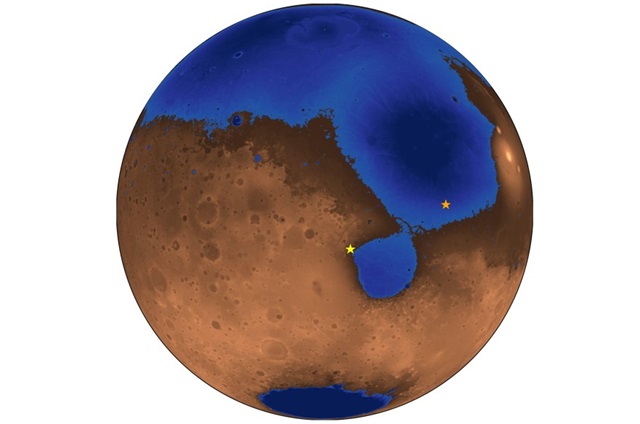
The discovery adds to growing evidence that Mars, now a cold and arid planet, was once much warmer, with a thicker atmosphere capable of sustaining liquid water. Scientists also suggest that the planet’s water, much of which may have escaped to space, is now trapped underground as ice or minerals.
The new research, published in the Proceedings of the National Academy of Sciences, could hold key implications in the search for past life on Mars, as shorelines on Earth have been historically rich in microbial life.