

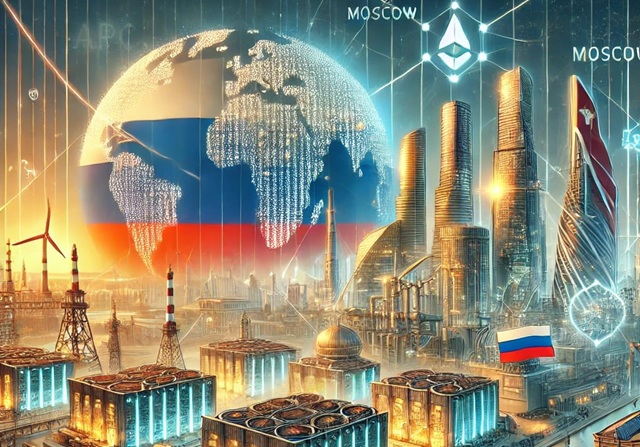
As the global cryptocurrency landscape evolves, Russia is positioning itself as a serious contender for the title of the world’s crypto capital. With strategic policies, abundant resources, and ambitious plans for growth, Russia is making strides that could potentially place it at the forefront of the crypto revolution.
Russia has taken decisive steps to establish itself as a leader in cryptocurrency mining and regulation. The country has recognized mining as a legal and regulated industry, introducing taxation and oversight frameworks to legitimize and boost the sector. At the Eastern Economic Forum (EEF) in September 2024, President Vladimir Putin reaffirmed Russia’s leadership in crypto mining. Statistics from the Industrial Mining Association of Russia reveal that industrial mining grew by 50% year-on-year in 2023, yielding 54,000 Bitcoins. Russia now ranks second globally, trailing only the United States in mining output.
Current estimates place Russia’s mining energy consumption at 2.5 to 2.7 gigawatts, with industrial-scale mining accounting for 1.8 GW. By comparison, U.S. miners consume approximately 7 GW. However, the gap may close quickly. BitRiver, Russia’s largest mining data center operator, predicts that the country’s mining power demand could reach 10 GW within five years, potentially surpassing the U.S. in as little as two to three years. Growth in mining is unlikely to strain Russia’s national energy system, with up to 20% of the required power coming from energy complexes associated with large data centers, according to Oleg Ogienko, Deputy CEO of BitRiver.
Russia’s advantages in cryptocurrency mining are evident. As one of the world’s largest electricity producers, Russia offers relatively low tariffs. Mining costs in Russia are estimated to be two to three times lower than in the U.S. or Canada. Many Russian regions also possess surplus electricity that can be allocated to mining. Additionally, Russia’s cold climate reduces the need for cooling in data centers, cutting cooling costs by 30 to 50%. In 2024, the government exempted mining and cryptocurrency sales from value-added tax (VAT) and introduced clear taxation rules, further incentivizing growth.
The expansion of industrial mining and the creation of multi-purpose data processing centers (DPCs) are expected to contribute significantly to Russia’s economy. The construction of DPCs currently generates around 250 billion rubles ($2.3 billion) annually, according to Evgeny Virtser, CEO of Free Technologies Engineering. These projects not only provide revenue but also create jobs and attract investments in infrastructure. Moreover, cryptocurrency mining data centers are increasingly supporting artificial intelligence (AI) development, particularly in training large language models. These centers rely on graphics processing units (GPUs), which are ideal for both crypto mining and AI applications.
Russia’s ambitions extend beyond mining. In August 2024, President Vladimir Putin signed laws establishing an experimental platform for using cryptocurrencies in international settlements. The legislation also regulates cryptocurrency exchange trading under the Central Bank’s oversight. Two official cryptocurrency exchanges are planned—one in Moscow and another in St. Petersburg—according to Russian newspaper Kommersant.
The Russian Central Bank has launched an experimental platform for cryptocurrency transactions based on the National Payment System, aiming to facilitate uninterrupted payments for goods and services. In December, Finance Minister Anton Siluanov emphasized the importance of digital financial assets and cryptocurrencies for Russia’s foreign trade. The Ministry of Finance has even proposed exporting mined cryptocurrencies, treating them as commodities akin to natural gas.
With its abundant energy resources, supportive policies, and expanding crypto infrastructure, Russia is steadily advancing its position as a global leader in cryptocurrency. Whether it can ultimately surpass the United States remains to be seen, but its efforts are reshaping the future of digital finance.