by Our Correspondent in Colombo
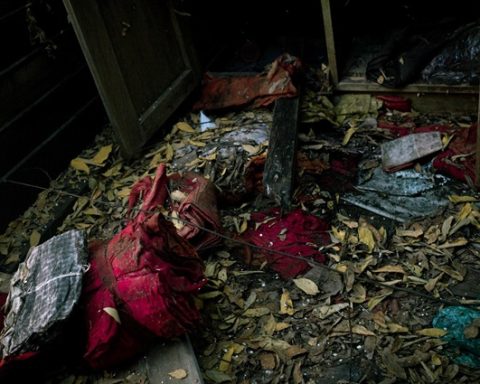
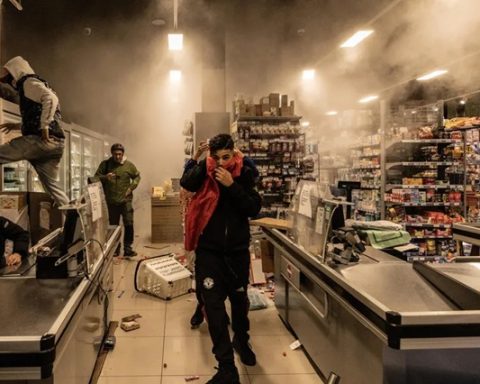
Sri Lanka’s humanitarian crisis deepened on Sunday as the official death toll from Cyclone Ditwah rose to 627, with 190 people still reported missing and more than 2.17 million individuals affected nationwide. According to the Disaster Management Center, the storm has devastated 611,530 families across all 25 districts, with Puttalam, Gampaha, Kandy, Colombo, Kurunegala, and Kegalle among the hardest hit. Entire communities have been uprooted, with 4,517 homes fully destroyed and another 76,066 partially damaged. Nearly 90,000 people are currently sheltered in 956 safety centers, while damaged roads, washed-out bridges, and isolated villages continue to hamper local relief efforts. For many districts, the crisis has shifted from an immediate disaster to a prolonged struggle for food, clean water, medical care, and safe shelter.
Against this dire backdrop, an unprecedented development unfolded at Katunayake Air Base: the arrival of two U.S. Air Force C-130J Super Hercules aircraft and personnel from the 36th Contingency Response Group. It is the first time in Sri Lanka’s history that American military forces have publicly deployed on the ground for civilian humanitarian operations. Their mission, carried out at the official request of the Sri Lankan government, is to provide rapid airlift and logistics support to deliver critical relief supplies to communities cut off by the cyclone. The aircraft, along with supporting units from the 374th Airlift Wing in Japan and the III Marine Expeditionary Force in Okinawa, are set to transport emergency items ranging from temporary shelter materials to safe drinking water and sanitation essentials—cargo that Sri Lankan authorities warn cannot wait for ground transport networks to recover.
Ironically, it took more than a week for the US military to arrive in Sri Lanka, while India’s swift assistance continued with the arrival of nine flights carrying humanitarian aid. Pakistan was also on the ground providing military support. Meanwhile, the UAE, Maldives, Russia, Myanmar, Switzerland, and several other countries also sent humanitarian aid to the victims of the cyclone.
However, U.S. Ambassador Julie Chung described Sri Lanka’s responders as “heroic,” noting that the United States had come prepared to “take on some heavy lifting” so that frontline Sri Lankan teams could remain focused on humanitarian needs rather than the limitations of destroyed infrastructure. The C-130J aircraft, known for operating in austere conditions, are uniquely capable of landing on short or damaged runways, enabling relief missions to access areas where roads remain impassable. American officials emphasized that when time is short and access is limited, logistics becomes the lifeline—and in this crisis, that lifeline is now international.
This swift deployment has been made possible in part by a recently signed defence agreement between Sri Lanka and the United States—a landmark memorandum that formalizes cooperation under the U.S. State Partnership Program. The pact, signed only weeks before Cyclone Ditwah struck, outlines collaborative efforts in maritime security, aviation operations, humanitarian assistance, disaster response, cyber defence, and broader military professional exchanges. While the United States and Sri Lanka have engaged in joint exercises and training for years, this agreement marks the first time such cooperation has been formally structured, enabling operational integration at a moment when Sri Lanka urgently needs external support. The presence of U.S. military aircraft on Sri Lankan soil for civilian disaster relief represents the first real-world activation of this new partnership.
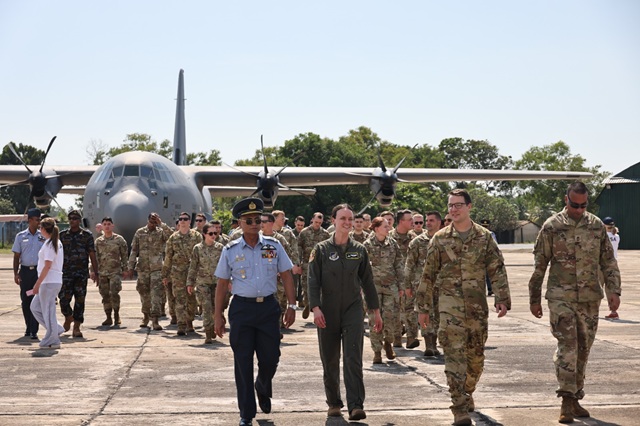
The United States has also recently provided the Sri Lanka Air Force with a package of airlift and logistics equipment valued at approximately $2.1 million. This includes fuel trucks, forklifts, ground-power units, floodlights, and portable cargo-loading platforms—assets that are now directly supporting ongoing cyclone response operations. These tools enhance the SLAF’s ability to receive, power, load, and distribute humanitarian cargo around the clock, expanding the nation’s capacity to move critical supplies quickly and effectively. In addition to equipment, the U.S. government had announced $2 million in emergency assistance within 72 hours of the cyclone’s landfall, targeting shelter, sanitation, water, and health services for storm-affected communities.
As Sri Lanka struggles to stabilize the situation, the arrival of U.S. military teams marks a defining moment—both in the immediate relief effort and in the broader geopolitical trajectory of the island. For decades, Sri Lanka has managed a careful balance in its foreign and defence policy, often wary of foreign military involvement in local affairs. Yet the sheer scale of Cyclone Ditwah’s destruction has created a moment in which practicality outweighs old sensitivities. With millions affected, hundreds dead, and entire districts still unreachable, the nation is relying on every available resource—and for the first time, that includes American boots on the ground.
The coming weeks will test how effectively the new U.S.–Sri Lanka defence cooperation can translate into real-world results. For now, the immediate priority remains getting life-saving supplies to families who have lost everything. But observers note that this unprecedented humanitarian collaboration may also signal the beginning of a deeper strategic partnership—one that extends far beyond the aftermath of Cyclone Ditwah and reshapes Sri Lanka’s place within the wider Indo-Pacific security landscape.