


For more than three decades, Éric Laurier, a forensic pathologist based in Valenciennes, France, has embarked on an extraordinary quest to uncover the truth about Adolf Hitler’s death. His research, culminating in the release of his book Le Cadavre d’Hitler (Hitler’s Corpse), sheds new light on the mysterious circumstances surrounding the Führer’s final moments and the subsequent Soviet investigation into his death. Some of Laurier’s findings, revealed this week, read like a tale more fitting for fiction than history.
According to a report in The Times, one of the most striking revelations from Laurier’s investigation concerns a seemingly trivial detail: a pair of socks found among the bodies in the Führerbunker, the underground complex where Hitler spent his final days. The Soviets, upon discovering thirteen bodies in the bunker, dismissed one corpse as not being Hitler’s based on a peculiar reason—one of the socks was darned. This led Soviet officials to conclude that the man in question could not have been Hitler, as they argued the dictator would never have worn socks in such a condition. Laurier, however, points out the absurdity of this judgment, highlighting how the Red Army’s approach to the investigation was influenced more by politics than by any serious forensic examination.
Laurier critiques the Soviet autopsy reports, noting that they often yielded results shaped by political motives. According to The Times, he argued that the Soviets were determined to present Hitler’s death as a dishonorable act of suicide to fit a narrative that aligned with Stalin’s post-war ambitions in Eastern Europe. This narrative sought to portray Hitler’s demise as cowardly and dishonorable, fueling the Soviet propaganda machine.
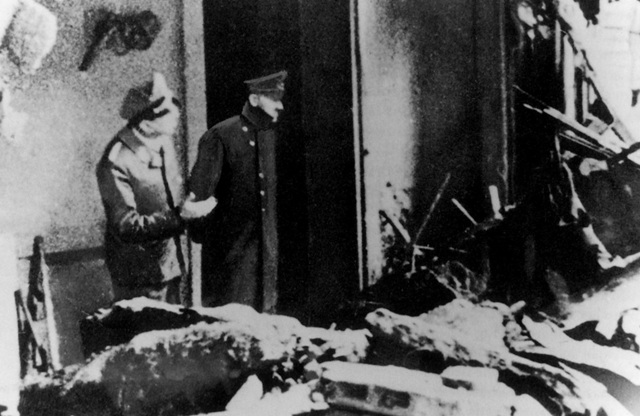
The accepted narrative of Hitler’s death has long been that on April 30, 1945, as the Allies closed in on Berlin, Hitler took his own life in the Führerbunker. In the final hours of his life, Hitler raged at the “weak” German people and his generals, dictated his last will and testament to his secretary Traudl Junge, and administered poison to his beloved German shepherd, Blondi. He and his wife, Eva Braun, whom he had married the night before, then took their own lives—Hitler allegedly by shooting himself in the head, while Braun ingested cyanide.
The bodies of the couple were carried to the garden of the Reich Chancellery, where they were set ablaze in an attempt to prevent the Soviets from retrieving them. Witnesses reported seeing Hitler’s headshot, while Braun’s body reportedly emitted the strong odor of almonds, a clear sign of cyanide poisoning.
Yet, despite the testimony of those present, the Soviets initially offered conflicting accounts of Hitler’s death. Some reports claimed that he had poisoned himself, while others suggested that he had survived and fled. These contradictions, compounded by Soviet secrecy and political maneuvering, gave rise to numerous conspiracy theories that persist to this day, fueled by questions about Hitler’s true fate.
The remains found in the Führerbunker were cataloged by the Soviets, with Hitler and Braun’s bodies being numbered 12 and 13, respectively. However, Laurier argues that the Soviet investigation was far from thorough. The Soviets performed toxicology tests on the first eleven bodies but failed to examine the remains of Hitler and Braun, despite the availability of fragments purportedly belonging to Hitler’s skull and jaw, which were sent to Moscow for further examination. These fragments were never tested for cyanide poisoning, Laurier says, adding to the mystery surrounding the cause of death.
Compounding the confusion, Laurier notes inconsistencies in the Soviet autopsy reports. For instance, one report claimed that Hitler was missing his left testicle, a detail that contradicted earlier medical examinations of Hitler, which suggested he was missing his right testicle. Laurier’s meticulous investigation, based on decades of research and careful analysis of previously declassified documents, casts doubt on the veracity of the Soviet autopsies and raises questions about the authenticity of the remains attributed to Hitler.
Perhaps the most stunning revelation, however, comes from the investigation of a fragment from Hitler’s skull, which had been taken to the United States for DNA testing by Professor Nick Bellantoni in the 1990s. Bellantoni’s analysis concluded that the fragment likely came from a woman, not a man. This discovery, combined with Laurier’s findings, challenges the notion that the skull fragments held in Moscow are indeed those of Adolf Hitler.
Despite these inconsistencies, Laurier does not subscribe to the conspiracy theory that Hitler survived the war. Instead, he believes that the Soviets’ flawed investigation and the political pressures of the time obscured the true cause of his death. Laurier’s book provides a meticulously researched account of the Soviet investigation and the ways in which political agendas shaped the narrative surrounding Hitler’s final moments.
As Laurier points out, the Soviet autopsy reports failed to examine key details about Braun’s death. Her remains, for example, showed signs of a severe chest injury from a Soviet shell, including six metal fragments. Laurier speculates that the bodies were interrupted in the process of being transported to the Chancellery garden for burning, possibly by a Soviet artillery attack. If this detail had been made public, he argues, it could have led to the perception that Braun died heroically while resisting, which the Soviets wanted to avoid at all costs.
Laurier’s interest in Hitler’s death began in 1993 when, as a pathology student, he stumbled upon an article about the autopsy of Hitler’s body. This sparked a lifelong fascination with the case. The declassification of key documents and the advent of the internet allowed Laurier to pursue his research more deeply, culminating in his book. His investigation, however, does not provide definitive answers to all the questions about Hitler’s death. Still, it serves as a crucial examination of how Soviet propaganda and blunders have shaped our understanding of one of history’s most infamous deaths.
In the end, while Laurier’s work may not definitively close the book on the mystery of Hitler’s demise, it raises important questions about the role of political manipulation in shaping historical narratives, especially when it comes to events as significant as the death of the Führer. The sock, the skull fragments, and the contradictions in Soviet reports all serve as a testament to the murky nature of history itself, where truth often lies tangled in a web of lies, blunders, and propaganda, as The Times notes.












Heil Hitler !