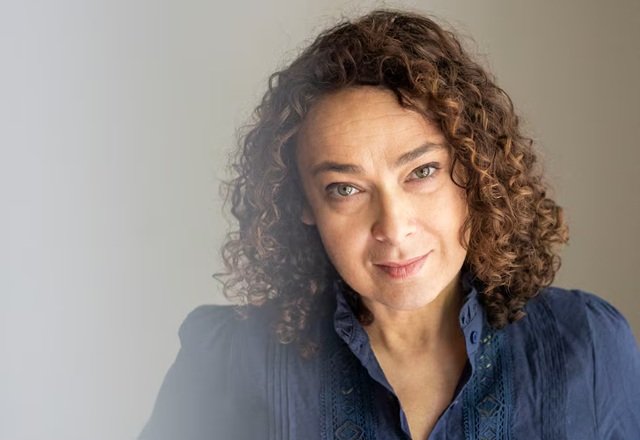
French rabbi and author Delphine Horvilleur has said that Jews “have learned from history that they will never find peace,” in a wide-ranging interview published by El País, where she reflects on Jewish identity, political violence, and the competing narratives surrounding Israel and Palestine. The conversation, conducted in Paris, also touches on her criticism of Israeli Prime Minister Benjamin Netanyahu, her understanding of Zionism, and the growing tensions within Jewish communities worldwide.
Horvilleur, 51, was ordained at a time when there were only a handful of female rabbis in France. Now based in Paris after living in Jerusalem and New York, she has built a public role that combines religious leadership, writing, and commentary on contemporary Jewish life. Speaking to El País in the Marais district, she describes a personal and intellectual journey shaped by language, displacement, and recurring political violence.
She recalls leaving Jerusalem after the assassination of Israeli Prime Minister Yitzhak Rabin, an event she describes as a rupture that forced her to reconsider the meaning of belonging and ideology. Rabin, who had supported dialogue with Palestinians, became for her a symbolic turning point. She later studied Arabic in Beirut, emphasizing the importance of understanding multiple languages and perspectives, and arguing that linguistic exchange is central to how communities construct meaning.
Throughout the interview with El País, Horvilleur repeatedly returns to the idea that identity is formed through historical experience and conflict. “The Jews are what history makes of them,” she says, framing Jewish identity as a product of survival under repeated threats rather than a fixed national or ideological category. She also reflects on internal divisions within Judaism, particularly around Zionism and political interpretation.
Horvilleur addresses criticism she receives from different parts of the Jewish community, noting that she is often attacked by what she describes as far-right Jewish voices because of her public criticism of Israeli policies in Gaza. At the same time, she says she is also accused of political positions that misrepresent her views on Zionism, highlighting what she describes as competing attempts to define Jewish identity in exclusive terms.
In her remarks to El País, she argues that Jewish tradition has historically been built on disagreement and debate, referencing the Talmud as a foundational text rooted in divergent interpretations rather than consensus. She contrasts this with what she sees as ideological rigidity, warning against narratives that reduce complex conflicts to a single moral or political perspective. She stresses that both Jewish and Palestinian claims to security and justice must be acknowledged in any attempt to understand the conflict in the Middle East.
Horvilleur also speaks about antisemitism, distinguishing it from other forms of racism by describing it as often linked to perceived inferiority and external blame. She says historical experience has led many Jews to associate their identity with a constant need for vigilance, including in societies where they are formally protected. She cites historical expulsions and persecution, including the Holocaust, as shaping this collective memory of insecurity, a theme that El País highlights throughout the interview.
On Israel’s political leadership, Horvilleur expresses concern about Benjamin Netanyahu’s influence and calls for strengthening democratic voices within Israel. She argues that Netanyahu’s discourse should not be taken as representative of Israel as a whole, emphasizing the diversity of political and social views within the country. She also refers to contact she maintains with individuals and groups working in Palestinian territories, describing efforts aimed at physical protection and humanitarian support.
The interview also revisits her personal experiences of violence, including a 2000 bombing in Jerusalem that damaged her home. She describes the emotional aftermath, including anger and fear, but contrasts that period with her current belief in the importance of maintaining distance and resisting cycles of hatred. This experience, she tells El País, has shaped her commitment to listening beyond ideological positions.
Beyond politics, Horvilleur discusses religious practice, storytelling, and Jewish rituals surrounding life and death. She explains the symbolic traditions associated with mourning and marriage, including the breaking of a glass at weddings to represent imperfection and loss. She also describes rabbinical work as accompanying people through key life moments, from birth rituals to funerals, emphasizing the role of questions over definitive answers.
She reflects on death as an integral part of life, saying that Jewish tradition teaches people to live with what is broken rather than to expect complete repair. In her view, religious learning is inseparable from daily experience, and moral values are demonstrated through behavior rather than declared. She recounts stories from the Talmud to illustrate the role of disagreement, humor, and human presence within spiritual life.
Toward the conclusion of the interview with El País, Horvilleur returns to broader concerns about language and meaning, arguing that public discourse has become increasingly polarized and that words such as Zionism are often used without shared understanding. She insists that clarity and dialogue are essential to prevent ideological simplification, particularly in discussions about Israel and Jewish identity.
As the interview closes, she reiterates a central idea that runs throughout her reflections: that history, trauma, and survival continue to shape Jewish life, but that meaning depends on maintaining space for debate, questioning, and coexistence of conflicting perspectives.