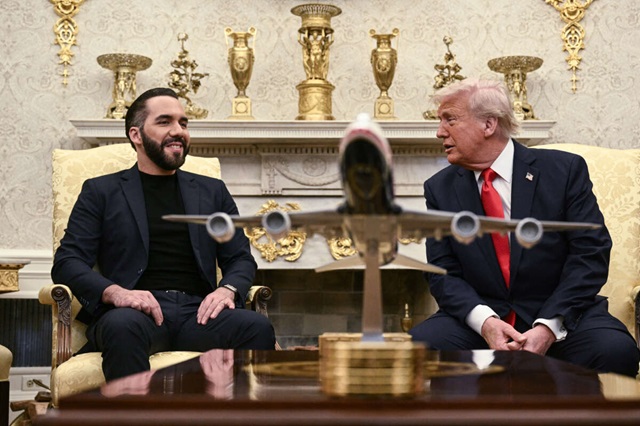
El Salvador’s legislative assembly has voted to abolish presidential term limits, effectively allowing President Nayib Bukele to remain in power indefinitely — a dramatic move that critics say marks the death of democracy in the country.
The sweeping constitutional change, passed with overwhelming support from Bukele’s allies in the assembly, cements the president’s iron grip on the Central American nation and follows years of power consolidation marked by repression, attacks on press freedom, and the erosion of judicial independence.
Only three opposition lawmakers voted against the measure. “Democracy in El Salvador has died,” declared Marcela Villatoro, one of the few remaining dissenting voices in the legislature.
Bukele, who once jokingly branded himself the “world’s coolest dictator,” rose to international prominence in 2022 with a brutal crackdown on gang violence that sent thousands to prison and helped slash the country’s sky-high homicide rate. The campaign earned him widespread domestic support, pushing his approval ratings above 80%, and inspired admiration across parts of Latin America.
His supporters credit him with restoring public safety and reclaiming neighborhoods long controlled by violent gangs. “He saved our streets,” said one local resident in San Salvador. “No other president dared to do what he did.”
But human rights organizations and opposition figures see a darker trajectory. Under Bukele’s rule, civil liberties have sharply declined. A prominent human rights activist was recently jailed, and dozens of journalists have fled the country amid threats, harassment, and surveillance.
“The dismantling of democratic institutions is happening in plain sight,” said a spokesperson for Human Rights Watch. “This is not security — it’s authoritarianism with popular approval.”
The constitutional change aligns with a pattern seen in other countries where strongmen leaders gradually remove checks on their power under the guise of reform or public safety.
With no remaining legal barriers to reelection and a weakened opposition, Bukele now appears poised to rule El Salvador for as long as he chooses — a reality that, for many, signals the end of the country’s fragile democratic experiment.