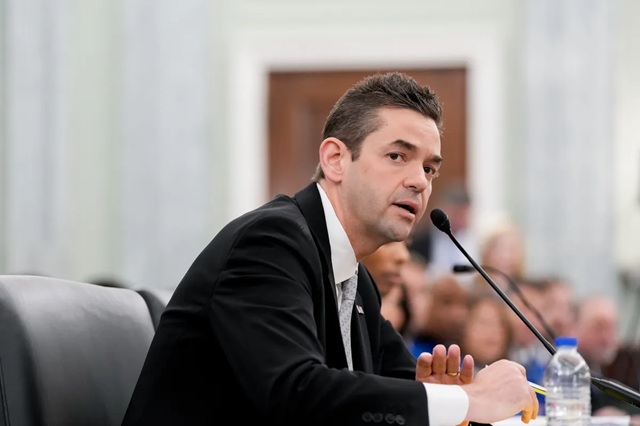
After months of political turbulence and scrutiny in Washington, tech billionaire and private astronaut Jared Isaacman has been confirmed as the next administrator of NASA, placing a leading advocate of commercial spaceflight at the head of the US space agency at one of its most consequential moments in decades. The US Senate approved his appointment by a 67–30 vote, ending a prolonged and often contentious nomination process that reflected deeper debates about the role of private enterprise in government-led space exploration.
Isaacman assumes leadership as NASA prepares for Artemis II, a mission expected to launch within weeks that will carry four astronauts on a crewed flight around the Moon. The mission represents humanity’s most ambitious journey beyond low Earth orbit since the Apollo era ended in 1972 and is seen as a critical step toward a sustained lunar presence and eventual missions to Mars. The timing of the leadership transition underscores the strategic importance of Isaacman’s confirmation for both NASA’s near-term objectives and long-term ambitions.
His appointment also resolves an internal power struggle within the US government. Acting NASA administrator Sean Duffy, who simultaneously serves as US transportation secretary, had sought to bring NASA under the permanent authority of his department. That effort collapsed with Isaacman’s confirmation, solidifying NASA’s independence at a time when its partnerships with private companies are expanding rapidly. Duffy publicly congratulated Isaacman, framing the moment as a step toward returning Americans to the Moon by 2028 and outpacing China in the new era of space competition.
Isaacman is best known as the founder and chief executive of payments company Shift4, which he launched at the age of 16 and later built into a multibillion-dollar enterprise. Beyond finance, he has become a prominent figure in commercial spaceflight, having flown to space twice on privately funded SpaceX missions carrying all-civilian crews. His most recent mission in 2024 included the first private-sector spacewalk, cementing his reputation as a symbol of the growing influence of commercial actors in space exploration.
That close association with SpaceX and its chief executive Elon Musk has been one of the most controversial aspects of Isaacman’s rise. Critics in Congress have questioned the financial ties between Isaacman and the company, warning of potential conflicts of interest at an agency that awards billions of dollars in contracts. Financial disclosures show that Isaacman’s Polaris program with SpaceX is valued at more than $50 million and that he has reported significant gains from investments linked to the company.
During his confirmation hearings, Isaacman sought to downplay concerns about favoritism, arguing that SpaceX’s role in human spaceflight is a structural reality rather than a personal preference. He told lawmakers that his decision to fly with SpaceX reflected the company’s unique capability to transport astronauts following the retirement of the Space Shuttle, emphasizing that NASA itself depends on the same commercial systems.
Isaacman’s journey to confirmation was far from straightforward. Initially nominated in late 2024, his appointment was abruptly withdrawn amid reports of strained relations between President Donald Trump and Elon Musk, fueling speculation about the political vulnerability of the pick. The nomination was revived months later as those relations appeared to improve, but fresh controversy emerged following the leak of an internal strategy document known as Project Athena.
The document outlined a sweeping vision for NASA that included nuclear electric propulsion, a renewed focus on Mars, and a rapid overhaul of agency programs. While supporters praised its ambition, critics warned that it could lead to job losses among civil servants and deprioritize traditional scientific research. Some senators withdrew their support, arguing that Isaacman had not sufficiently distanced himself from the most contentious proposals.
Additional questions were raised about the political dynamics behind Isaacman’s return to favor, including revelations that he had donated roughly $2 million to President Trump’s Super PAC. Isaacman responded by saying the donations were made during a brief period when he considered entering politics himself and insisted that he aims to remain politically neutral in his role, portraying himself as a centrist focused on unifying the agency.
Isaacman’s confirmation marks a departure from tradition at NASA, where administrators have typically come from scientific, engineering, or public service backgrounds. His profile as a tech entrepreneur and private astronaut has divided opinion within the scientific community, but it has also drawn strong support from commercial space advocates and former astronauts who see his experience as uniquely suited to an era defined by public-private partnerships.
As NASA prepares to send astronauts back around the Moon and faces growing international competition in space, Isaacman’s leadership is set to influence not only how the agency operates, but how the United States defines its role beyond Earth. His tenure will test whether a commercially minded outsider can successfully steer one of the world’s most storied scientific institutions through its next giant leap.