The abduction, rape, and killing of 11-year-old Lyhanna has become a defining moment in France’s response to child sexual abuse, triggering one of the country’s largest judicial reviews of unresolved cases involving minors. The investigation into her death uncovered a series of institutional failures that allowed the man accused of the crime to remain free despite multiple previous allegations of sexual violence against children. In response, French authorities launched a nationwide reassessment of thousands of neglected complaints, reopening more than 1,350 investigations and placing 675 suspects in pretrial detention within five weeks.
According to reporting by El País, the case has transformed child sexual abuse into what French authorities now describe as a judicial priority, exposing longstanding weaknesses in the country’s criminal justice system and prompting urgent action across courts and law enforcement agencies.
The suspect, 41-year-old Jérôme Barella, is the father of two children who attended the same school as Lyhanna. Before his arrest, he had reportedly been the subject of five separate complaints involving allegations of sexual abuse of minors. Despite those accusations, the complaints were dismissed or failed to progress through the justice system, allowing him to remain at liberty.
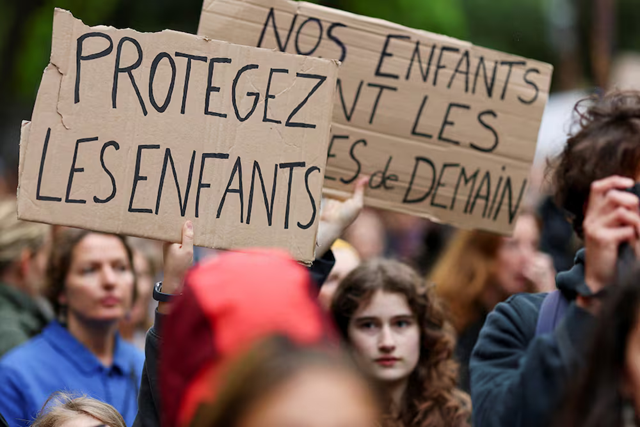
Public outrage intensified as details of the case emerged. Demonstrations were held outside major courthouses and the Ministry of Justice, while demands mounted for accountability over what many viewed as a chain of preventable failures. Justice Minister Gérald Darmanin, facing calls to resign, ordered France’s chief prosecutors to review approximately 70,000 complaints involving minors that had received little or no follow-up. He set a deadline of July 14 for the nationwide review.
The response produced immediate results. By mid-July, judicial authorities had reopened approximately 1,350 investigations involving child sexual abuse, roughly four times the number opened during the same period the previous year. More than 1,000 of those cases were classified as priority investigations because the alleged suspects had been identified, possessed criminal records, and the victims remained underage.
The Ministry of Justice announced that prosecutors had examined 69,626 case files while reviewing a total of 85,047 complaints submitted across the country. According to official figures, 61.5 percent of the reviewed procedures involved criminal offenses, while 38.5 percent concerned more serious crimes. Authorities reported that alleged perpetrators had been identified in 83.5 percent of the cases, with the remaining 16.5 percent involving unidentified suspects.
The review followed the publication of an official inspection report examining police and judicial handling of the Lyhanna case. Investigators concluded that repeated procedural failures enabled Barella to remain free after a mother reported in August 2025 that he had raped her 10-year-old daughter. Previous allegations had also been made by other minors, and he had earlier been dismissed from the educational institution where he worked following a harassment complaint.
Despite those warning signs, inspectors found that the latest complaint had not been treated as a priority. Stéphane Noël, Inspector General of the National Gendarmerie, acknowledged that the investigation suffered from accumulated delays and insufficient follow-up by both the gendarmerie and prosecutors.
Darmanin argued in the days following the discovery of Lyhanna’s body that the failures reflected not a shortage of laws or legal powers but an inability to prioritize child rape investigations. Political opponents disputed that assessment, accusing the government of focusing more heavily on other criminal issues, including drug trafficking. The broader concerns, however, predated the Lyhanna case.
According to the Women’s Foundation, rape victims in France wait more than ten months on average before investigations into their complaints begin, and approximately 94 percent of reported rape cases are eventually closed without prosecution. In April 2025, the European Court of Human Rights ruled against France for failing to protect three women who had reported being raped when they were 13, 14, and 15 years old, concluding that the authorities had not provided adequate protection.
The scale of sexual violence against children has further intensified scrutiny. Estimates by the Independent Commission on Incest and Sexual Violence Against Children indicate that approximately 160,000 children are raped each year in France, based on projections and survey data. Ciivise, the national anti-incest organization, citing official statistics, reports that every three minutes a child becomes the victim of sexual assault, rape, or incest, amounting to roughly three children in every school classroom over time.
A second inspection report, commissioned following the Lyhanna case and cited by French media, identified shortages in investigative resources as another significant factor. The report examined an earlier complaint filed by Lyhanna’s mother in October 2022 concerning an alleged rape that had occurred two years earlier in the Gers department.
Although investigators acted quickly at the outset, inspectors found that the child’s interview did not comply with ministerial recommendations because of staffing shortages at the Béthune police station. The report also concluded that the victim’s psychological evaluation had been assigned to a psychologist who was not listed among officially approved court experts.
Inspectors further criticized the resulting psychological report, describing it as unsigned, undated, and methodologically closer to an assessment of the child’s credibility than a clinical evaluation, a practice prohibited under existing guidelines. The psychologist pointed to perceived inconsistencies in the girl’s account, weakening the case and contributing to its loss of priority status within the justice system.
The Lyhanna case is not the only instance to expose shortcomings in France’s handling of child sexual abuse. One year earlier, the country was shaken by the trial of surgeon Joël Le Scouarnec, who received a 20-year prison sentence after being convicted of abusing or raping more than 300 young people over three decades, most of them children, during medical consultations or surgical procedures. Although he had previously been convicted in 2005 for possessing child sexual abuse material, he was never prohibited from practicing medicine and continued treating children and adolescents until his arrest in 2017.
As French authorities continue reviewing thousands of unresolved complaints, the Lyhanna investigation has become the catalyst for one of the country’s most extensive reassessments of child sexual abuse cases. The nationwide review remains ongoing as prosecutors work through files that had previously received little or no judicial follow-up, placing renewed focus on how allegations involving minors are investigated and prosecuted.