At the end of the A21, a few kilometres from Hénin-Beaumont, several terrils rise into the landscape: mountains as high as 132 metres, formed from the waste of the Pas-de-Calais coal mines. They were built in the 1960s, during the industrial expansion of northern France, but were completed only in the late 1980s, as the region entered decline. It was a period that marked not only the collapse of an industrial economy but also the emergence of a political project that would steadily draw former working-class voters towards the far right, even under the leadership of Jean-Marie Le Pen, the antisemitic founder of the movement.
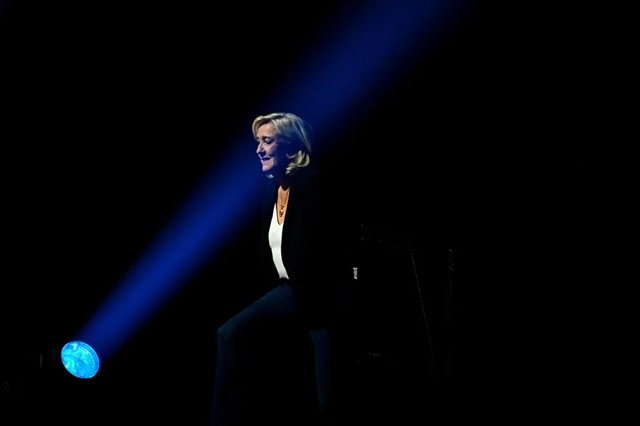
Since then, Hénin-Beaumont, a town of 26,000 people, has increasingly become a symbol of Marine Le Pen’s political project. Le Pen, the member of parliament for the constituency, returned there on Sunday for the opening of the political season, addressing an audience of about 3,000 people who had gathered impatiently to hear her first major political speech of the new term. “French people will have priority in their own home,” she declared.
The political stakes surrounding her return are unusually high. Polls indicate very strongly that, if the presidential election were held now, the leader of the National Rally (RN) would be by far the most voted candidate in the first round, with almost one-third of the vote, and would win the second round regardless of her opponent. “This presidential election will decide everything: we will either allow our country to sink into the quicksands of customs and murkiness, or we will make the change we desire, the one that will lead to the rebirth of France,” she proclaimed.
Yet Le Pen’s rentrée had not been straightforward. After a dizzying start to the summer, when she managed to avoid political disqualification and definitively become a candidate for next April’s presidential election, despite the possibility that an appeal to the Supreme Court could eventually result in an electronic bracelet, the political season began unusually for the RN.
Le Pen and her political heir, Jordan Bardella, had become increasingly distant. Bardella, frustrated that the judicial ruling had prevented him from becoming the candidate, had clashed with Le Pen over major economic questions and issues such as a proposed ban on the veil. The tensions eventually contributed to the departure of the young politician’s principal adviser. In that context, returning to Hénin-Beaumont, where the political project had taken root, carried particular significance. So did the appearance of Le Pen and Bardella together.
Bardella, who turned 31 on Sunday, did not speak. Last year, he had addressed every rally. This time he applauded and smiled as the crowd chanted, “Marine, President!” His role, for now, was to return to the bench. “If anyone thinks I will be disloyal to Marine, they do not know me,” he had said days earlier.
Le Pen was surrounded in the auditorium by local supporters and journalists from around the world. Housing occupied an unusually large part of her speech. She attacked what she described as restrictions imposed on the property market in the name of environmental policy and proposed repealing the law requiring cities to maintain 25% social housing.
She also focused on the labour market and purchasing power, promising tax cuts if elected and a reduction in the retirement age. “Here we know what it means to work. Days that start early and finish late. Waiting impatiently for the salary, paying the bills. We know what factories closing means, gloomy prospects for the future of our young people,” she said.
Her target was also the centre-right, particularly Édouard Philippe and Gabriel Attal, both former prime ministers under Emmanuel Macron. “They believe they can stand for election while escaping responsibility for their past,” Le Pen said.
The setting mattered. Hénin-Beaumont is the ground zero of the political narrative surrounding Marine Le Pen’s appeal to social discontent. She again invoked the demands of the gilets jaunes, saying they had “never been addressed”. But the movement she leads is increasingly divided between two political and cultural models, as well as two geographical constituencies, jokingly described in France as the far right of butter and the far right of olive oil.
One is the deindustrialised north, centred on places such as Hénin-Beaumont, where the population remains marked by what it sees as the abandonment of the left. Outside the rally, the retired Pascal Renoir recalled a family history rooted in the mines. “Both my grandfathers were miners. Heroes forgotten by the left. When the mines closed, we had many problems. Nobody remembered us and the left, which governed here, devoted itself to stealing instead of helping us.”
The other constituency is the impoverished south, affected by integration problems attributed to immigration. Le Pen addressed that audience too, promising: “We will establish priority for French people. No French person will lose rights. They will also have priority for social housing.”
Since taking over the leadership of the movement in 2011, Le Pen has pursued a strategy known within the organisation as dédiabolisation: breaking with part of the image inherited from her father, presenting the party as a potential party of government and expanding its electoral base among popular classes that had traditionally voted for the left and had been affected by deindustrialisation and globalisation. Hénin-Beaumont became one of the laboratories for that assault on the traditional working-class vote.
“There is a heartless right that confuses social policy with socialism, and which will reproach me for being the latter,” Le Pen declared. Beside her, Bardella, perhaps the most prominent representative of the other current within the movement, applauded silently.
Le Pen first arrived in Hénin-Beaumont in 2007 alongside Steeve Briois and Bruno Bilde, two activists who had already spent years building the party’s presence in the territory. Pas-de-Calais offered the FN precisely what it needed: a working-class, deindustrialised region deeply marked by the crisis of the left. Briois, now approaching his third term as mayor, had begun working politically in Hénin in the 1990s, long before Le Pen became the movement’s national figure.
“It is important that she has come today. It is a tradition for us to start the political season here and she is the member of parliament for this constituency. She always comes on a Sunday in September to take part in the town fair,” Briois told EL PAÍS.
Last year, however, Le Pen chose Bordeaux instead, away from the working-class, popular and socially disadvantaged world of the mining basin. It was a political strategy, but it also reflected tensions between Bardella and Briois, who had competed for the party presidency before Bardella prevailed. “They cannot stand each other. Bardella does not like coming here. For him it is too working-class, popular, social. He is more focused on immigration issues in the south,” said Gianni Ranieri, a municipal councillor for the Communist Party.
The RN’s strategy was relatively simple but politically ambitious: to demonstrate that it could cease being merely a protest party and become a party of government. To achieve that, it needed to win a city, administer it and demonstrate that its representatives could behave like “normal” politicians.
Yet when Le Pen returns to Hénin-Beaumont, the rhetoric remains intense. She arrived, ate, spoke and left. “We must confront this toxic system where everything is done to remain in power. Evil forces that want to lead our beautiful France towards decline. We cannot lose this battle. We must lead patriots like you to victory!”
The wider European context complicates that project. The far right is advancing firmly across Europe. Alternative for Germany (AfD) is presenting a stronger candidacy than ever; Vox is strengthening in the polls amid the crisis in Ceuta; and Giorgia Meloni now leads the longest-serving government in modern Italy. Many of the European Union’s responses now pass through France.
Yet Le Pen is seeking to distinguish the RN from some of its European counterparts. She has distanced herself from AfD because of what she regards as its pro-Nazi inclinations, even as she now invokes Charles De Gaulle after her party denounced him for years. Jean-Philip Tanguy, a senior RN figure, described his reaction to meeting AfD representatives in stark terms: “I left terrified.”
Asked about AfD’s electoral triumph in Saxony-Anhalt, where 44% voted for the party on the previous Sunday, Tanguy said: “I am appalled: that so many people supported a party that relativises Nazism and has even said that you could be in the SS and be a good person. And their proposals for what they call re-emigration, even expelling Germans of foreign origin… We quickly decided to break off any relationship with them.”
Hénin-Beaumont remains far removed from that phenomenon. But the question facing Le Pen’s movement is no longer simply whether it can convert working-class disillusionment into votes. It is whether a party built through that transformation can translate its electoral rise into government while managing the divisions within its own ranks and the controversies surrounding some of its European partners.
The unresolved question is therefore what a Le Pen government would look like. Would it behave pragmatically, as Meloni has done in Italy, or would impulses rooted in the ideas of the party’s original founders still emerge? Among those founders were collaborators with Nazi Germany and members of the OAS, the terrorist group that repeatedly attempted to assassinate De Gaulle.