Israel’s 15-month genocidal aggression on Gaza has left deep scars, both physical and emotional, on thousands of Palestinians. Among them is 18-year-old Iyad al-Aklou, whose love for football remains unshaken despite the devastating loss of his mother, his home, and his right hand.
In November 2023, an Israeli airstrike targeted his home in the Beach refugee camp in Gaza City, killing his mother and forcing him to undergo a life-altering amputation. Like hundreds of thousands of others, Iyad was displaced and sought refuge in a fragile tent in Khan Younis, separated from his father and immediate family until the ceasefire took effect on January 19, 2025.
Before the war, Iyad was a promising midfielder and forward with Gaza City’s Al-Sadaqa Club—one of many Palestinian football clubs bombed by Israel during the assault. According to the Palestine Football Association, Israel’s relentless attacks led to the killing of over 700 athletes, including 382 footballers.
A Life Transformed, A Dream Unbroken
Speaking to The Electronic Intifada, Iyad reflected on how the war has fundamentally changed him.
“I missing part of my life. I’ve evolved into an introvert. I don’t want people looking at me with sympathy.”
Yet, despite his injury and trauma, his passion for football has remained steadfast. Recently, he and other players resumed five-a-side football matches, with Iyad taking on the unexpected role of goalkeeper.
“It was a bizarre feeling,” he said. “It was as if I still had both hands—which of course I didn’t—a distinct disadvantage for a goalkeeper.”
Despite the challenge, he remains determined to pursue his dream of becoming a professional footballer.
“I hope the ceasefire will last forever so we can live in peace and freedom and return to our homes in Gaza. Despite my injury, I’ll never stop chasing my passion.”
A Growing Community of Amputee Athletes
Ironically, Gaza may now be one of the few places where Iyad’s dream of playing professional football remains viable.
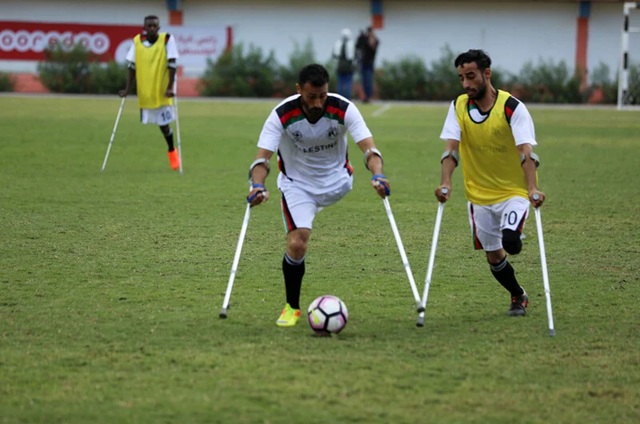
The Palestinian Amputee Football Association, founded in 2018, emerged in response to Israel’s shoot-to-maim policy during the Great March of Return protests, which left thousands of young Palestinians as amputees, primarily with lower-limb injuries.
Today, after months of even more devastating violence, Gaza is home to what the UN has called “the largest cohort of child amputees in modern history.”
Fouad Abu Ghalioon, 67, the founder of the amputee football association, emphasized the importance of sports in helping young amputees reclaim their lives.
“We built this to revive their love and passion for football and to offer them relief and support,” he told The Electronic Intifada.
During the war, the association’s headquarters became a shelter for the displaced. However, officials have recently resumed organizing five-a-side matches, hoping to restore some sense of normalcy and community.
“There is a long way to go,” Abu Ghalioon admitted. “Gaza’s sports infrastructure has been annihilated. Almost no facility escaped Israel’s attacks.”
Beyond the need to rebuild destroyed stadiums and training grounds, he stressed the necessity of psychological support for the young athletes who have survived such trauma. Despite the challenges, Abu Ghalioon is determined to see Gaza’s amputee team compete in the next Amputee World Cup.
“Our team lacks members but has determination and ambition. With the ceasefire, we hope for the crossings to reopen so we can take part in the World Cup qualification,” he said.
“We Must Be a Priority for FIFA”
For many injured athletes in Gaza, football is not just a game—it is an act of resistance and resilience.
Mehdi al-Nawasra, 27, a former defender for Khadamat Al-Maghazi FC, lost his entire family in an Israeli airstrike on December 24, 2023. The attack on his home in Maghazi refugee camp killed 48 relatives, including his parents. Severely wounded, Mehdi had his right leg amputated and spent a year in Deir al-Balah as a refugee.
“I always relished football. Playing for me was pure happiness,” he said. “But I can’t play the game as before. I can’t even walk and work as before.”
Despite his loss, Mehdi remains resolute in his desire to play again. He also has a message for the international football community.
“I lost my family, my football career, my house, my leg,” he said. “My message to FIFA and all sports organizations is that we’re like anyone across the globe. We must be a priority for you.”
As Gaza’s athletes struggle to rebuild their lives amid the ruins, their unwavering dedication to football stands as a testament to their resilience. With support, they hope to step onto the global stage—not just as victims of war, but as champions of perseverance and hope.