


by Luxman Aravind
“Siri Dalada Wandanawa”, the special exposition of the Sacred Tooth Relic, being held for the first time in 16 years, is scheduled to commence at the Temple of the Sacred Tooth Relic in Kandy today (April 18, 2025) afternoon. Yet, beneath the ceremonial glitz and spiritual spectacle of this long-awaited event lies a troubling, festering reality: that casteism—one of the most insidious social constructs humanity has known—still thrives unchecked in the very heart of Theravāda Buddhism in Sri Lanka. And not just “thrives”, but parades itself shamelessly, draped in saffron robes and crowned with ceremonial grandeur.
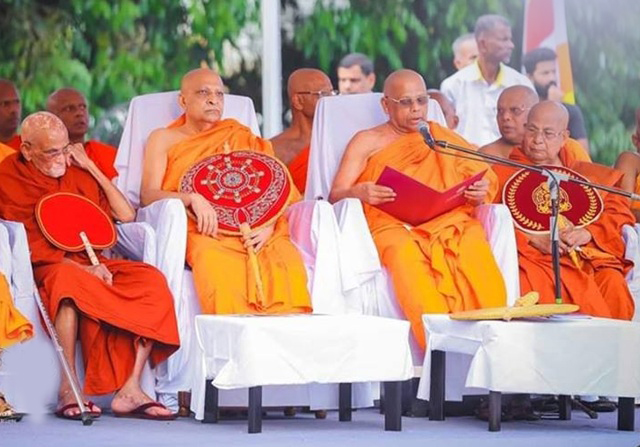
During a recent state-sponsored religious celebration, intended to honour the Tripitaka as a prospective UNESCO World Heritage treasure, the hierarchy of Sinhala Buddhist monasticism was laid bare in a manner that was as symbolically violent as it was visually degrading. The chief monks of the two dominant Kandyan sects—the Malwathu and Asgiri chapters of the Siam Nikaya—were placed on elevated thrones with footstools, while their counterparts from the Amarapura and Ramanna Nikayas were relegated to lesser chairs on the floor. This was no trivial matter of logistics or oversight. It was a declaration. A reassertion of a centuries-old caste supremacy that continues to corrode the spiritual and moral authority of the Sangha.
Here, in what should be the most sacred corner of the island’s spiritual heritage, what was witnessed was not unity, not humility, not the teachings of the Buddha — but a crude reenactment of colonial-era salon caste theatre, steeped in contempt and hierarchy.
And it raises a question that cannot be ignored any longer: What moral claim does this Sangha have to represent the Dhamma of the Buddha, when it consciously violates the very spirit of that Dhamma?
For the Buddha was unambiguously clear on the matter of caste. In the Vasala Sutta, he proclaimed, “Na jaccā vasalo hoti, na jaccā hoti brāhmaṇo; kammanā vasalo hoti, kammanā hoti brāhmaṇo.” Not by birth is one a low-caste outcaste, nor by birth a Brahmin; by action one becomes a low-caste, by action one becomes a Brahmin. In these words lies one of the most radical social revolutions of ancient India—a direct rejection of Brahmanical caste doctrine. And yet today, over 2,500 years later, in a country that proudly calls itself the home of Theravāda Buddhism, it is precisely birth—not action—that determines access, authority, and ordination within the Sangha.
The Siam Nikaya, established in 1753 with the blessings of the Kandyan kings, institutionalised caste discrimination in the very moment of its inception. It reserved ordination for the Goyigama caste alone, excluding the majority of Sinhala Buddhists from the full monastic life. This was not a misinterpretation. It was a conscious policy rooted in the feudal power structures of Kandyan society. To this day, there are allegations—never publicly refuted—that candidates for ordination in the Siam Nikaya are subjected to genealogical vetting that spans seven generations. The Buddha welcomed the son of a slave into his Order. The Siam Nikaya would turn him away.
Let us not mince words: this is heresy. Not in the sense of violating dogma, but in the far more grievous sense of violating Dhamma — the moral truth that forms the bedrock of Buddhism.
What we are witnessing in Sri Lankan Buddhism is not a continuation of the Buddha’s path, but its subversion. A theocratic caste-state has emerged, cloaked in ritual, perfumed in incense, and insulated from criticism by centuries of unexamined reverence. In this state, the Sangha is no longer a field of merit, but a hierarchy of bloodlines. The Tooth Relic is no longer a symbol of the Buddha’s living presence, but an emblem of dynastic power. It rests not in a temple of equality, but in a palace of prejudice.
The rot is not limited to seating arrangements at state functions. It infects ordination itself. The very reason the Amarapura and Ramanna Nikayas had to be established was because the Siam Nikaya refused to admit monks from so-called “low” castes. The Amarapura Nikaya, born from the frustration of Salagama caste Buddhists in the south, and the Ramanna Nikaya, inspired by egalitarian aspirations, were acts of rebellion against caste apartheid within the Sangha. And yet, over time, these very sects have also splintered into dozens of caste- and region-based sub-sects. Today, Sri Lanka is home to more than thirty distinct monastic sects, many of which continue to reflect and reproduce the caste biases of lay society.
In truth, the only truly heretical act in this entire spectacle is to speak openly of it.
It is considered disrespectful to question monks, no matter how regressive or discriminatory their views. When the author of this essay once asked the late Palipana Chandananda Mahanayake of the Malwathu Vihara why an 18th-century edict by a Hindu-born king, Kirthi Sri Rajasinghe, is given more weight than the teachings of the Buddha, the monk’s reply was simply: “Who are you to question us?” Indeed. Who are we?
We are citizens of a republic that claims to be both democratic and Buddhist. We are heirs to a religion that taught that birth is irrelevant to virtue. We are the children of a Buddha who said: “Just as all rivers enter the sea and become one salt, so too do all castes enter the Sangha and become one in discipline.” And we are being asked—no, compelled—to kneel before a caste-ridden priesthood that contradicts all of this, and worse, does so in the Buddha’s name.
This contradiction is not new. It has played out repeatedly in Sri Lanka’s post-colonial history. When President Ranasinghe Premadasa, of Salagama caste origin, sought to take his presidential oath at the Dalada Maligawa in 1989, the Malwathu and Asgiri chapters reportedly objected to the presence of his wife at the ceremony. When Premadasa threatened to move the Sacred Relic to Colombo, the monks backed down. They bowed—not to Dhamma, but to political reality. Years earlier, when civil servant B.J. Fernando was appointed Government Agent of Kandy by Dudley Senanayake’s government in 1969, the Kandyan caste elite threatened to revolt because Fernando was of Hena caste origin. These are not isolated incidents. They are symptoms of a disease.
And that disease is not merely casteism. It is hypocrisy—the performance of piety, the mimicry of morality, while quietly preserving a social order based on exclusion and inherited privilege.
In this, the monastic elite of the upcountry behaves more like a Brahmanical priesthood than a Buddhist Sangha. They are the antithesis of the Buddha’s vision. They have become the very thing he renounced.
In his final sermon, the Buddha said, “Be a light unto yourselves.” He did not say to bow before thrones. He did not say to protect caste boundaries. He did not say that Goyigama monks should occupy golden halls while others sit below them. What he said was this: “By action is one a Brahmin.” And yet, in 2025, Sinhala Buddhists are asked to ignore the Buddha’s words in order to defend those who distort them.
Let us be clear: this is not a cultural problem. It is a moral crisis. A spiritual betrayal. A systemic collapse of the very foundation on which Buddhist ethics rest.
The time has come for a reckoning.
The Tooth Relic will remain sacred only if we strip away the gold plating of caste pride and allow the Dhamma to breathe again. The Sangha will remain worthy only if it undergoes the radical purification that the Buddha himself called for. And the lay community — so long manipulated into passive complicity — must find its voice and demand an end to this charade.
There are those who will accuse this essay of being divisive, of stirring unnecessary controversy. But to them we must say: it is not truth that divides. It is falsehood. It is silence. It is the whispered compromise with injustice that perpetuates it.
The Buddha did not whisper. He spoke clearly, directly, fearlessly. He tore down the caste walls of his time with words sharper than any sword. If we are to honour him, we must do the same.
Otherwise, let us not pretend that what happens in Kandy is a continuation of his teaching. Let us call it what it is: a gilded illusion, an aristocracy of robes, a betrayal enshrined.
And let the Sacred Tooth, which once belonged to a man who defied caste to awaken the world, not become a relic of silence—but a call to rise.









